


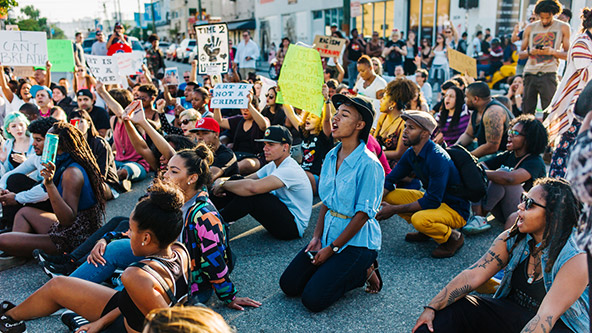
 (Photo by iStock/StreetMuse)
Walking on the University of California, Berkeley, campus a few years ago, Matthew Feinberg ran into a group of protesters who blocked his path. Feinberg, now a social psychologist at the University of Toronto’s Rotman School of Management, supported the protesters’ cause but struggled to sympathize with them after the hostile encounter.
Feinberg wondered more broadly about how protest behaviors affect support for social movements. His puzzlement gave birth to a research question: Does it help or hurt a movement when activists block traffic, shut down highways, damage property, or engage in other highly visible and disruptive actions?
Feinberg partnered with Robb Willer, a sociologist at Stanford University, and Chloe Kovacheff, a doctoral candidate at Rotman, designed six experiments to answer this question. They recruited hundreds of participants from across the United States through Amazon Mechanical Turk, a crowdsourcing platform. They then measured the participants’ responses to stories of protest behaviors that were perceived as extreme and highly disruptive and explored the psychological processes driving their reactions. Casting a wide net, the authors looked at movements across the political spectrum, from progressive to conservative, focusing on any protest activity that study participants deemed emotionally or physically harmful.
“We found that extreme protest behaviors are often viewed as immoral, which decreases an individual’s emotional connection and subsequently affects identification with the movement,” Kovacheff says. “Social identity, or how much someone feels they belong to a group, is a huge motivator. When people feel that they belong to a group, they’re going to want to do things for them,” she explains.
Kovacheff and her co-authors discovered that the reverse is also true. When study participants observed or experienced extreme protest actions, they felt more aloof from protesters and identified less with them, which diminished participants’ support. Perceptions of immorality play an important role in this process: Study participants judged behaviors they perceived to cause harm or impinge on personal freedoms to be immoral.
“We know a great deal about why people are motivated to act for protest movements but know much less about the tactics, or specific forms of action, that may increase or decrease the public’s identification with and support for these movements,” says Martijn van Zomeren, a psychologist at the University of Groningen in the Netherlands. “These findings suggest that extreme protest behaviors are not an effective tactic in this respect.”
Looking at protest movements around the world, researchers have documented some of the ways in which violent tactics can be counterproductive by driving away potential allies. But Feinberg, Willer, and Kovacheff move beyond the binary of violent and peaceful, illuminating the effects of protest behaviors that fit into another category: nonviolent but still very disruptive.
The authors’ six experiments were designed to account for individual differences that help shape popular responses to extreme protest actions. Factored into their analysis are participants’ political views, ideology, race, and preexisting attitudes about the cause in question. In all six studies, the authors gauged participants’ support for the movement and asked about their willingness to join it at a future event. This allowed them to determine whether extreme tactics not only undermine support for a particular protest but also erode sympathy for other causes championed by the movement. Indeed, the authors found that extreme protest actions weaken support for the movement’s “central positions.”
Consequently, activists face a dilemma, say Feinberg, Willer, and Kovacheff. A growing body of research shows that disruptive protest actions often succeed at raising popular awareness and putting pressure on institutions to bring about change, and yet this study’s findings demonstrate how more extreme actions are often viewed as immoral, which decreases the public’s emotional connection and social identification with the movement.
“Previous studies have shown that the media is more likely to cover an issue when it is dramatic or sensational,” Kovacheff explains. “Because of this, more extreme protests attract more coverage that brings awareness to the movement. However, our research finds that these tactics might incur significant costs by leading to reduced public support.”
The study’s findings “have strong implications for those crafting movement tactics,” van Zomeren says, and “no doubt await further research in other cultural and political contexts.” But even just knowledge of a “potential tradeoff between tactics that are effective at raising awareness and those that garner support” can be helpful for activists, Kovacheff suggests. Activists might consider pursuing multiple strategies to build support, focusing on ways to strengthen perceptions of morality while cultivating closer emotional ties and social identification with the public.
Matthew Feinberg, Robb Willer, and Chloe Kovacheff, “The Activist’s Dilemma: Extreme Protest Actions Reduce Popular Support for Social Movements,” Journal of Personality and Social Psychology, vol. 119, no. 5, 2020, pp. 1086-1111.
Editor's note: A previous version of this article mistakenly claimed that Matthew Feinberg and Robb Willer were together when the episode at the UC Berkeley campus took place. We regret the error.
Read more stories by Daniela Blei.