


Berlin’s Leibniz High School, a handsome art deco building from the turn of the 20th century, has a new imprimatur on its facade: a black-and-white metallic plaque, about the size of a large shoebox, that reads “Schule ohne Rassismus, Schule mit Courage” (“School without Racism, School with Courage”).
The elite institution in downtown Berlin is the latest in Germany—the 2,763rd, to be precise—to feature such a tablet, expanding the countrywide network that makes School without Racism, or SoR, the largest independent antidiscrimination school-oriented program of its kind. Today incorporated into about 9 percent of all schools in Germany, SoR arguably serves as a model for extracurricular initiatives fighting against identity-based discrimination in schools.
“The plaque is something that our students see every day that they enter the school,” explains Sanem Kleff, director of the Berlin-based NGO Aktion Courage, which operates the SoR program. “It’s not an award or commendation, but rather it reminds [them] that they’ve taken a pledge to strive to be a discrimination-free school and to demonstrate civil courage in the face of xenophobia.”
Aktion Courage was founded in 1995 as School without Racism in response to a spate of hate-fueled violence in then newly unified Germany. Assaults, arson, and bombings claimed the lives of dozens of people, predominantly from minority communities. Several of the nation’s leading figures discussed an idea already in practice in Belgium—an initiative that worked with pupils on school premises but was not part of the school system—as a solution to this unrest. Like the Belgian program, SoR was envisioned as a bridge between highly competent local NGOs working on antidiscrimination and inclusion issues, on the one hand, and students and teachers who wanted to take more concrete steps to address the prejudice in their schools, on the other.
By 2000, the network, renamed Aktion Courage, had grown to 39 schools and was looking to place a seasoned professional educator at its helm. Kleff, born in Turkey but raised in northern Germany, had taught immigrants and refugees in German schools for 20 years before managing the diversity efforts at Germany’s main labor union for educators. Her experience made her the perfect leader for Aktion Courage. Two years later, the journalist Eberhard Seidel, author of several books that analyze right-wing extremism, joined her as Aktion’s director.
SoR has since burgeoned from a tiny, all-volunteer outfit in a handful of secondary schools in western Germany into a sizable network that oversees and links a prodigious amalgam of schools, NGOs, civic education associations, and prominent personalities devoted to acting against discrimination in Germany. It offers students and teachers an array of resources to aid them in combating school-based prejudice—racism, sexism, homophobia, anti-Semitism, hard-right radicalism, and religious intolerance.
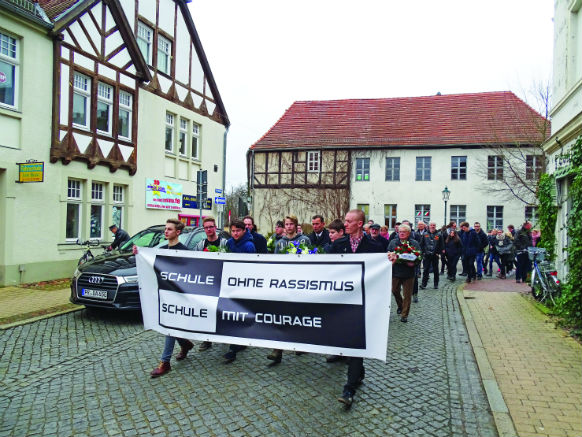 Student members of
School without Racism
march in Perleberg, Germany,
to honor the victims of
National Socialism (Photo courtesy of Wikimedia Commons)
Student members of
School without Racism
march in Perleberg, Germany,
to honor the victims of
National Socialism (Photo courtesy of Wikimedia Commons)
A Foundation in Student Activism
Aktion Courage’s modus operandi is firmly grassroots; it is democratic and highly decentralized and runs like a holacracy. The students—not the educators or the SoR coordination offices that exist in every one of Germany’s 16 federal states—run its school-based chapters. None of the chapters follows any prescribed programming.
A longtime observer of youth culture in Germany, sociologist Klaus Farin says that SoR’s strength resides in its circumventing the top-down, authoritarian structures of schools that tend to preach and command, thus often turning off young people. “SoR introduces a very strong element of participatory democracy into schools,” says Farin. He notes that the Berlin office usually has very little to do with the chapters directly, and that even the statewide coordinators exist primarily for the students to access for resources, if they so choose.
“It’s all about the students. They’re the ones who organize and do all the work,” says Stefan Breuer, a pedagogy expert at Dresden’s Technical University. “They’re not consumers. They decide what they want to focus on and then carry out the projects themselves, in their own schools. Essentially, it turns them into activists.”
SoR maintains a supervisory role through the teachers, school social workers, and local partners affiliated with the chapters, many of whom have been part of the network for years. “They might get the ball rolling but then step back,” explains 17-year-old Thilo Dieing, an SoR member and student in Mannheim, a city in western Germany. “They could jump back in, if necessary, but they’re at the same level as the students, not above us. They make sure the spirit of SoR is accurately represented.”
In order to become part of the SoR network, interested students must garner the official support of at least 70 percent of the students, teachers, and staff. A petition with the requisite signatures commits the school to act against discrimination, harassment, and violence by creating an “environment of tolerance.” The chapter must agree to hold at least one antidiscrimination event per year.
The completed petition qualifies the school as a network member and earns it a black-and-white SoR plaque. But “the plaque isn’t the end of anything,” Kleff underscores. “It’s just the beginning. It’s a pledge to fill this designation with content, to make it happen.”
Membership also ensures that the school receives a coordination partner, usually a local organization that Aktion Courage has vetted. This arrangement automatically connects the chapter to civil society outside school and enables the students to tap the partner’s expertise. In Frankfurt, for example, the Anne Frank Educational Centre, an NGO promoting tolerance, partners with local SoR chapters. The chapters’ partners are largely responsible for raising funds, some of which come from the federal states in which they are based, and can also link the school chapter to other NGOs in the network.
The chapters’ projects vary widely, depending on the school, the student personalities, and topics that the students deem critical issues of the day—from hosting fundraising campaigns for World AIDS Day to setting up the provision of diverse aid to refugees. In 2018, for example, the Niederzier Merzenich Comprehensive School hosted workshops for students in grades 5 to 13 on its annual Anti-Discrimination Day. The 11th grade explored ways to prevent homophobia in the school’s everyday culture, while the 10th grade invited university experts to address how to counter the resurgence of hard-right radicalism. The oldest students, in grade 13, took a day trip to a documentation center in Cologne to examine its collection of Nazi-era materials.
The Niederzier Merzenich chapter also runs a weekly working group on antidiscrimination practices, and its leading members attend the annual SoR national conference. The conference provides a venue for chapters to share information and experiences; newer chapters, in the greener stages of operation, benefit particularly.
Kleff and Seidel emphasize that the purpose of SoR is not to overload the pupils with information but to inspire them to engage with other students and partner groups. This, they say, is what German schools are missing, even though postwar Germany has undertaken unprecedented measures to reckon with its Nazi past. In all German schools, teachers are required to address German fascism and the origins of xenophobia. Still, racism persists. “The roots of racial völkisch ideas in our culture obviously run very deep, deeper than many of us had thought,” says Seidel. “History lessons aren’t enough.”
Can Racism Be Erased?
SoR and other antidiscrimination initiatives have never been more crucial in Germany than they are today. In 2017, for the first time ever, a far-right party called Alternative for Germany, which considers refugees welfare parasites and a blight on German culture, won seats in Germany’s national parliament. A fierce debate over immigration has raged, and violence against refugees has spiked. Meanwhile, anti-Semitism is on the rise; many Jewish Germans are afraid to wear a kippa in the street.
Regions of eastern Germany, where farright support runs particularly deep, are tendentious terrain for SoR. So great is the threat of repercussions that some chapter leaders use pseudonyms when writing in the SoR newspaper Q-rage!.
Saba-Nur Cheema, of the Anne Frank Educational Centre, credits SoR’s structure for being flexible enough to react quickly to developments. The center organized a series of workshops in immediate response to a recent wave of anti-Semitic outbursts because, says Cheema, “students wanted to do something to understand what [is] happening now and why.” In contrast, it can take years for new material to be introduced into Germany’s school curricula, and arguably even longer for the intellectual absorption of that material to take effect.
SoR isn’t without critics. The title School without Racism is misleading, says Ruhr University of Bochum professor Karim Fereidooni, because “there’s no such thing as racism- or sexism-free spaces in our society.” He continues, “By proclaiming this, it can have the effect of silencing students who experience racism in school.”
Fereidooni and others also charge that some SoR schools become inactive but nevertheless keep the plaque affixed to their facade. He recommends regular evaluations of the member schools and consequences for those that don’t comply with SoR standards. Furthermore, he and others have warned, the emphasis on quantity—the thousand-plus network—can’t occur at the expense of quality. They’d like SoR to take a more hands-on approach by more closely managing its chapters.
Aktion Courage has fielded these criticisms and admits that an evaluation process is complicated but necessary. As for criticisms about quantity, Aktion Courage is pleased with its growth but has never suggested that it alone can conquer racism in Germany.
In times of crisis, new schools like Berlin’s Leibniz High School will continue to seek ways to address the rise of xenophobia across Germany and its ramifications for the communities of teachers, students, and families that they serve. And this means that Aktion Courage’s SoR impact will continue to grow, as more and more schools proudly display their black-and-white plaques.
Read more stories by Paul Hockenos.