


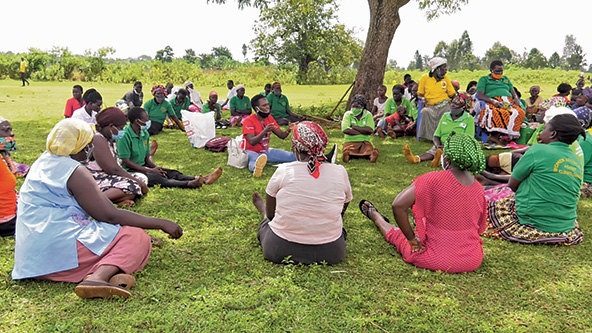
 WCCI staff host a women-only community dialogue session in the Tororo District of Uganda, in 2020. (Photo courtesy of Fred Mugeni/WCCI)
According to the United Nations’ Intergovernmental Panel on Climate Change, the world must reduce global emissions by 45 percent to reach the Paris Agreement’s goal of limiting global temperature rise to 2 degrees Celsius by the end of the century. However, the 2020 Paris Agreement national pledges to reduce global emissions by 2030 will achieve only a 1 percent reduction if they are met—a far cry from the needed 45 percent.
The government sector’s inadequate efforts to address climate change have spurred nonprofits like the emerging network Women’s Climate Centers International (WCCI) to take charge.
The mission of WCCI, founded in 2019 by an intercontinental team of activists from the United States and Africa, is to educate and train women to develop indigenous expertise and leadership in the areas of conservation, ecological restoration, and climate advocacy within the larger endeavor of establishing a network of centers. Led by women, these centers aim to build the capacities of local communities to fulfill their own climate change needs and to serve as hubs for scientific research and indigenous knowledge sharing.
WCCI’s focus on women, and specifically women in rural areas, is intentional. More than 400 million women globally work in agriculture. Yet, despite making up an estimated 43 percent of the world’s agricultural labor force, women constitute less than 20 percent of the world’s landholders, in part due to legal restrictions. No wonder more than 50 percent of women live in extreme poverty and are disproportionately affected by extreme weather events, which include the loss of agricultural productivity and destruction of life and property—all of which stem from the climate crisis.
“It’s no secret that women in rural areas are underresourced in climate technologies and underrepresented in the climate discussion,” WCCI cofounder Tracy Mann says, which is why the network intends to create “a nexus of women climate leaders and collective climate efforts.”
WCCI emerged from women’s conversations about climate change beginning nearly a decade ago, in 2011, when Hajra Mukasa and Godliver Businge from Uganda, and Rose Wamala and Rosemary Atieno from Kenya, met during their fellowships at the Global Women’s Water Initiative (GWWI). In 2017, GWWI Executive Director Gemma Bulos introduced the group to Sarah Diefendorf, executive director of the Environmental Finance Center West (EFCWest), who joined as a founding member and then introduced them to Mann in 2018. Mann founded the US nonprofit Climate Wise Women in 2009 with Constance Okollet, from Uganda, who became WCCI’s final founder.
In 2019, Mann secured funding from the Climate Justice Resilience Fund (CJRF) for a retreat in Kampala, Uganda, for the entire collective to meet and develop the action plan for WCCI’s launch. CJRF Director Heather McGray explains that their investment in the network aligns with their own mission to help women, youth, and indigenous people adapt to climate change: “What we felt was special about the WCCI is that it is a sisterhood of women [rather than] a single entrepreneur.”
The action plan called for the establishment of WCCI’s first climate center, scheduled to open in the Tororo District, Uganda, in December 2021. The team is already at work figuring out how their mission will translate into action inside the center. WCCI staff facilitated a series of dialogues with more than 1,000 Tororo District residents to build community awareness and solicit feedback for setting the agenda.
The Tororo community has asked for their site to include a youth activities center, as well as a tree-sapling nursery and land for biointensive farming, which offer employment and on-the-job training.
Plantings commenced as soon as the purchase of the land was finalized in early 2020. The first season of produce was sold in December 2020 directly from the land site of the center, as well as in local markets. The sales revenue covered the costs of seeds and labor. The first sale of saplings is scheduled for May 2021. In addition to these income-generating activities, WCCI is funded by the CJRF and individual donors but also generates operating income from environmental consultation contracts with organizations such as the International Institute for Sustainable Development and the World Resources Institute.
“We see ourselves as facilitators,” Mukasa says of WCCI’s role. “With the community leaders, we survey the community to identify and prioritize areas of need, which guide our [work].”
The founders feel they have already achieved some success with the groundbreaking for the center’s construction and the programs they implemented during the COVID-19 pandemic. WCCI aims to launch two more centers, a second in Uganda and one in Kenya, by 2027, with the goal of establishing a broader network of female African climate activists.
Read more stories by Michael Seo.