


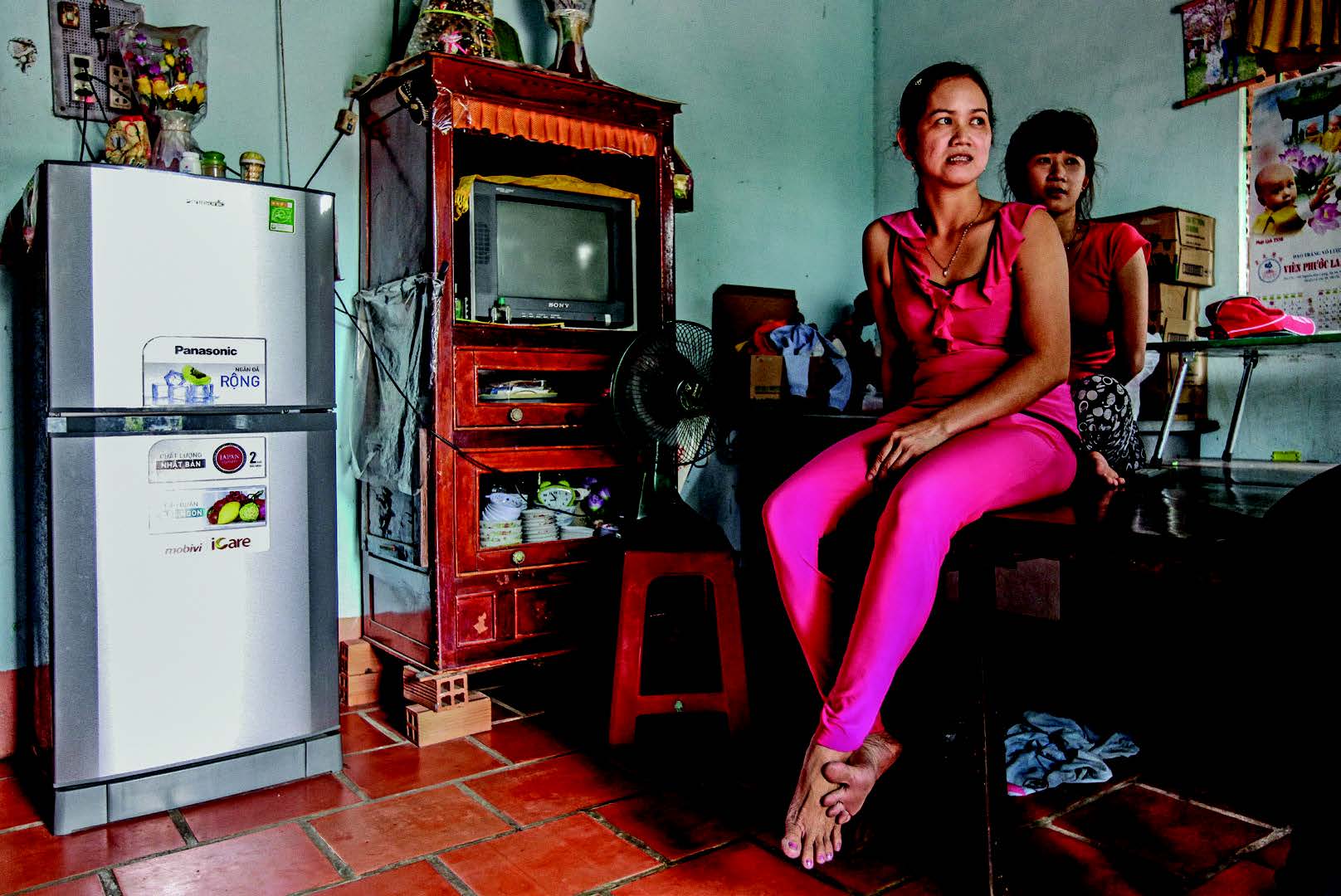
 Mai Thi Bich Hoa (foreground)
sits near her new
refrigerator purchased
through iCare Benefits. (Photo courtesy of iCare Benefits)
Mai Thi Bich Hoa (foreground)
sits near her new
refrigerator purchased
through iCare Benefits. (Photo courtesy of iCare Benefits)
Duong Thi Thai and her husband, Nguyen Van Khoi, work in Ho Chi Minh City at the Freetrend Ltd. factory, a series of low-slung buildings where, on any given day, nearly 20,000 people labor. There the couple make shoes, earning about VND 10 million ($445) per month, which, while certainly better than not having a job, leaves them near the bottom of Vietnam’s wage scale.
After getting married in 2009, Thai says, they hoped to buy a few basic appliances for their new one-room apartment. For the newlyweds, as well as tens of millions of people in the developing world who manufacture consumer goods but struggle to afford them, acquiring a refrigerator or computer requires many months of scrupulous saving. Sometimes those purchases never get made: Saving money is hard, finances are tricky, and life is unpredictable.
Thai and Khoi’s income is almost completely consumed by rent, living expenses, and school supplies for their two young children, leaving little to purchase the new appliances they desired. Then, in 2014, Freetrend partnered with iCare Benefits, a social-enterprise company founded that year to help factory laborers like Thai and Khoi afford basic consumer goods and services, which iCare sells on zero-interest installment plans to workers who qualify for membership.
To someone in a developed country who is accustomed to easy credit and borrowing a few bucks without risking life-altering debt, the plans might not sound like much. But in Vietnam, where consumer credit is a privilege of the affluent, people like Thai and her husband would otherwise be forced to borrow from black-market lenders, who charge usurious interest rates. Access to zero-interest financing represented a remarkable opportunity.
They bought a washing machine, a mattress, and a phone. “Myself and many other workers want to thank the program,” Thai says. “Without it, it may take many years before we can save enough.”
Theirs is a story repeated across Vietnam and seven other Southeast Asian countries, where iCare is answering what economists call the challenge of financial inclusion for 3.1 million factory workers.
“Even if you make $200 a month, we try to make that $200 a lot more than it is,” iCare CEO Trung Dung says. “We’ve proved we can increase purchasing power by two to three months’ salary. People make 12 months of salary—but their standard of living feels like 14 months.”
Consumption Without Debt Risk
Three decades ago, Dung fled political persecution in Vietnam and arrived almost penniless in the United States. He went on to found three companies, including Silicon Valley darling OnDisplay. In 2007 he returned to his home country to found Mobivi, an electronic payment service. The company saw some success, though its concept was premature and the field competitive. “Here people don’t need payment solutions,” says Hao Diep, who was Dung’s assistant at Mobivi and is now iCare’s chief operating officer. “They need access to products and services.”
Diep grew up in a rural Vietnamese village where, when she was a child, her mother borrowed $400—$100 for Diep’s schooling, $300 for her brother’s motorcycle—from a black-market moneylender. It took four years to pay back the loan and its interest, which plunged the family into bankruptcy. “People came to take stuff away,” she remembers. “My mother was a good person. She was a teacher. But she couldn’t afford to get access to banking or lending.”
It was Diep who devised a new model for Mobivi, which was reborn as iCare: The new enterprise would buy products at wholesale prices, then offer them at low markups to workers who would pay a small amount upfront and have the rest deducted from their paychecks, without interest, over the next several months.
Demand took off. Workers like Thai and Khoi could, for the first time, buy basic goods without risking debt. And because, as a condition of joining, iCare members needed to have worked at their factory for at least one year prior, companies anxious to reduce employee turnover had incentive to join. In two months during the spring of 2014, iCare went from 10,000 to 175,00 members. By the year’s end, total membership hit 400,000, which swelled to 1.4 million in 2015 and 3.1 million—in Laos, Cambodia, Thailand, Indonesia, India, Bangladesh, the Philippines, and Brazil—by 2016’s end.
As iCare grew, their offerings expanded to include vaccines, medicine, school supplies, and education services—the enablers of a stable, middle-class life. Not only are members able to buy washing machines, refrigerators, and other basic amenities, but also they are buffeted from extraordinary expenses—such as unexpected illnesses, weddings, or new school years—that can push a household over the financial precipice.
Each year, the company conducts impact surveys. According to iCare Director of Strategy Ryan Galloway, they show that members save an average of $220 per year on interest charges, plus eight days’ worth of time that would otherwise have been spent dealing with lenders and bill collectors. Before iCare partners with factories, roughly 85 percent of workers borrow from black-market lenders or their extended families; within a year of joining, that number drops to 15 percent.
“They’re just scratching the surface,” says Brett Dickstein, a market researcher at Sustainable Trade, Inc. who previously served as iCare’s director of communications. “They want it to be the premier social benefits program to low-income workers around the world.”
To make it all work, iCare needs buy-in from three parties: the factories who give them centralized access to workers; the companies whose products they sell; and their own creditors, including banks and impact investment funds, who provide the capital for iCare to finance the operation. While each participant brings challenges, the last is perhaps trickiest—as well as most crucial.
“What is very important and critical here is that you can demonstrate the economic sustainability of the program,” Dung says. iCare became a social enterprise rather than a nonprofit so that it could secure the funding necessary to scale so massively.
Doug Clayton, founder of the Leopard Capital investment fund and an iCare board member, insists from experience that a for-profit approach is key. “I’ve been looking at this space for a decade, and come across a lot of investment ideas and entrepreneurs trying to target the bottom of the pyramid,” Clayton says. “Most of them are less commercial and more social, and have trouble creating a sustainable model. They rely on donations and grants and so on. iCare Benefits is the first company I’ve come across that is tremendously commercial—and tremendously impactful.”
Central to iCare’s economic viability is the efficiency of its supply chain. Products are displayed at and distributed through factories, so iCare does not need to rent retail space or deal with door-to-door delivery. As a consequence, Dung says, their logistical costs are several times lower than those of standard e-commerce retailers. They also have developed automated tools for communicating with members. Taken together, these advantages add up to a profit margin of between 3 and 4 percent—enough to convince investors that, social impact aside, iCare is a good bet. “If the economics aren’t sustainable, the social impact doesn’t exist,” Dung says.
Millions Served
Striking the right balance between social and financial goals can be tricky. During North America’s industrial revolution, company stores were common, particularly in remote towns where factories sold goods to the captive market of their employees. Often they exploited workers, saddling them with debt and making it impossible for them to leave their jobs. But iCare is careful to protect members, offering financial literacy training and capping their purchases at three months’ salary. That avoids “this cycle of overspending and over-leveraging,” Dung says. “They can’t overspend even if they want to.”
The project leaves untouched the basic need such workers have for consumer banking. Barry Herman, a development economist at The New School, wonders if a better option might be employee credit unions or standalone savings institutions “promoting savings, not just debt, and not tying worker purchases to contracted suppliers.” To this point, Dung responds that credit unions are rare in much of Southeast Asia and of limited usefulness. Far fewer people make deposits than need to borrow money.
Another, deeper tension is the macro-level issue of poverty itself. “You cannot borrow your way out of poverty,” cautions Akos Rona-Tas, a University of California, San Diego sociologist who specializes in credit. “If people do not have enough money to buy things your economy produces, you either have to raise wages or redistribute money directly from the rich to the poor. Consumer credit is not the answer.”
In the grand scheme of things, perhaps, this is true. But exclusion from financial services can turn poverty into a vicious cycle. And even if iCare cannot lift all boats, it still gives workers a ladder to a better standard of living. iCare plans further expansions of health, education, and other social services, including savings and retirement plans; as the company grows, Diep says, it might use its leverage to nudge governments and industry to pursue more worker-friendly policies.
Diep and Dung expect to reach tens of millions more people in the next decade, expanding iCare’s model beyond factories to include other kinds of workers, such as fishermen and farmers. Eventually, Diep says, it could cover entire rural communities like the one where her mother went bankrupt over a motorcycle and tuition. Reaching 100 million people, she says, is a realistic goal.
“They’re our members, not our customers,” Diep says—and iCare’s three-million-strong membership, already massive, “is a starting point.”
A previous version of the article misidentified Brett Dickstein’s role at iCare. We regret the error.
Read more stories by Brandon Keim.