


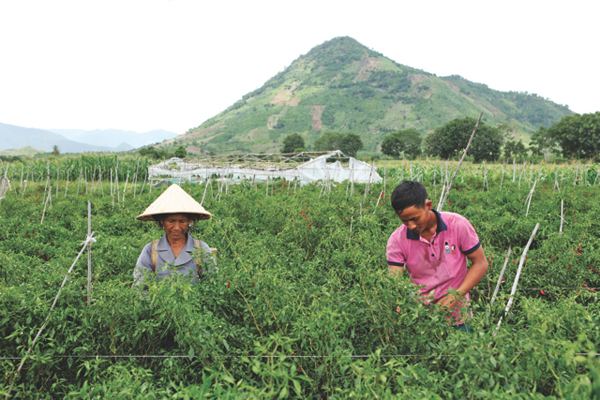
 Two farmers tend to chili pepper crops near Tam Ngan village in Vietnam. (Photo courtesy of Saemaul Creating Shared Value)
Hoang Ha Jo Ngo, a farmer and a father of three, lives in Tam Ngan village, located in the Ninh Thuan province of Vietnam. Back in early 2014, he was in a state of despair. His farmland was severely distressed: It suffered from nutrient depletion and from an unstable water supply that resulted from a break in the irrigation pipeline to his farm. “I tried everything. Since I had no money, I took out loans,” Jo Ngo says. He used the loan money to buy fertilizer and high-quality seeds. “Still,” he recalls, “the quantity and quality of my corn did not meet the market standard. All I had left was the debt, which was the size of my annual income.”
Then, in April 2014, Jo Ngo heard that a chili pepper farming project would soon start in Tam Ngan. He volunteered to take part in a pilot phase of the project. “This was my critical chance to break free from the old pattern of taking out loans every season and just waiting for the crops to grow, without knowing what else to do,” he says.
The project, called Saemaul Creating Shared Value, is a collaborative effort by three large entities: CJ Cheil Jedang, a Korean food company; the Korea International Cooperation Agency (KOICA); and the government of Vietnam. The goal of the project is to reduce extreme poverty in Tam Ngan by working with farmers to establish red chili pepper farming. CJ Cheil Jedang provides a ready market for that crop, and its involvement in the project reflects a commitment to the shared value model of economic development. In that model, created by Michael Porter and Mark Kramer, companies follow a strategy that embeds social value creation in their business operations.
A crucial feature of the project is the use of methods borrowed from the Saemaul Movement, which flourished in South Korea in the 1970s. The Saemaul model aims to revitalize rural areas by providing farmers not only with practical improvements and technical training, but also with motivational education and other, less tangible forms of support. The purpose of these efforts is to awaken a productive, “can do” spirit in people who have been worn down by poverty.
By participating in the project, Jo Ngo has learned new farming techniques and cultivated new habits of self-reliance. He has talked with a farming expert about fertilizer choices, about managing water use, and about the growth rate of different chili seed variations. Through training sessions offered by project organizers, he has changed his work routine and now starts each day with a morning checkup of his farm. Each week, he takes part in a village-wide discussion that covers topics that range from farm labor cooperation to the creation of a village fund to pay for local improvements.
The Saemaul Creating Shared Value project in Tam Ngan is still at an early stage, but already it has changed villagers’ lives. One day this past May, Jo Ngo conducted his regular morning checkup. He gently examined the red chili pepper crop that he was now growing. As he saw red juice flow from a ripe pepper, he had a clear sense that his work on the crop was paying off. For the first time in his life, he says, he was glad to be a farmer.
A Shared Solution
Ninh Thuan province, with a per capita gross domestic product of $1,038, is one of the poorest of Vietnam’s 63 provinces. In Tam Ngan, which is home to about 1,150 people, the level of poverty is especially stark. The average annual farm income in the village is about $235—that is, about 64 cents per day—and more than 46 percent of the population is below the national poverty line. In Vietnam overall, meanwhile, the percentage of people who live below the poverty line has fallen from about 60 percent to about 20 percent over the past two decades.
The persistence of extreme poverty in Tam Ngan is largely attributable to its low agricultural productivity. Instead of using tractors, farmers rely on bovine and human labor. Broken irrigation facilities result in irregularfarming, inefficient land usage, and low-quality crops. Fertilizer use is rare. As a result of these deficiencies, farms in Tam Ngan produce one ton of rice per hectare. Farms in South Korea, by comparison, produce six to seven tons per hectare. In addition, the village has no agricultural cooperative: Farmers must market their crops on their own.
So Tam Ngan has an acute need for assistance in developing its agricultural sector. At the same time, CJ Cheil Jedang faces an emerging crisis in its sourcing of a critical agricultural product. Chili pepper, an important ingredient in Korean cuisine, is CJ’s third-most-purchased agricultural input. China has long been the company’s main supplier of chili pepper, but in recent years increasing labor costs have made that source more expensive. CJ leaders also have concerns about the use of pesticides on Chinese farms. In looking for an alternative source, they have fastened their attention on Vietnam. CJ and its parent company, CJ Group, already have extensive operations in that country. In addition, the region that includes Tam Ngan village has a good climate for chili pepper farming.
By investing in Tam Ngan, CJ leaders aspired to maximize both social impact and business impact. But CJ did not have the resources on its own to develop the village’s potential, so the company partnered with KOICA and with the Vietnamese government. CJ is helping to build up agricultural infrastructure and to update the use of technology in the village. Through a contract farming arrangement, CJ also guarantees that it will purchase the chili pepper harvested in Tam Ngan. KOICA is deploying its expertise in project management and in the development of Saemaulbased community-building practices. The Vietnamese government provides staff support and works to clear legal and bureaucratic obstacles. Expenses for the project through 2017 total $1.7 million, and CJ and KOICA each plan to contribute half of that amount.
Managing a complex project of this kind entails real challenges. “Consensus is difficult in a situation involving multiple stakeholders, all with different principles,” says Ji Young Kim, a project manager for Saemaul Creating Shared Value. Nonetheless, partners in the project are keeping their focus on the big picture. “Sourcing chili pepper from Tam Ngan is not CJ’s final goal,” says Heekyung Jo Min, vice president of CJ. “Sustainable value is possible only when the farmers have a strong desire for a better life. At CJ, we will support the village beyond CJ’s business needs.”
An Education in Empowerment
Jin Cheol Jeon, senior vice president of the CSV (Creating Shared Value) department at CJ, recalls his early encounters with the people of Tam Ngan: “At the beginning, the villagers did not think that they were entitled to healthy and happy lives. They just accepted the given conditions of life, without trying to make changes.” A lifetime of poverty, in other words, had deprived villagers of the ability to develop self-reliance.
That’s where the Saemaul model comes into play. The term “saemaul” combines two ideas: “progressive renewal” (sae) and “regional and social communities” (maul). The Saemaul Movement in South Korea incorporated poverty eradication, rural modernization, and attitudinal change. As a first step, movement organizers would make noticeable changes in a community—road improvements, for example—in order to instill in residents a sense that revitalization was possible. Next, organizers would encourage farmers to join commercial farming projects that would lead them to boost their productivity. Alongside those efforts, the movement puts a premium on using motivational education and group discussion to foster a “we can do it” outlook.
The impact of the Saemaul Movement was striking. From 1970 to 1979, the average farm household income in South Korea rose from $825 to $4,602. Such achievements have sparked efforts to apply the Saemaul model more broadly. In 2011, for instance, the World Food Programme entered into an agreement with the South Korean government to spread the model to developing countries.
The move to bring Saemaul methods to Tam Ngan has been under way for about a year. In October 2014, villagers formed a Saemaul Committee and named the head of the village as its leader. They also started four community groups—one group each for farmers, wives, young people, and elderly people. In the same month, Saemaul specialists from South Korea began holding Saemaul education sessions. In these sessions, villagers learned about conducting a group discussion, managing a cooperative unit, and other topics. “Saemaul education [reveals] power in us that we were not aware of,” says Khiet Ha Da Droach, a Tam Ngan villager who leads the youth group. Ohoon Kwon, a Saemaul specialist, explains the ambitious vision that lies behind the Saemaul model: “What we are hoping for is a small change that will [inspire] the rest of the village. We believe that change in one villager at a time will build a villagewide transformation.”
Signs of that transformation are now visible in Tam Ngan. In 2014, the Saemaul Creating Shared Value project helped fund and implement renovation of a preschool and a community center. In 2015, the village elementary school underwent an upgrade. Efforts are also under way to improve irrigation systems and to develop other aspects of agricultural infrastructure.
Villagers like Jo Ngo present signs of change as well. He now displays an optimistic, forward-looking attitude. “I wish to pay off my loans, and I wish for a better life for my children and the whole village,” he says. “We are saving our crops to raise a village fund, helping out on neighbors’ farms, and discussing ways to improve the future of our village.”
Read more stories by Tai-Young Kim & Yoo-Jin Lee.