


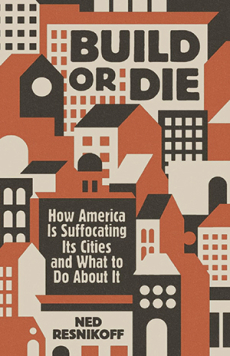
Build or Die: How America Is Suffocating Its Cities and What to Do About It
Ned Resnikoff
352 pages, Island Press, 2026
When did the housing crisis begin? Whether that’s an academic debate or a tiresome social media argument (devolving into bitter factional squabbling), sincere answers to the question are necessary. Diagnosing the origin of the spiraling housing costs and accompanying urban dislocation will be crucial to properly developing any kind of meaningful, let alone equitable response.
In his New York City-focused A Right to Housing?, Samuel Stein argues that the deindustrialization of the 1970s led to “three types of vacuums.” There was a spatial vacuum, in which the City was dotted with vacant manufacturing sites; there was an economic vacuum, as the industrial wage dissipated; and there was a political vacuum, as mass politics dissolved. The “real estate state” entered—as Stein outlined in his 2019 Capital City and applies here—“a confluence of state power and real estate capital that pursues a political and planning agenda of surging land and property values.”
For Stein, the problem is that while the planning agenda uses land to build value, this only sometimes produces housing. The real estate state will prioritize other agendas when there is more value in producing, for example, office space, warehouses, or data centers. People are only an input in this model: They take home wages, then spend those wages on rent, food, and anything else from toothpaste to sweaters to Pokémon cards (the nebulous “retail” category that has substantially shifted from real buildings to online). Who these people are is less important than the fact that they are spending money. Society, from this perspective, might be useful to the state but not necessary. Homes are only a more profitable alternative than shelters.
A city viewed this way is more than a bit bleak. Might it also diminish the power of such people to vote, to protest the state and demand change? Though empowered and inspired by Mayor Zohran Mamdani’s election, Stein organizes his book around the dyad: “We Can” / “Can We” that asks if it is possible to defeat this real estate state and develop a social right to housing. The book’s concluding chapter, “Doubt and Faith,” describes his ambivalent answer.
If Stein describes a quiet coup, Ned Resnikoff diagnoses the problem at the founding of modern land use itself. At the twilight of the Gilded Age in the 1900s, as he writes in Build or Die: How America Is Suffocating Its Cities and What to Do About It, the Progressive movement developed what we now understand as zoning, as a “reform-minded effort to check the spread of disease and unsanitary conditions—to impose some order [on] the chaos and filth of the unregulated city.” Resnikoff identifies zoning, therefore, as “an instrument of apartheid” to “keep unwanted immigrants, nonwhites, and poor people out of their communities and confined to their own neighborhoods.”
Of course, Build or Die doesn’t mark zoning as America’s original housing sin, since urban life was hardly a utopian land of comradeship before Progressives came to power in American cities. Resnikoff references parking reform, mixed-use neighborhoods, and good governance as crucial to his YIMBY platform, the “Yes In My Back Yard” movement that seeks to make “cities into places where … ‘no one is left out,’” as Resnikoff says (also paraphrasing New Deal President Franklin Roosevelt). But zoning is a start, Resnikoff’s wedge to eventually produce more housing, more tax revenue, and more urban vibrancy that will make American cities dignified places to live.
Thus, we are back to what started things off. If the housing crisis comes from the takeover of urban governance, by property over people, then a counter-coup might suffice (for which Stein looks to Mamdani’s vision for New York City). But if the housing crisis is a product of governance itself, then a wholly new rule is in order.
A White Paper Revolution
Build or Die is a diatribe, a catalogue of Resnikoff’s discontent, and much of it will be familiar to folks who have been working in American housing policy. It’s laid out, straightforwardly, in the first part of the book: Zoning is overly restrictive, cars take up too much space, and the politics of local life have too many veto points.
The two see eye-to-eye on what is happening in their communities; the difference is that where Resnikoff homes in on regulatory reform, Stein looks to a big-picture struggle for the decommodification of housing. Where Resnikoff describes a land of housing plenty, where opening up zoning will lead to greater growth, choice, and opportunity, Stein asks: Why stop there?
Resnikoff has a deep bibliography, and it includes plenty of California-based policy hubs like the Terner Center for Housing Innovation and the San Francisco Bay Area Planning and Urban Research Association (SPUR), as well as more than a few blogs and Substacks. The book could be understood as a way to concretize talking points that tend to circulate online, on social media, but with ample and substantive citations. Resnikoff came to fight in his book. He has a way of building up an argument and then smashing its counterarguments with a few well-cited studies, for example: titling a chapter “The Case for Building More Homes” and including a subsection called “Vacancy Trutherism.”
The work is thorough and has the support of technocrats, advocates, and other laudable nerds. One can imagine the YIMBY cadres using pull quotes as they push for new legislation, hector elected officials, or, yes, make nifty social media posts. But can a land-use revolution be governed and memed into being?
Build or Die points to how the state of California has made rapid changes to create a variety of streamlined housing options, most successfully accessory dwelling units (ADUs), which can be built three at a time in nearly any single-family parcel in the state. Is it now easier to build in California? Yes. Are California’s two major metro areas, Los Angeles and the San Francisco Bay Area, still full of exorbitant rents? Absolutely.
Resnikoff works in the same reformist Progressive tradition as the developments that he identifies as the origin of the problem. Because zoning, as practiced, is not working, Resnikoff writes that we need radical change to practice it better, and Build or Die ends with a prescriptive chapter, “Doing Your Part,” suggesting getting involved on general plan amendments and in public comment periods. But is he looking for common ground with an existential crisis? He didn’t title the book Build or Die, or Somewhere in the Middle, after all. If the issue is dire—and it is—then the book ends with the equivalent of building a better mousetrap when we are trying to catch a bear.
A Target With Many Paths
In Stein’s attacks on the real estate state, zoning reform is often found to be somewhat accommodationist. “In the absence of zoning constraints,” Stein asks, would private developers “actually build enough supply to create homes for all”? Of course not, he writes: “No matter how we rewrite our zoning codes, there will have to be a strong role for the state, not only to keep capitalists from maintaining tight housing markets, but to build the homes for-profit developers won’t.”
This argument rhymes with Resnikoff’s approach to homelessness. Build or Die is generally supportive of a “Housing First” solution and underscores the fact that “the ultimate goal should be ensuring that no one becomes homeless in the first place.” Similarly, Stein acknowledges that large lot sizes and single-family zoning “is antithetical to a right to housing” and, in an understatement, notes that “exclusionary zoning is not a liberatory policy.”
In this sense, the two see eye-to-eye on what is happening in their communities; the difference is that where Resnikoff homes in on regulatory reform, Stein looks to a big-picture struggle for the decommodification of housing. Stein takes seriously the political, logistical, and labor requirements for providing dignified housing for all: “Once we are talking about decommodifying land and labor,” he writes, “we are not talking about an ambitious policy agenda but rather a revolution. Are we ready to take these implications seriously? If so, how? If not, at what cost?” Where Resnikoff describes a land of housing plenty, where opening up zoning will lead to greater growth, choice, and opportunity, Stein asks: Why stop there? If we agree that better housing leads to a better society, then let us simply demand a better society.
Somewhere along the line, the two arguments cross streams. Build or Die takes a reformist approach to ripping out a cornerstone of American property law. A Right to Housing? discusses public policy in a yearning, often-religious, mode. Neither seems content with trying to improve society somewhat. They want to build a world we are proud to live in.
Living Together
The YIMBY movement has momentum, albeit a tragic sort. There are simply so many communities, in so many cities, feeling increasing housing stress and demanding that their representatives do something. Building housing, and lowering the costs and barriers to doing so, is something to do. And while rents and home costs are stratospheric in the usual suspect communities, there are cities like Sacramento and Austin that have seen flatlined or declining costs. Development is still uneven everywhere, however. The American scar tissue of race and gender impair the ability to get building done, by certain people, in certain neighborhoods—and you know the ones—in each metropolis.
In the right light, though, one could see the YIMBY coalition taking over the three vacuums that Stein identifies in A Right to Housing?: underbuilt single-family land, overstretched housing budgets, and a restive professional class who are agitating for change. And if this coalition could come to power, there would be no need to stop at zoning reform. “No one left out” could very well mean no one left out. But winning power is wielding power. If the YIMBY coalition is ascendant, they will ultimately have to align with the Real Estate State or the people. Is every person’s dignity worth the political platform speaking for them, even if the market can’t provide? That may be the ultimate “Yes” in “YIMBY.”