


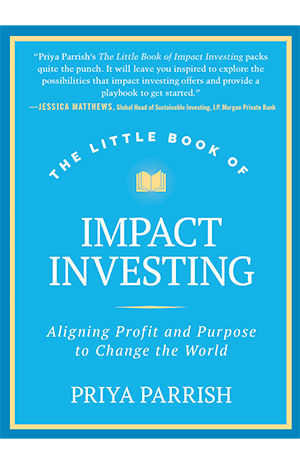
The Little Book of Impact Investing: Aligning Profit and Purpose to Change the World
Priya Parrish
272 pages, Wiley, 2024
My journey to impact investing began when I was an undergraduate studying economics and entrepreneurship and couldn’t find any examples of people harnessing the power of business to improve the world. That was 20 years ago, before impact investing was a recognized strategy. Back then, just about everyone in the field was an entrepreneur experimenting with investment tools, trying to figure out how to do well financially while also making positive change. I joined right in.
The term “impact investing” has been around since 2007 but hasn’t taken hold the way I thought (and hoped) it might. There are still a lot of myths about what impact investing truly is and does, the most prevalent of which is that doing good won’t generate returns. This couldn’t be more false, yet it persists. This book is my attempt to debunk this myth and others like it, as well as make sense of the confusion, as it’s difficult for a newcomer to understand the jargon, sort through the many false or exaggerated claims, and follow the heated debates about this topic. This book is for the “impact curious,” or anyone who wants more than just financial returns from their investments. It is for anyone interested in finding out what their investments can do when aligned with purpose. It is for anyone who wishes to live in alignment with their values—in every aspect of their lives.
This particular excerpt from my book, The Little Book of Impact Investing, provides a history of the term and activity in the space. It addresses why now is a particularly good time to make business do more and do better—so that the world can and will too.— Priya Parrish
* * *
If the Rockefeller Foundation coined impact investing in 2007 and attempts to invest this way go back two decades further, why are we just now starting to see it adopted at scale by mainstream asset managers? To answer this question, we need to step back from the investor’s seat and consider impact investing as a noninvestment professional with a desire to improve quality of life. For some of us, this means understanding our privileges such as quality housing, time to pursue hobbies and passions, and access to resources such as education and healthcare.
I believe that everyone desires a world where more people can live with dignity, health, and opportunity. The disagreement lies in how to organize society’s resources to achieve these goals, with some believing that minimal government involvement is the best way to incentivize people to earn a good life. Others see the challenges with that approach, recognizing that we don’t all start with the same abilities and resources, so we should find ways to redistribute them in ways that are more equitable.
However, we can all agree that governments have yet to be able to address our needs as a society. News stories increasingly report how Gen Zers are living with angst about the effects of climate change, with some even questioning the viability of planning for a family in the future. But it’s not just Gen Z that is stressed out. There is angst among Millennials, Gen Xers, and even Baby Boomers about how we as individuals or families will face these changes.
The rise of technology, which has created so much wealth, productivity, and possibility, also drives the malaise that affects every generation. For example, the use of social media and gaming has led to ever-increasing rates of loneliness, body-shaming, and loss of social skills for children and teens. Technology wields considerable personal autonomy and choice over learning, from online schools to coding boot camps, but also creates more uncertainty over how long your skills will last. This goes for whether you are an assembly-line worker competing against autonomous machines or a lawyer watching the rise of ChatGPT.
The feeling that “this moment is unique” is a common refrain in every generation. Yet, factually, so many uncertainties facing us today suggest that this moment in time—with all of the environmental, geopolitical, and social challenges we face—really is different. For the first time in U.S. history, it’s more likely that children will grow into adults with a lower standard of living than their parents. This is not a doomsday scenario, and it does not mean the world as we know it is ending, but we are most certainly facing the reality that there are more variables at play and fewer reliable tools to achieve the kind of economic mobility that we all strive for and that prior generations have achieved in this country. Casting a vote on election day doesn’t give many people confidence that this is all we need to do to solve the monumental challenges facing our collective futures. Donating money every time there is a school shooting doesn’t feel more impactful than making a social media post to send your thoughts and prayers. Paying $20 to offset your carbon emissions from your flight also feels more like an attempt by the airlines to pacify your climate fears than truly prevent the effects of extreme weather. Choosing to buy goods and services that were intentionally made with regard to the effect on workers and the planet, not just business owners, is perhaps the closest we get to feeling like we have any control over our fate.
U.S. households have more in savings or investable capital than they give away in philanthropy each year. We can use these resources to make change now. Philanthropic organizations such as the Heron Foundation have considered this, noting that the 5% given away each year to programs would be much more effective if they also tapped the 95% of capital in their endowment to further its mission and began doing so in 2012.
Not all of these shifts have been led by institutions themselves. The public has also played an important role in forcing foundations to confront how a mismatch between what they were investing in with the 95% of the foundation’s corpus and how that worked against the goals of the 5% of the mission-aligned capital. Take the Gates Foundation, the largest in the world at $67 billion. Following the IRS guidelines, as most foundations do, the Gates Foundation gives away at least 5% of its assets yearly to avoid taxes. That equates to donating roughly $3.35 billion to its main philanthropic focus areas of global health initiatives, public education in the United States, and social services in the Pacific Northwest where Microsoft is located.
But what about the other $63.65 billion? In 2007, the L.A. Times published a report about the alarming 95% portion of the Gates Foundation endowment that was invested in companies perpetuating the very challenges that the 5% was trying to fight.3 Specifically, the article cited $218 million in grants toward polio and measles immunization and research worldwide, including the Niger Delta. At the same time, it had invested $423 million in five companies—Eno, Royal Dutch Shell, ExxonMobil, Chevron, and Total of France—primarily responsible for most of the flares blanketing the Niger Delta with pollution well beyond permitted amounts in the United States and Europe, where these companies also operated.
The Times reported that local leaders blamed oil development for fostering many of the afflictions that the foundation combats. For example, oil boreholes also fill with stagnant water, which is an ideal breeding ground to spread malaria, one of the key diseases that the foundation is fighting. Oil workers are also a magnet for prostitution, which contributes to a surge in HIV and teenage pregnancy, both of which the Gates Foundation targets to ease the ills of the poor. The Times article had an explosive impact on the Gates Foundation and other U.S. foundations generally. Two days later, the Gates Foundation announced that it would review its holdings and approach to investments and explore other strategies to fulfill its social responsibility, both in terms of the foundation’s aspirations and in understanding the impact it might have. In 2009, the foundation created the Strategic Investment Fund team to begin making nongrant investments to “address urgent challenges in global development, global health, and education.”4 After a $400 million pilot, it has grown to a $2.5 billion effort. Despite seeming like a large amount of money, it still translates into only a 4% allocation of the total foundation. However, I’m optimistic that success will lead to further growth. Moreover, the ripple effect of more foundations making similar shifts continues to create an impact.
Excerpted with permission from the publisher, Wiley, from The Little Book of Impact Investing: Aligning Profit and Purpose to Change the World by Priya Parrish. Copyright © 2025 by Priya Parrish. All rights reserved. This book is available wherever books and eBooks are sold.