


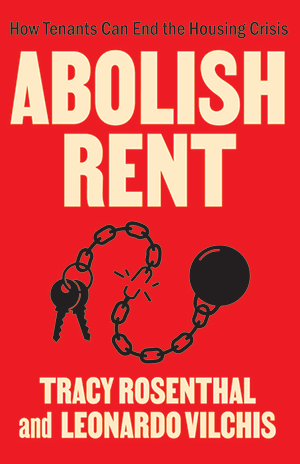
Abolish Rent: How Tenants Can End the Housing Crisis
Tracy Rosenthal & Leonardo Vilchis
224 pages, Haymarket Books, 2024
More than 650,000 people across the country are unsheltered every night, not including those surfing on couches, surviving in cars, or barely teetering on the brink. More than half of tenants are rent-burdened; 22 percent spend their entire income on rent, skipping meals, cutting pills in half, cramming whole families into single bedrooms, staying with abusers, or taking on debt just to put a roof over their heads. When the roof swells with water, we pay for the privilege of having any roof at all. When the wet morass swells with mold, we pay for the privilege of being poisoned.
Meanwhile, landlords file seven evictions a minute, raking in more than $500 billion a year. The truth of our housing system is that from the perspective of its winners, the system works just fine. The capitalist housing system isn’t designed to provide the best quality housing to the most people, but to generate the most profit and extract the most rent. To win a world where shelter is a fundamental right will mean the interests of landlords and real estate speculators no longer trump our basic human need for a home. It will take a liberatory struggle—a struggle led by tenants themselves.
Tenants unions are a vehicle for tenants to claim collective control of our housing and our lives. A union allows us to come together, share tactics and develop leaders, build collective power and take collective risks. But the tools we have as tenants—our rent checks, our bodies, our capacity to organize—can’t be put to work without long-term commitment and community. Pulled from the fourth chapter, this excerpt from Abolish Rent: How Tenants Can End the Housing Crisis is focused on community as the backbone of all of our fights and as the reason we bother fighting at all.—Tracy Rosenthal and Leonardo Vilchis
* * *
Ines Alcazar has lived on Flower Drive for over fifty years. Her block of rent-stabilized buildings sits against the 110 freeway, near USC and, now, two sports stadiums. Containing about eighty apartments, all the buildings on her block have been acquired over time by Ventus Group, an investment firm spearheaded by two USC alumni. In 2018 Ventus petitioned the city to demolish the block and redevelop the site, and in 2019 the firm managed to oust the adjacent block of rent-stabilized buildings entirely. Alcazar saw it all: one by one, each of her neighbors accepted buyout deals to leave their homes. None could afford a new place anywhere else in the neighborhood. They’d signed over not just their apartments, but their communities, too.
Alcazar told us that when LATU knocked on her door in 2021, it was like having a prayer answered. She joined organizer David Anthony Albright in getting her block together for a meeting on a paved lot behind one of the buildings. Even at that first gathering, the tenants identified their own isolation as a source of disempowerment: the landlord had given out different information to each tenant; he’d offered them all different amounts of money while calling it the maximum allowed; and he’d told them lies about their neighbors cutting deals to get them to turn on each other. They knew then that keeping their housing meant they’d need to work together. First, they had to get to know each other. Building community on their block also meant staying separate from elected officials and nonprofits, who cynically deploy the idea of “community” for their own advancement or agenda. Their city council member, Curren Price Jr., dodged the tenants’ calls while attending the developer’s ribbon cuttings. The association discovered that Price had accepted campaign donations from both Ventus Group and its CEO. And in 2019 he’d come under investigation for approving real estate deals for his wife’s clients. (In 2023 LA’s District Attorney charged him with ten counts of embezzlement, perjury, and conflict of interest: for $150,000 in bribes, they said, he’d passed on millions in savings to developers.) They had to steer clear of a nonprofit, too. A community organization had claimed to be helping the tenants who’d lived on the block next to theirs. In fact, it had accepted a $100,000 check from Curren Price’s district fund, then shut the tenants out of negotiations, encouraging them into individual buyouts. As Alcazar said of both the government representatives and nonprofits working on the block next door, “They were not working for the people ... They were leading them to negotiate their defeat [with the developer] instead of coming to help them fight to stay in their places.” They needed to stay independent—and united. Building community on Flower Drive became a key part of the association’s strategy to stay put. As individuals, they would likely face the same fate as the tenants a block away. Together, their fate was their own.
Their tenants association both forged new relationships and gave new meaning to old ones. Some members remarked how little they knew of who lived next door, how “good day” and “good night” was the extent of their communication with people who share a profound aspect of their lives. Now, they’ve put in nearly four years of sharing space and strategizing. Alcazar has seen the production of community—building one-on-one relationships with individuals, negotiating conflicts, and maintaining a group culture that people want to be in and return to—as necessary labor. Alcazar explicitly connects that labor with their association’s capacity for self-defense. “No one is going to be there to defend us. We have to defend ourselves,” she said. “Working together as a community, it makes you feel you have this power in you. Like nobody is going to take it away.”
When one of the owners attended a Flower Drive Tenants Association meeting, Alcazar explained, he praised the buyout offers as opportunities and argued that the new development would improve the neighborhood—though the tenants would not be able to stay to enjoy it. Their community was revealed in their united front against him that night: “don’t be harassing us, don’t be sending anybody to negotiate ... We’re not leaving, we want to stay here and we want to fight for it,” Alcazar summarized. By speaking as a community, the tenants experienced their power to intervene in the landlord’s plans and take control of the situation. “He said his truth,” Alcazar said, “But his truth was not the truth.”
Acting in community remakes our political orientation to our everyday life. Alcazar explained that participating in the union has transformed her relationship to the idea of “communism,” which she once associated with being controlled. Now, she says, it’s about having control. “Communist to me is community. Community working together. Common, you have everything in common. That’s communism. My dream is that one day not only Flower Drive but all these tenants unions become communist—communist as working together, for one purpose, getting a house for everybody.”
In organizing together, we learn that the living conditions in our individual apartments are rarely isolated. If our electricity is on the fritz, the apartments on our line share the same issues. If our sink leaks, it does so onto the neighbor downstairs. Roaches and rats are excellent teachers of this truth: they crawl through the spaces that keep us separate—a problem for one is a problem for all. We share more than a landlord: we share hallways and yards, parking lots and alleys, lobbies, trash and laundry rooms. And we share the physical space of our block. Who is put at risk by a landlord’s failure to maintain our buildings? Who gets rats when a landlord fails to collect trash on time? Our immediate neighbors are implicated in our struggle. They are also who we have to rely on when we need support. Who can show up the quickest when our landlord tries to harass us or when the sheriffs arrive to throw us out?
A tenants union helps transform groups of people into defensive and offensive communities. Community isn’t a resource waiting to be tapped, or a static object ready to be discovered. It isn’t a network we access or a system we unveil. Community is an intentional process and a long-term commitment. The meanings of our communities are often shaped by those who seek to exploit them, negotiating defeat in their names. We reject these white-washed notions. Our communities are forged in struggles for tenant power, which put poor and working-class people in control of the institutions in which they participate. Community names our braided relationships, anchored by place and shared activity. As LATU cofounder Dont Rhine often says, “we make our community by defending it.”
Alone in our apartments, we are likely to ignore the disrepair of our housing, believing that we should be grateful for the roof over our heads, that nothing would change even if we complained, or that speaking up would make us targets for retaliation. The union builds community to allow tenants to overcome their shame and share their living conditions with each other. Collectively identifying a pattern of neglect, that community helps us find the resolve to intervene and the will to collectivize risk.
When the habits we know are interrupted, when we can no longer swing by a neighbor’s house on the way home from work, pick up a snack at our favorite street vendor, recognize the faces of our neighbors, we feel lost, frightened, severed, furious. We no longer experience our homes as ours. We experience what sociologist Mindy Fullilove calls “root shock,” a trauma with physical and emotional consequences. The union builds community to overcome this sense of disempowerment, to testify to our ongoing presence in our neighborhoods, to bolster our sense of control over our lives. When we act together in solidarity, we solidify the bonds gentrification breaks.
Our unions are shaped not just by what we’re fighting against, but also by what we’re fighting for. Grounded in the everyday survival of tenants and the social life of our buildings and communities, they strengthen the practices of mutual care that already existed between us. We build up systems of communication; we guard packages, watch each other’s pets and children, run errands for those of us who are sick; we share the burden of child care, provide for each other’s basic needs with food distribution and harm reduction, and create spaces for art and celebration. Our unions weaponize everyday life.
Understanding the union as a community helps us clarify who its leaders are: the base members who maintain the relationships that constitute it, who cultivate deep and stable coexistence. We can recognize leadership in those who provide their homes as social spaces, who set up meetings, who make reminder calls, who make sure that everyone feels welcome. Leaders take ownership of collective belonging. For our leaders, there is no separation between the social life of their building, block, and neighborhood and the struggle to stay put. The union is a way of life.
The home is where we reproduce our lives, where we maintain our bodies, where we eat our meals, where we care for our families, our elders, and our social and private selves. But the home has been made a place of private subordination, the place where we’re supposed to deal with the fallout of our grueling jobs on our own, manage our disintegrating futures without making a fuss. The tenants union disrupts that project of isolation, politicizing domestic space and challenging the right’s current monopoly over visions of what our homes—our reproductive lives—should be like. Of course, domestic space is often maintained by women’s unpaid second shift, their labor of caring, cooking, cleaning, and community making. As a movement to defend and control the home, our movement will often be led by women—women on their third shift, performing the labor of social justice. Tenant organizing is domestic work to be carried out by people of all genders. It makes homemaking a project to remake the world.
An excerpt from Abolish Rent: How Tenants Can End the Housing Crisis by Tracy Rosenthal and Leonardo Vilchis, published by Haymarket Books and reprinted with permission.