


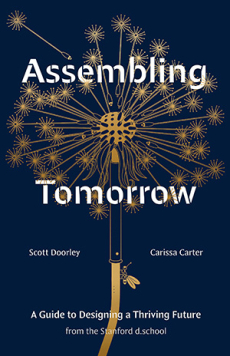
Assembling Tomorrow: A Guide to Designing a Thriving Future from the Stanford d.school
Scott Doorley & Carissa Carter
301 pages, Ten Speed Press, 2024
Today is an era of runaway design, where everything we create—everyday products, hybrid workspaces, viral media posts, recycling systems, gene therapies, AI bots, or nuclear fusion generators—tangles with our environment and emotions in unpredictable ways. Our by-products alter the biosphere, social media shapes norms, and datasets drive decisions, making the impacts of our actions hard to anticipate, notice, and repair.
To be a maker today—to be human—is to collaborate with the world. It is to create and be created, to work and be worked on, to make and be made. To be human is to tinker, create, fix, care, and bring new things into the world. It is to design.
However, even with the best intentions, we keep making things that don’t quite work and might wreak havoc. Why?
We forget to include our weaknesses in our designs—not to exploit them but to respond to them. Things get messy when our capacity to create meets our limited capacity to understand our influence. Building a product is hard work, but tracking its results, ripples, and repercussions is another story. We end up with transportation that warms the planet, social media that frays our nerves, and AI that alters our relationships.
This book is about broken things, the good intentions that designed them, and the great possibilities lingering amid their cracks. Intentions and consequences don’t always align as expected. Good is not always good, and bad is not all bad. Both are hard to predict and see. But if we pay close attention to how our designs may tear things apart and we create with healing in mind from the start, we can assemble a world worth making.—Carissa Carter and Scott Doorley
* * *
When we interview the finalist applicants to Stanford’s Design MS, we ask them to talk us through a project in their portfolio that they’re particularly proud of. Then we have them extrapolate: What’s the dream? How would you like to see this take hold in the world? They’ve usually painted a neat and admirable vision. Then we ask the real question: When everything with that project goes right, what will go wrong?
Imagine that you do whatever you set out to and do it just as you described. What are the second-and third-order implications? How could your project change things for the better—and the worse? What could go wrong?
It’s a daunting, name-your-monsters question that requires you to look imperfection in the eye and get comfortable with your discomfort. Nobody wants to envision a world where their creations cause trouble, but it is liberating and fascinating to accept the challenge of dealing with the downsides of your work. Taking responsibility from the start saves the agony of wondering what you are missing.
Asking questions like these doesn’t mean our dreams will be error free, but it allows us to think through negative consequences, no matter how far afield they may seem. We don’t know what’s going to happen with the things we make. But questions like these can make sure we won’t shy away from dealing with the errors if (and when) they happen.
Breaking is natural. Over time, things fall apart. We get old. Foliage dies and decays. Buildings crumble. The things we make have been breaking all along, but we don’t spend much time dwelling on it—partly because we don’t want to believe our designs will break, partly because we’ve decided not to notice.
Sometimes things break because they are misused. Sometimes they wear out. Other times the things we make work according to plan but break something else. But everything we make is going to break: This is the first, last, and perhaps only rule of design.
But you can make the most of the breaks by turning constraints into possibility, leaning into imperfection, and redefining what it means to respond by preparing to heal, not just after, but during and well before breaks happen. Here are some tools that will help you aim for imperfection.
Gain Literacy in Mischievous Materials
Here is a mantra: You don’t need to know the code, but you need to know what the code can do.
Put another way, you don’t need to be a technical expert in everything, but you should aim to understand what different technologies and materials can do. You know many materials already. You know that paper can be folded into airplanes and written on with ink. You know that clay can be molded into mugs. You know that light can be captured with sensors and turned into pixels to make photographs. You even know that shared goals, networking, and sticky messaging can be shaped into a protest.
Mediums are what we build with. Everything is made of something, often many things. Many materials are tangible. But other, newer materials aren’t as intuitively transparent. Algorithms and blockchains, synthetic biologies and massive datasets—these are the new materials that makers are using to create our world. They predict our desires and actions online (offline too). They create new medicines, organize currencies, contribute to criminal justice decisions. These mediums are tricky—we call them “mischievous materials.”
For the future to include room for everybody, now is the time to get literate in the ways it gets made and to help others get literate too. Practice this with the go-to materials you work with: What are they good at? How do they work? If you find yourself mired in technical jargon, level up the question. Ask, “Why is this important?” And then again, “Why is that important?” In no time you’ll be talking about materials in terms of what they can do and make happen, not the intricacies of how they work. The more you share this with others, the more you boost their material literacy too.
Tools Plus Time Make Power
Design is as human as talking, maybe more so. It’s hard to come by hard evidence of language before the dawn of writing, but most educated guesses say people were speaking at least a few hundred thousand years ago. Evidence of tool-making comes a good two million years before that. Our ancestors most likely made things to serve their needs well before they talked about how they did it. Design came first.
Design by everybody lasted for eons, but, in the age of industry and mass media, things began to shift, leaving opportunity for only a select few to create at such large scales. Even outside industrial-scale design, there was a sharp line between creatives and normal folk. Not so much anymore. With the advent of fast, cheap processors, cameras in pockets, and 3D printers, we’re all creators again. The tools just look different.
Soon the bigger question might not be who has the tools, but who has the time? We need to look at time divides in the same way as digital divides and wealth gaps. Scratch the surface of the research on the homespun industry and it’s bound to reveal some disparities. Who exactly is inventing at home? Who can afford the time and the space to do it? It’s an equity issue.
Other questions linger. What are we really creating? What’s easy to make and what isn’t? Right now, recording a video or song is simple; not too long ago, that wasn’t so. But creating an artificial pancreas is not simple. Should it be? Maybe healthcare hacking and homespun synthetic biology are new folk arts too.
Learn to Love Constraints
The constraints you choose make or break a design’s aesthetics, and they make or break your ethics. When you create, what you choose not to do is as important as what you choose to do. The constraints you follow are your ethics; they get built right into the fabric of the world.
Ecological economist Herman Daly put a poetically simple label on the things we might choose to contain but tend to ignore. He called them bads, as in “depletion and pollution are costs, they are bads rather than goods.” Goods (like goods and services) produce bads (like social strife and contamination).
What constraints might you impose on your own work? Longevity? Inclusivity? Health? Happiness?
Get Ready to Respond
How do we work on our ability to respond when things don’t go as planned? First and foremost is being brave enough to act but humble enough to adjust. Red Burns, a torchbearer of technology and humanity, left us this pearl of wisdom: “Combine that edgy mixture of self-confidence and doubt—enough self-confidence to try new things, enough self-doubt to question.” Responses need to come from both actions and words.
Chasing possibilities and acting responsibly sometimes seem like they are in conflict, but we need them both. It would be a shame if we sacrificed potential on the altar of anxiety. We need unapologetic optimism and radical responsibility side by side. We should be building on successes without ignoring the troublesome parts. Even utopias need a sewage system.
One way to better our ability to respond? Embrace imperfections—especially if your creations are big, quick, and unwieldy.
The bigger the things are, the harder they can be to control. So, while a single person or even a single company (with a few grand exceptions) can’t do it all, if you design products, lead a company, are a parent, or just care, you should be eager to adopt shared constraints that take the bads into account. Cooperative coordination, safety measures, and smart regulation make for a good, thriving, imperfect world.
Be prepared for things to break. Even if you’ve done everything right, something will go wrong. Gain as much literacy as you can in materials, particularly the mischievous ones, and share what you learn. Be strategic about the work you take on and both the stakeholders you include and those you leave out. Remember that the constraints you choose to follow are a manifestation of your ethics. Preserve your ability to respond. Use imperfection as protection.
And don’t be afraid to investigate what the things you make are bound to make and are destined to break—the unseen potential and the unintended consequences. Look beyond your intended audience and toward anyone and everything that might be touched by your designs. As you do, keep in mind the words of designer, printer, and activist Rick Griffith: “Good design should have no victims.” Proceed accordingly.