


The Inclusive Language Field Guide: 6 Simple Principles for Avoiding Painful Mistakes and Communicating Respectfully
Suzanne Wertheim
256 pages, Berrett-Koehler Publishers, 2023
Changes in what is and isn’t acceptable language can be a source of stress for many people, both in and out of the workplace. I wrote The Inclusive Language Field Guide: 6 Simple Principles for Avoiding Painful Mistakes and Communicating Respectfully to address two common problems: People saying unpleasant and harmful things because they don’t realize what is problematic about their language, and people not having access to the information that can help them be as respectful and as welcoming in their communication as they want to be.
In some respects, 21st-century etiquette is like older versions, but with one major update: It is now expected that we will take into consideration people whose perspectives have historically been ignored, erased, or dismissed as less important. Analyzing language patterns allows us to see unpleasant distortions that can be hidden in seemingly innocuous words and phrases. I’ve distilled decades of research on human communication into six basic behavioral principles that can be used to guide all of our speech and writing:
- Reflect reality
- Show respect
- Draw people in
- Incorporate other perspectives
- Prevent erasure
- Recognize pain points.
The following excerpt is taken from the chapter examining the third principle, on how to “draw people in.” This chapter looks at a few ways that our language can inappropriately decenter and marginalizes people. For example, a Korean American child is marginalized by instructions in an art class that assume that everyone has a creased eyelid. Words describing disabled people frequently undergo a semantic shift, where the meaning is changed to something negative or outright insulting. Perceptibly disabled people are frequently underestimated and spoken to as if they are incompetent. And modern usage of the word “diverse” can hide some problematic ways of organizing and conceptualizing the world.—Suzanne Wertheim
* * *
It was the last meeting before they started interviewing job candidates. The hiring manager looked at his engineering team. “Don’t forget, we’re getting pressure from HR. So we have to make sure at least one diverse candidate makes it to the final round,” he said. The team members nodded and made notes in their files. No one asked him what he meant by a “diverse candidate”—they all knew.
When someone says, “a diverse candidate,” who do they mean? If they’re in the US, they usually mean someone who isn’t a white man. Less frequently, they mean someone who isn’t heterosexual or cisgender. And they may sometimes mean someone who isn’t abled.
This use of the word diverse is problematic.
Until very recently, when referring to people, the adjective diverse was only used with nouns or phrases that represent groups. For example:
- A diverse workforce
- A diverse candidate pool
- A diverse employee base
That’s because, when referencing people, the semantic framing of diverse points to a scenario involving difference within a group of people. In this scenario, some people are one way, and other people are another way. Together, the individual differences make up a diverse group.
But in the last few years, I’ve seen the rise of diverse to refer to a single person. Most frequently in the context of hiring. So, what’s going on?
Today, diverse is often being used as a euphemism for
- a person who is white and female, or
- a person of color of any gender.
And, less frequently,
- a person who is a member of the LGBTQ+ community, or
- a person who is perceptibly disabled.
Why is this a problem?
It’s a problem because it presents whiteness, maleness, heterosexuality, and abledness as the default—as if they are the “normal” ways of being, the central core by which everyone else is defined as “other.”
There’s a really useful linguistic concept that helps explain why this happens. It’s called markedness. You can sort a lot of the world into two categories: unmarked and marked.
The unmarked thing is the default, the dominant form, the form that requires less effort.
And the marked thing is seen as nontypical, special, divergent—a form that requires more effort. It is often defined in opposition to or different from the “default” or unmarked form rather than its own thing.
In the US, when it comes to race, the unmarked category is people who are white, and the marked category is people who are not white.
When it comes to gender, the unmarked category is male. And the marked category is people who are not male.
When it comes to sexuality, the unmarked category is heterosexual. And the marked category is people who are not heterosexual.
And when it comes to ability, the unmarked category is abled. And the marked category is disabled.
Linguistic patterns give us insight into the mental models we use to sort out and assign value to the world around us.
For example, in English, most words that point to the male version of something are the default, the bare root. And in order to point to the female version of something, you add an extra word or word part, usually a suffix, to show that you’re talking about something divergent, something marked.

For all of these words, the unmarked form is shorter. The male form is the base form, the default form. And then, the default form is marked with something additional to turn it into the female version. The feminine suffix ess is added, or the profession is prefaced with female, or a name has an -a added to the end to make a female version.
You’ll find similar markedness with race. For example, in the mid-2000s I used to spend a lot of time reading a website called Overheard in New York. And this markedness would show up all the time in the way overheard people were described.
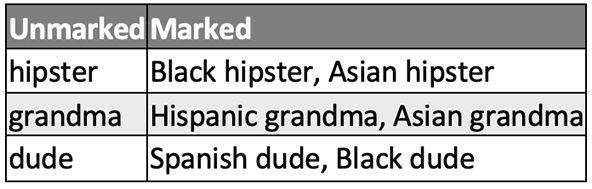
The reader was led to assume that a “regular” hipster, grandma, or dude was white. People who weren’t white were marked with additional words to describe them.
You can check this out yourself by looking at Wikipedia pages for people. If you go to the Early Life section, you’ll find that white people very frequently do not have their ethnic or racial background mentioned. But people of color (and Jewish people of all skin tones) do.
The same is true for many novels written by white people. In these novels, white characters don’t have their race mentioned, but people of color are marked with ethnic or racial descriptors. Think about the eye descriptions from Crystal Hana Kim’s story at the beginning of this chapter: everyone else in the class had an unmarked eye, but she had a marked monolid eye.
Throughout this book, I use some marked names for the US, like Tomoko, and some unmarked names, like Daniel. How have you been picturing the people with unmarked names? Are they all white? And if you, reader, are not white, have they all been the same race/ethnicity as you?
In the US, when we talk about race, whiteness as a racial category is often erased. For many white people, race is about other people.
For example, what is plain old American history? It is presented from a white point of view. So every February is Black History Month. It’s marked as different.
But, as many people have noted, in the US (and other places colonized by white Europeans), Black history is also white his- tory. To claim, for example, that slavery is specifically Black history erases the role that white people played in the creation and maintenance of chattel slavery.
When people say “diverse candidate” to mean “a person who isn’t perceived as white,” they’re leaving white people out of the diversity equation.
They’re suggesting that diversity is only about the marked people. That a “diverse” person is someone defined as different from the dominant group. Someone who isn’t white. Someone who isn’t male. Someone who isn’t straight. Someone who isn’t abled.
Someone who is “different.”
But everyone plays a role in diversity. So it’s better to avoid language that suggests that creating diversity is only the responsibility of people who have been traditionally marginalized, overlooked, and kept away from power. Which is ironic, because they are exactly the people with the least power and least access to make systemic and top-down changes.
I recommend only using diverse to reference groups of people and not individuals. If you want to highlight that you’re looking to diversify a group, one handy way to characterize people is underrepresented and overrepresented.
For example, the hiring manager could have said something like this: “Okay, for the open position, we want to make sure we look for candidates from underrepresented groups so we can balance things out on our team.”
Diversity is about everybody. And when you make sure everyone is part of the equation, you can move past the idea that one kind of person is “regular” and everyone else is different, peculiar, divergent. And you can be genuinely inclusive instead.