


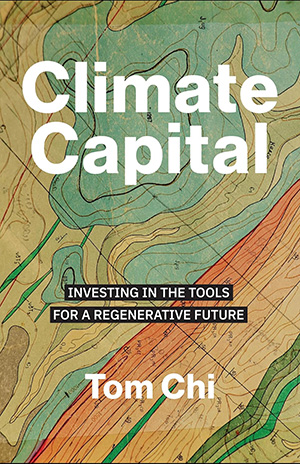
Climate Capital: Investing in the Tools for a Regenerative Future
Tom Chi
320 pages, Wiley, 2026
The three big challenges of the 21st century are climate destabilization, economic reinvention, and geopolitical stability. Climate Capital: Investing in the Tools for a Regenerative Future aims to share tools to rise to these challenges and build a purposeful and regenerative future together. The book teaches new mental models, incentive structures, and tools that can be directly applied to the big challenges and also lay the foundation for a more broadly functional society.
Rather than proposing a single ideological solution, this excerpted section speaks to the distinction between prove-you-wrong intention and build-forward intention. The former dominates our current discourse; the latter is how working systems are actually developed. Through historical and practical examples—from environmental policy to DARPA’s approach to innovation—the excerpt points toward methods that favor iteration, evidence, and care over punditry.
The larger project of Climate Capital is to reconnect climate action, economic design, and political practice to things that actually work. That means being thoughtful about physical planetary constraints, human psychology, and institutional evolution in practice, not as ideology or daydreaming. The goal is not to win arguments, but to restore our capacity to build futures that are resilient, humane, and worthy of the rare planet we inhabit.—Tom Chi
* * *
This is a century that requires more sanity and care, not less. It is a century defined by planet-spanning challenges that demand nuance, grace, and grit. Treating politics like a sporting event—marked by blind loyalty to team jerseys rather than a disciplined practice of listening and acting to improve society—is a foundational failure. Add to this the influence of unbounded corporate money, layered onto a media environment optimized primarily for engagement, ratings, and profit maximization, and we begin to see the outline of a machine that degrades society for the sake of short-term quarterly gains. While this landscape often invites despair, moments of breakdown also reveal the need for corrective forces—and that recognition can become the seed of meaningful action.
One useful reframing is to examine how systems evolve over longer time horizons. When viewed through that lens, it becomes clear that many current political positions on environmental issues in the United States are relatively recent constructions. The Endangered Species Act, for example, passed unanimously in the Senate (92–0) and overwhelmingly in the House (390–12) in 1973, under President Nixon, a Republican. Some of the most significant environmental protections in U.S. history were enacted by Republican administrations, including the establishment of national parks and public lands under Theodore Roosevelt. These policies exemplify how conservatism and conservation can—and historically did—go hand in hand.
I grew up fishing, and many people who hunt and fish vote conservative while caring deeply about protecting their local ecosystems, just as Roosevelt did. For most of the nation’s history, environmental stewardship was not a partisan issue. Only in recent decades has a partisan narrative been deliberately manufactured—largely to serve oil industry interests and secure political contributions. Political consultants were paid millions to recast widely supported values like clean air, clean water, and healthy ecosystems into divisive wedge issues. In allowing this, we have permitted a form of psychological damage to enter the system, where people are incentivized to make the public less informed and less capable of responding to the challenges and opportunities ahead.
Of course, the laws of physics and ecology are indifferent to this noise. Natural systems degrade when damaged, regardless of rhetoric, rationalizations, or the adversarial team sport politics has become. We must find ways to work with reality as it is, and to recognize that much politicized media is focused less on building understanding than on reinforcing existing beliefs. Just as we have polluted the physical environment, we have polluted the informational one.
By prioritizing opinion and spectacle over comprehensive, contextualized data, we enable politicians, corporations, and media figures to fabricate, distract, selectively inform, and operate with weak standards of rigor. Over time, this erodes our collective ability to make sense of the world. Like all forms of pollution, the harm eventually returns to us: physical pollution damages our bodies, while informational pollution damages our minds. Just as waterborne pollutants eventually accumulate in the ocean, informational pollution settles into the beliefs of everyday people—misguiding them, disempowering them, and pulling them away from grounded, compassionate action. In its place, we inherit polarization and talking points, crowding out the direct care we might otherwise extend to one another.
Most often, when groups of people become politically stuck, it’s because political parties have strongly reinforced in-group and out-group thinking, and the media covers those differences like a sports match: immovable sides battling one another, with the spoils framed as a zero-sum game. What we mostly encounter in this format is prove-you-wrong media. The underlying assumption is that winning an argument and proving others wrong is equivalent to solving the problem. Anyone who actually solves problems knows this isn’t true. This media format—repeated endlessly—has almost no overlap with the real process of problem-solving.
For those who care about the health and governance of local and global communities, and who want the time they invest in collective issues to be as productive as possible, there is a simple check: notice whether the people around you are operating in a prove-you-wrong mindset or a build-forward mindset. Most complex problems cannot be solved in the abstract through discussion alone, prior to implementation. Real solutions require real-world trials, iteration, learning, and improvement. They require discovering which operational variables actually matter—variables that are usually unknown at the start—so workable outcomes can emerge from experience.
Time spent with build-forward people is time well spent. These are individuals who try practical improvements, observe outcomes objectively, and actively listen for what is helping people in practice. They are willing to adapt when favored ideas fall short. They don’t waste much energy defending positions, because careful listening—attuned to nuance and real-world impact—is far more valuable than argument. Serving a problem space well requires curiosity and responsiveness, not rhetorical dominance.
An instructive example of this kind of iteration at a program level comes from work developed by Regina Dugan during her tenure at the Defense Advanced Research Projects Agency (DARPA). There, project managers were tasked with identifying promising ideas across dozens of frontier technical domains. Rather than betting heavily on a few early winners, they distributed small grants across many teams to learn from real progress happening close to the work. These grants were intentionally modest—large enough to support exploration, but not so large that they distorted research trajectories. Teams simply reported back on a few key metrics DARPA was seeking to improve.
After this wide exploration, a principled down-selection process followed. Approaches that showed stronger progress against target metrics received larger follow-on support, while others were allowed to sunset. This smaller pool of efforts was then tracked carefully across a broader set of criteria, leading to a final selection for substantial backing. This method allowed a small group of decision-makers to make sense of a complex and unruly field in a cost-effective, data-driven way.
Importantly, the organization was also designed around limited tours of duty. Project managers typically served two to three years—long enough to do rigorous work, but short enough to avoid empire-building or career entrenchment. The goal was to assess a technical frontier with integrity, not to advance personal agendas. That structure helped preserve the quality of the data and the clarity of the decision-making process.
Now imagine applying a similar approach to large, contentious social or economic policy challenges. A society genuinely interested in solving a persistent problem could deploy teams to study how different governments—large and small—have attempted to address it. The goal would be to learn as much as possible, as quickly as possible, from the full range of approaches tried across cultures and contexts. From that informed position, the most promising strategies could be identified, along with the design and operational factors that make them succeed.
From there, a subset of approaches could be piloted at small scale, with clear metrics and transparent evaluation. The results of those trials would then feed back into public decision-making, grounding political conversations in outcomes rather than arguments, scapegoating, or scandal. The most important problems we face deserve this level of rigor. As more people align themselves with build-forward efforts that prioritize compassion and effectiveness, it becomes easier to recognize when leaders and proposals fall short of that standard. With sufficient individual and collective agency, we can begin building better futures immediately, right where we are.
What’s been outlined here is not an exhaustive set of problem-solving techniques, and not every idea will work in every context. In a build-forward spirit, those with better approaches—or proven methods already in use—should add them to their own local toolkits. The intention here is to help initiate momentum, clarify useful distinctions, and create space for something substantially better to emerge.
The broader takeaway is this: if we can learn to break out of limiting frames—socialist versus capitalist, liberal versus conservative, in-group versus out-group, binaries where they don’t belong—and develop an immune system against those who pull every issue toward argument rather than good-faith problem-solving, we create conditions for real iteration and learning. Each step in this direction strengthens the political metabolism of society, allowing it to handle the complexity and nuance that effective solutions demand.
People who don’t build often default to arguments and protests as their primary tools. While those have a place, anyone who has repaired an ecosystem or designed a complex technology knows that sophisticated outcomes require sophisticated conversation, coordination, and action across diverse inputs.
It’s also worth acknowledging that reductive thinking is easier. It’s easier to engage thousands of people in frustrating, simplistic debate than to sustain data-driven, build-forward conversations that lead to coherent action. Building real community requires good faith, leadership skill, compassion, creativity, critical thinking, and commitment—and we currently lack enough of these capacities in the places where they are most needed.
That said, if any challenges are worth raising the bar for, the ecological, economic, and political integrity of our civilization are surely among them. It is easy to have shallow conversations; living with their consequences is far harder. The easy path ultimately proves more costly, allowing problems to compound, eroding trust, and training people into less capable ways of engaging with the world.
Claims that addressing climate disruption is “too expensive” have already collapsed. We are now experiencing single events that cause hundreds of billions of dollars in damage—costs that far exceed what proactive solutions would require. Reactive spending secures nothing; it merely treads water while risks accelerate.
For all the grief and disruption the coming decades will bring, there are also gifts embedded in these moments: clarity, urgency, and the call to work together on problems larger than ourselves. We are deciding, right now, what kind of ancestors we will be. The people alive in the coming decades will largely determine whether Earth’s biosphere recovers in a century, several centuries, or much longer.
Grief itself is not a collapse—it is a clarifying force. It reminds us what we truly care about. In that sense, grief functions as a foundational technology for intergenerational care. Few experiences create lifelong commitment to something larger than oneself, and grief is one of them. Transforming grief into care and meaningful practice is one of the most profound paths a life can take, and it will be taken by many who contribute to the long relay race required to repair our planet.
If we succeed, we will have navigated one of the most pivotal moments in human history. We will have built an economy that allows humanity to be a net positive to nature, and a political system capable of being a net positive to humanity. We will have learned how to meet our greatest challenges through collective action, developing skills that bring agency and capability into our lives and communities.
Earth is an extraordinarily rare place in the universe. Technological civilizations capable of shaping entire planets appear to be exceedingly uncommon—we know of only one. Recognizing the rarity of this privilege invites a level of care and integrity worthy of it. When we truly understand how improbable our existence is, many of the squabbles and misaligned frameworks we’ve inherited shrink in scale. These frameworks are forms of unnecessary self-inflicted harm, and allegiance to them must come second to the larger project of stewarding the rare gift of life on this planet.
The challenges described here may feel immense, but they are brief on geological timescales. Let them be the forces that mature us into wisdom, rather than the forces that dissolve our gifts through fear, ignorance, and division.
Excerpted with permission from the publisher, Wiley, from Climate Capital: Investing in the Tools for a Regenerative Future by Tom Chi. Copyright © 2026 by Tom Chi. All rights reserved. This book is available wherever books and eBooks are sold.