


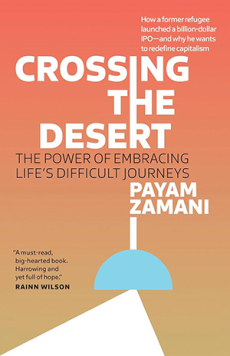
Crossing the Desert: The Power of Embracing Life's Difficult Journeys
Payam Zamani
352 pages, BenBella Books, 2024
In this excerpt adapted from my book, Crossing the Desert: The Power of Embracing Life’s Difficult Journeys, I describe how I developed my vision for a more compassionate and sustainable form of capitalism. I call it “spiritual capitalism,” where success is measured not just by financial gains, but by championing the collective well-being of humanity and the planet. This approach is greatly influenced by the spiritual teachings of the Baha’i Faith, which have guided me throughout my life, from when I was forced to flee Iran as a religious refugee to today, with how I want to run my businesses.
Over and over again, I have witnessed how the greedy, "growth-at-all-costs" approach imposed on companies, often by the VC world, crippled them from the inside. It happened to my first company and the one I describe in the passage below. When I saw that the company I had founded was struggling, as was my soul, under the prevailing approach taken by the business world, it was time to test my own approach to running a business according to my personal values. For years, I had wanted to incorporate the timeless spiritual beliefs that people from all creeds and backgrounds embrace—unity, justice, love, and more—and make them an integral part of my professional life. I did not want to do this for PR purposes but because we should fundamentally believe that our spiritual codes of conduct and values will bring a much better version of us to the business world and the world at large.
I believe that my well-being is interconnected with the well-being of humanity as a whole. I don’t live in isolation from the larger world, so if I only believe in the maximization of shareholder value, then I am not aligned with the larger well-being. In my current company, One Planet Group, we make a humble attempt to challenge the idea of success as a zero-sum game that traditional business models present. There is an alternative. It is one where businesses can thrive by enriching the lives of all stakeholders while also fostering a culture of shared prosperity.—Payam Zamani
* * *
To me, running a business is kind of like taking care of your family: Taking care of our family of employees should be the bare minimum. And it’s not something we can fake. We will be tested every step of the way, and every financial decision and its moral dimensions and its inevitable consequences will have to be considered.
After finally gaining full control of my company and making a clean break from its tumultuous past, I was free to get started on the uncharted journey ahead: integrating my desire to serve and live in alignment with my spiritual values with the work that our company was doing.
One of the ways we did that was to attempt to eliminate workplace gossip by creating a channel through which employees could submit anonymous comments and questions, which were read and addressed at our weekly all-hands meetings—encouraging open and honest communication from the bottom up.
We also made it clear that we were not in this business to win at any cost. We made it clear to everyone at Buyerlink, our company, that our success would not depend on someone else’s demise.
But I didn’t want anyone to have to guess what we were all about. I didn’t want anyone to feel confused about what our culture might be built upon. So, together, we spoke about the principles that were most important to us and were in line with the spiritual beliefs that were the animating force behind everything we did.
The principles we espoused aligned not only with how we wanted to conduct ourselves in the business world, but as conscientious adults and human beings. And they are: Unity, Intention, Independence, Love, Truthfulness, and Justice.
It should come as no surprise that several of these convictions reflect some of the teachings of the Baha’i Faith, or that they were drawn directly from the lessons of my own life experience. And while I do not claim to be an ideal model of putting these principles into action, I do believe that my humble pursuit of these principles, striving to live up to them and do my best to achieve them in our business pursuits and in life in general, has contributed greatly to every positive thing I’ve accomplished so far.
By doing our best to adhere to these principles in the examples we set through hiring, through sales, and through the dealmaking we had done so far, they were fast becoming an integrated part of our company culture—and we were already successful because of them, simply because we were putting this new example of how to run a business into the world.
One major way in which we tried to set a new example early on was to set aside a percentage of our profits to give back to the community around us—to causes that mattered to us, and more.
The idea wasn’t to “give 1 percent back” as many Silicon Valley companies do to attain some sort of feel-good PR value. The idea was to give so much that it hurt—to make giving a top priority. To give so much that it was a relevant figure—one that would cause us to rethink investments elsewhere.
As a private company, free from any outside investors who often were in it for what I believed were the wrong reasons, Buyerlink was profitable. But more importantly, we were quickly growing into a self-sustaining, highly fulfilling company, supporting a wide array of employees, clients, and offices around the world with the humanitarian values of service and giving at its core.
And Buyerlink was just the beginning.
If I wanted to prove to myself (and the world) that a new form of capitalism was possible, I knew that we needed to give the world an even better example. We needed to build something that was more relevant and that would create a platform with much more expanded reach.
So, in 2015, just as all of our new ideas for the company were getting on their feet, I created a parent company that would allow us to expand into other areas. With a parent company we could grow and invest in other businesses and be an active incubator and ecosystem through which we could test our ideas while helping other forward-thinking entrepreneurs launch their own journeys.
I thought about one of the core principles of the Baha’i Faith—Unity— the ultimate spiritual vision of a peaceful connection between all people on this planet, beyond the arbitrary concepts of borders and the divisiveness of politics or religious dogma.
And in that spirit, I named our company One Planet Group.
After everything I had witnessed through my experiences in the business world so far, this would be the laboratory in which we would try to answer the many questions I found myself asking:
Could we set a humble yet robust example of pairing good business with good intentions?
Could we measure success in more than dollars, but by how we spend our resources on helping and serving others, by how many lives we touch in a positive way, and by how we better our communities and the world around us?
My inspiration for creating this laboratory of a business model clearly came from my Baha’i Faith, but I never wanted to impose my religion on anyone. Instead, I asked our employees and managers if we could try to meet the challenge of bringing certain timeless spiritual principles to the business. And at first, these ideas seemed radical—because they are the opposite of what we usually talk about when we’re talking about “business goals.” But the truth is, these are the very principles that lead us to a spiritually satisfying life. To happiness. To fulfillment. And shouldn’t such principles that we seek in our lives be applied to our work as well? If not, how can we ever be expected to lead coherent lives?
Values and principles shouldn’t be turned on or off the moment we walk through one door or another, should they?
Perhaps the most “radical” idea we brought to the table was this: The first thing that One Planet will deliver is love.
If we want to make our world a better place, then as business leaders, we’ve got to love our people. We’ve got to love our clients. We’ve got to love our partners and our vendors, too. Because, without that, the whole thing falls apart. Our humanity gets lost.
This means that we should even love our competition.
We tell this to our employees all the time: If our success relies on someone else’s demise then maybe we should get out of that business.
If our product is superior, if people truly prefer whatever it is we’re selling and that naturally affects a competitor, we don’t want to deny the consumer of that choice. But we never want to think about Company A, B, or C and say, “We want to beat them.” Never. That is simply not the way we operate.
We are competing against ourselves, and never someone else—which basically means that we’re taking the aspect of war out of the workplace and replacing it instead with a spirit of “let’s work for the benefit of all.”
We can always be better at what we do, and there is no question that focusing on what the competition is doing can quickly cause us to lose our bearings. That’s a scary path to go down. There’s no end to it. There will always be someone out there doing things differently than we are, and maybe doing things better than we are. We see the results of that outward-facing pressure on social media all the time, as people fill themselves with anxiety and worry because someone else is getting more “likes” than they are. It’s not healthy. But we also see it in the hoarding of wealth amongst the super-rich, especially in recent decades. I mean, how much is enough? Do we value anything other than more, more, more and take, take, take? Where is the value of balance and mutual benefit? Why is it so difficult in our society to embrace the idea that a rising tide should lift all boats? Doing so wouldn’t make the wealthy become anything less than they are. It would just mean that the poor and middle class can rise, too, as we all benefit from the riches of this planet.
There will always be somebody wealthier. Someone prettier. Someone stronger. Someone smarter. Someone more innovative. Always. So, if all we’re doing is competing with each other, then we’re bound to be unhappy. And I don’t think it’s hard to argue that, statistically speaking, we are unhappy. Workers are unhappy. Leaders are unhappy. Even billionaires are unhappy! Because we’re unhappy with the status quo. And one of the driving reasons for that unhappiness is because we feel there isn’t enough purpose to what we do.
Doing things the way we’ve always done them is no longer working for the vast majority of people on this planet.
So, at One Planet Group, we decided: We don’t think the world needs another “successful” business built on the outdated, unfulfilling, old measures of growth and competition. There are already plenty of those. What we want is to build our success on broader, more inclusive terms.
The very definition of “success” must change if we want to build ourselves a better system, and a better world. We cannot continue to measure “success” by dollars and cents and quarterly results alone. Shareholder value is one measure of success, but how can it continue to be the only measure when we see the overall poor results of that system in action? The destruction of the planet, employee instability, worsening mental health crises all across the world, price-gouging under the guise of “inflation” that brings the vast majority of middle-class, hardworking families to the breaking point every month—let alone the poor. If the shareholders are the only ones benefiting, I argue that’s not a “success” at all.
Even those who are making the vast majority of the money aren’t happy. There are countless stories of “successful” business leaders who flame out in their forties and fifties—who quit and try to find fulfillment elsewhere, working for charities, building homes in Africa, teaching, starting over in the countryside somewhere. Why? Because making money and maximizing shareholder value are not fulfilling reasons to live and work. They do not bring happiness. The entire idea of building businesses solely for the sake of getting rich isn’t only an empty endeavor; it’s an archaic way of thinking.
If we want to find true success, we have to modernize.
If we want to find true success, we must think bigger. We must think of all of the stakeholders in the lives of our businesses: the employees, the communities around us, the planet on which we live, the customers, the vendors, our competitors, all of it. We have the means to consider all of those factors in our business endeavors, so why not get started?
In spiritual teachings of all sorts, there are timeless tales that tell us how to live more fulfilling lives. And one universal message that crosses the boundaries of nearly all religions is this: When we focus more on the happiness of others than on the happiness of ourselves, we become the happiest version of ourselves.
What we’re attempting to show at One Planet is that applying these principles to business is not an act of diminishing returns. We’re not “giving up” on things that make good business sense. What we’re attempting to do is to show that a winning business, one that does all of these things, is not only possible, but in fact offers us a better way to build a great organization. An organization elevated to not just deliver financial success, but one that delivers a great journey to its employees, and leaves the world what I like to call “ever so slightly” a better place.