


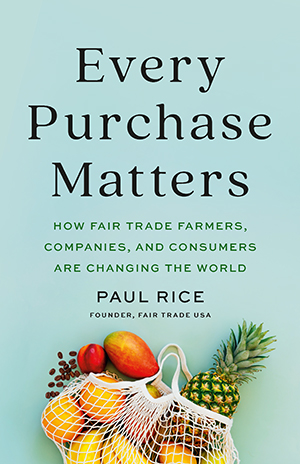
Every Purchase Matters: How Fair Trade Farmers, Companies, and Consumers Are Changing the World
Paul Rice
336 pages, PublicAffairs, 2025
At a time when so many people feel alienated by the political process and alarmed about the direction of our country, many are asking how they can make their voices heard and impact the world in a positive way. When it comes to addressing child labor, global poverty, deforestation, and climate change, what is the role of business? What is our role as consumers? My new book, Every Purchase Matters: How Fair Trade Farmers, Companies, and Consumers Are Changing the World, tackles these tough, timely questions.
We each have the power to change the world through the products we buy. This simple premise has driven the growth of the conscious consumer movement for decades. In response, companies are developing a profitable business case for responsible sourcing and sustainable products. Today, a review of the research or a walk down any grocery store aisle will confirm the macro-trend toward sustainability, representing a seismic shift in how our products are made, sourced, and consumed. While we may feel frustrated with the pace of change, the progress is undeniable.
Fair Trade has been a unique learning laboratory for this evolution of business and society. In writing the book, I call on the close relationships I cultivated over the last 40 years—during a decade in the highlands of Nicaragua and then as founder and CEO of Fair Trade USA—with farmers, activists, and business leaders. These pioneers of conscious capitalism share their rich stories of success and failure, lessons learned, and their extraordinary impact on communities and the environment. Their often surprising insights make a fascinating and persuasive case for responsible sourcing, conscious consumerism, and shared value.
This excerpt examines the crucial issue of consumers’ willingness to pay more for sustainable products. Premium pricing is an obstacle to mainstream consumer adoption of sustainable products, and we see a persistent “intention gap”—the frustrating disconnect between consumers expressing a willingness to pay more for sustainable products and their actual purchasing behavior. I think you’ll enjoy reading how innovative, purpose-driven companies are successfully bridging the intention gap and making responsibly sourced goods successful in mainstream markets.—Paul Rice
* * *
On a recent visit to Austin, Texas, I had a chance to spend a day hanging out with my friend John Mackey, co-founder of Whole Foods. Between biking around beautiful Barton Creek and playing some fiercely competitive rounds of backgammon, we had a chance to chat about the world—and the world of sustainability. When I asked John who he thinks should pay the extra costs associated with sustainability, his answer was characteristically quick and unequivocal. “Ultimately, it’s the consumers who have to pay. I think products that are certified organic or Fair Trade should cost more. Consumers should pay a premium for them.”
John’s response didn’t surprise me, especially given his track record in the sustainability movement. He built Whole Foods into the retail giant it is today based on his bet that conscious consumers would be willing to pay more for higher-quality and sustainable products. “There’s a kind of pay-for-what-you-get dynamic at play with sustainable products,” he told me. “When they cost more, the benefits are clearer to the customer. People feel more virtuous when they’re paying the premium. They feel like they’re making a sacrifice, but they’re doing it because they believe in the values. That’s true for organic and I think is true for Fair Trade.”
I agree with John’s take on the consumers’ willingness to pay a premium for sustainability, at least in some segments. There’s a lot of data to back it up. For example, a 2021 study by the Wharton School’s Baker Retailing Center found that two-thirds of those surveyed said they would pay more for sustainable products (First Insight, 2021). Our own Fair Trade consumer research has shown similar results. Consumers, when asked, tend to say they’ll pay more for products with the Fair Trade Certified label on them. Dozens of studies like these show similar consumer willingness to pay more for products that carry social or environmental attributes.
But when I see data like this, I wonder why our movement hasn’t grown more quickly. If such a large percentage of consumers really are willing to pay more for sustainable products, as they say in surveys, then why do Fair Trade products still make up less than 1 percent of what US consumers spend on goods? Even organic products, which have become widely available across nearly every category of food, only account for 6 percent of US retail food sales (Organic Trade Association, 2023). I asked Greg Spragg, who helped us launch our line of Fair Trade coffee with Sam’s Club in 2005, about this disappointing phenomenon. “I tell people this all the time. What consumers say on a survey and what they actually do are two different things. If you survey a lot of younger people especially, the majority say they are willing to pay more. But when they go into the supermarket or shop online, they only have so much money to spend. They may change their mind. When budget gets in the way, they often make another choice.”
Greg articulated what has come to be known in consumer research circles as the “intention gap.” While a tremendous amount of data shows that many consumers would prefer to buy sustainable and ethical products and are willing to pay more for them, there’s some skepticism among the experts and in the industry about how much these good intentions translate into actual shopper behavior and growth in sales. Like Greg, many have suggested that plenty of people will say they prefer products that are sustainably produced, but that doesn’t necessarily mean they will actually buy them when given the choice, especially if the retail price is higher.
On the other hand, an encouraging body of research shows that the gap between consumer intention and purchase behavior is beginning to shrink. In the spring of 2023, for example, McKinsey & Company and NielsenIQ published a joint study exploring the different rates of sales growth for products with and without sustainability claims. The expressed intent of the study was to look “beyond the self-reported intentions of US consumers and examine their actual spending behavior—tracking dollars instead of sentiment.” The study was conducted over a five-year period (2017–2022) and included 44,000 brands across thirty-two food, beverage, personal-care, and household categories. The findings were fascinating. Over that five-year period, holding prices constant, the actual sales growth of products making environmental, social, and governance (ESG) claims (6.4 percent growth) outpaced those that didn’t (4.7 percent growth). The average cumulative growth over that period among ESG products was 28 percent compared to only 20 percent for non-ESG products. This trend is likely to continue, the study concludes (Frey et al., 2023).
Studies like these suggest that the gap between consumers’ intentions to buy sustainable products and their actual purchasing behavior is starting to close. Spending habits are shifting toward more sustainable products, and conscious consumers are beginning to put more of their money where their mouths are. As we’ve already examined earlier in the book, Millennial and Gen Z consumers are particularly demanding in their expectations of companies’ social and environmental responsibility—suggesting that conscious consumerism is a macrotrend. But the research has yet to explore whether consumers are also willing to pay more for sustainable products—or, more precisely, it has yet to ascertain how many consumers and how much more.
While the research on this topic has been limited, Harvard government professor Michael Hiscox has done a handful of significant studies showing that consumers are willing to pay more for Fair Trade Certified products. In a 2015 study published by Stanford University, Hiscox and his colleagues Jens Hainmueller and Sandra Sequeira explored customer behavior across multiple locations at a large US grocery store chain. They found that sales of two popular coffee brands rose by 10 percent when carrying the Fair Trade label. Even more significantly, they found that those sales increases remained steady with an up to 8 percent price bump (Hainmueller, Hiscox, and Sequeira, 2015). We need more research like this across broader product categories, but the results are promising.
While the data are still imperfect, the trends they’re beginning to illuminate give me a lot of optimism about the consumer’s role in helping build a more sustainable model of capitalism. In fact, I do believe that the “intention gap” will continue to shrink, especially as Millennials and Gen Z get older and have more discretionary income. Companies will continue to study these consumer trends and respond to them, expanding the assortment, availability, and convenience of sustainable products. We are making progress. But what about the pace of change? What needs to be true for us to truly democratize the ethical sourcing movement and make sustainable products affordable and attractive to the mainstream?
From John Mackey’s vantage point, responsible purchasing may never be a mainstream movement. At least not anytime soon. He believes that “conscious consumerism is partly an epiphenomenon of increased prosperity. As people have more disposable income, they’re willing to invest it in sustainable products. So you could say Fair Trade is kind of a luxury good. The people that are really struggling to pay their mortgages, put their clothing on their kids, and pay their medical bills are a lot less concerned about Fair Trade. People who have higher income can basically afford to be more conscious.”
It’s difficult to argue with John’s logic, looking through the lens of this current moment in time. The segment of the population that can “afford to be conscious”—that is able and willing to pay more for sustainability—may be a minority of shoppers for the foreseeable future. But as John points out, “That doesn’t mean it can’t be a very big niche, and it doesn’t mean it can’t continue to grow.” Others, like Walmart’s Doug McMillon, would argue that products can be both sustainable and affordable if the scale is there. While it’s difficult to say exactly what percentage of the population has the awareness, interest, and means to buy sustainable products today, that segment is significant—and it’s growing.
While not all consumers are able or willing to pay more for sustainability, I believe that enough of them are to make a critical difference. Let’s say, for example, that roughly 25 percent of US consumers are regularly buying sustainable products today, which I believe is a pretty conservative estimate if you examine the studies I’ve cited in this book (GreenPrint, 2021). But getting even half of that audience to buy Fair Trade products loyally and consistently, even if they cost a bit more, would enable a dramatic leap from the 1 to 5 percent of market share we currently account for in our various categories. This, in turn, would unleash dramatically greater impact for farmers, workers, and their families. So there is a huge opportunity for growth, even within the limits of the current conscious consumer segment.
How fast will that growth be? I believe the pace of change will be driven not only by shifting consumer trends but also by the competitive dynamic between companies that are already battling for the lucrative conscious consumer segment. This dynamic will lead to innovation, and consumer prices for products that are ethically sourced should come down over time.