


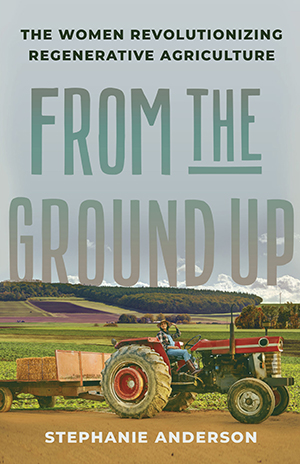
From the Ground Up: The Women Revolutionizing Regenerative Agriculture
Stephanie Anderson
256 pages, The New Press, 2024
I started writing From the Ground Up: The Women Revolutionizing Regenerative Agriculture during the COVID-19 pandemic. Like you, I watched the food system struggle mightily—and in many cases fail—to adapt to changing conditions. I knew a little more than the average person about the food and agriculture sector; I grew up on my parents’ conventional cattle and wheat operation in western South Dakota and have written about agriculture, rural life, and the environment for more than a decade. Still, I felt confused and even frightened by what we witnessed. Are these scenes we can change, I wondered, or will this collapse repeat itself when the next disruption strikes?
Something unexpected happened as I set out to answer that question: Over and over, I found women leading the way, and in many different capacities. They were using regenerative rather than conventional agriculture on their farms. Conducting vital research on soil health and nutrition. Pushing climate-friendly farm policies and helping Big Food labels transition to regeneratively sourced ingredients. Putting sustainability at the center of food distribution. Helping capital flow to the right places to scale up regenerative production. Prioritizing ecosystem, community, and human health as much as bottom-line health.
Regenerative agriculture, very briefly, means applying nature’s processes—diversity and ecosystem inter-dependency being key ones—to food production. In practice, that often means avoiding chemical inputs, minimizing tillage, utilizing cover crops, returning cropland to grassland, not relying on monoculture cropping or heavy animal confinement, and increasing crop and livestock diversity per acre. These practices improve ecosystem health, especially soil health, which helps build resilience to changing conditions. Regenerative is scalable and economically viable, often generating more income per acre compared to conventional production.
One of the women pushing this revolution forward is Susan Jaster, farm outreach worker with Lincoln University Cooperative Extension in Missouri. Susan partners with farmers in many ways, but her primary work is helping them be responsible stewards of their soil, water, and animals. She also conducts research on regenerative practices. On one visit to Missouri, I talked with Susan and four other women farmers using a Sustainable Agriculture Research and Education grant to analyze the relationship between grazing, wild forb and insect biodiversity, and soil health.
The research of these women—and their very presence as female farmers in the heavily industrialized Corn Belt—offered a gateway for exploring the patriarchal roots of modern agriculture and how women are challenging norms. More crucially, their story shows how women are helping build the resilient food system we so desperately need in a changing climate.—Stephanie Anderson
* * *
Kelly recalls a parasite problem she faced when she first put livestock on her land. Because the ecosystem was so out of whack from decades of industrial farming, parasite numbers jumped high enough to kill animals. A nosy neighbor commented to Kelly’s mother that he couldn’t understand why Kelly and her husband were trying to run animals there. Couldn’t they see the land was dead and needed agrochemicals to fix it? That’s the wrong mentality, Kelly says. “Now I get to regenerate it and figure out how to utilize it,” she says. “Susan saw it from when it started and through this grant and where we’ve been in changing it, and it’s a huge difference. My loss of animals due to parasites has pretty much been nothing this year. This property isn’t dead; it just needed some healing and it needed some time.”
The nosy neighbor happened to be a man, and his response to regenerative practices is typical not just in rural Missouri, but in much of America’s farm country. The women are quick to say that regenerative is never anti-male, nor is it woman-only (a sentiment I and other women featured in this book would heartily agree with). But they also acknowledge the pushback from male peers: derogatory comments, accusations of being crazy, dismissals of their work as “not real farming.” I’ve heard that before, and so has Susan. Women and men alike who use regenerative organic practices often receive skepticism and even outright scorn.
Conservatives have branded regenerative agriculture as a liberal agenda, a model farmers ought to reject as antibusiness and anti-progress, a threat to their existence. Some farmers shun regenerative agriculture because it is associated with addressing climate change, which many don’t believe in or see as a liberal lie meant to push them out of agriculture. And while I trust this percentage of farmers is small, some do not think long-term and instead adopt a “take all you can, while you can” attitude toward our shared soil resource. Transitioning to regenerative agriculture also involves a stated or unstated admission that industrial agriculture isn’t the best option for producing food in a changing climate—and we all know how hard it is to admit we’re wrong, whether to others or just to ourselves.
What most farmers do accept is the corn-and-beans mentality, a shorthand reference to grain production relying on tillage or chemical no-till, fertilizers, GMO seeds, cash crop rotations without covers, and other industrial strategies. Why the corn-and-beans mentality reigns is no secret: Big Ag propaganda combined with government programs incentivizing large-scale commodity production convinced farmers they’ll go broke without conventional inputs, a tight focus on yields, and specialization. As rural anthropologist Jane W. Gibson and her colleague Benjamin J. Gray describe it, “Farmers have been ideologically colonized by the values of industrial agriculture.”
The corn-and-beans mentality is one reason many Midwest farmers react to regenerative practices like the nosy neighbor. Another is the simple fact that Susan, Dawn, Cathy, Kelly, and Sariah are women, and sexist attitudes linger about a woman’s place in agriculture. Researchers have documented the social and institutional biases against female operators, especially as related to conservation. Sometimes these biases arise from the perception that the tasks women engage in do not constitute farming. Growing up in rural western South Dakota, I watched women like my mother work on farms and ranches. These women labored just as hard as their husbands. They put in a full day moving cattle or stacking bales, and then made dinner and cleaned the house. They served as accountant, gardener, cook, errand runner, and barnyard livestock tender. They handled basically everything related to the kids. Although their work held the operation together, the dismissive term for these women was “farm wife.”
In the white Western agricultural tradition, women have long done farmwork, but men typically claimed the title of farmer or rancher because men did most of the “real” physical work. To this day in many conventional agriculture circles, women are usually understood as helpers or hobby farmers, not as farmers or agriculture leaders in their own right. “Women have been invisible in this space for a long time, but they’ve been very much a part of the ag world,” Roesch-McNally says. “I still laugh when I talk to women who are like, ‘Oh, I’m not the farmer, that’s my husband, but I’ve been doing the farm books.’ In any other business if you did all of the accounting and finances, you would consider yourself a critical component of the business. But in agriculture, it’s different.”
The kind of thinking Roesch-McNally describes goes all the way back to the invention of the plow. For thousands of years and across the globe, writes Mark Bittman in Animal, Vegetable, Junk: A History of Food, from Sustainable to Suicidal, women were the primary agriculturalists: planting, seed saving, domesticating animals, developing tools, and determining how to use the land. Men and women divided labor, but “these divisions were not defined by dominance and subservience ... it seems likely that roles shifted toward patriarchy as the plow and other heavier equipment that required significant brawn were introduced to farming.” In other words, when farming became more about physical than intellectual work, it also became more male.
Patriarchal institutions went on to support this development in America. From colonization forward, farms typically belonged to men both on paper and in the minds of their peers. Land often passed from father to son and bypassed daughters. Partly to blame is the rural idyll myth, which casts rural life as romantic and centers the heterosexual white couple and their children as natural farmers. “Under this vision, (white) men are the farmers, and their (white) wives are their helpmates. When the time comes, the farmer’s son inherits the land, and their daughter either disappears from the imagination or is expected to marry a (male) farmer or rancher if she wants to stay in agriculture,” write scholars Ryanne Pilgeram, Katherine Dentzman, and Paul Lewin. They go on to argue that “part of the work of rewriting women into agriculture is about dismantling this fiction and yet recognizing that it creates real and persistent barriers for anyone who exists somehow outside of the rural idyll trope.”
The rural idyll is not only a sexist and racist fiction, but also an inaccurate depiction of the economic reality on most farms. Countless female farmers work full- or part-time nonfarm jobs to keep family finances afloat and secure health insurance. They squeeze farm work into whatever time is left. Many of my farm friends’ moms lived this kind of life back in South Dakota. Willingly or unwillingly, these women traded on-farm hours for steady paychecks that covered seed, fuel, and livestock feed, often because farming conventionally as their husbands were determined to do is financially tenuous. They ended up in a double-bind: the women’s off-farm work further robbed them of the title of farmer or rancher, but they could not fully dedicate themselves to their careers (and thus earn complete legitimacy in the workplace) because they shared their energy with the farm. Some women bore the burden of the rural idyll more than others over the years. Widely documented systemic racism often pushed farmers of color, particularly Black farmers, out of agriculture or prevented them from entering altogether. Unmarried or queer female producers were rare, and those who were on the land often faced discrimination and out- right hostility.
These combined social norms—the “farm wife” label, the unseen labor, the rejection for embracing sustainability or otherwise not fitting the white, heterosexual mold—remain largely unchanged in industrial agriculture, a sector still controlled overwhelmingly by white men. That they dominate the agribusiness world should be no surprise. After all, white men implemented settler colonialism rooted in slavery and the removal of Indigenous tribes, then built the postcolonial American agricultural system that became modern conventional production. They adapted European philosophies of dominion and extraction to the landscape, then applied American industrial and capitalistic practices—economies of scale, mechanization, standardization, genetic engineering, chemical solutions. For most of this country’s history, men controlled federal and state agriculture programs and policies, universities and private labs devoted to agricultural science, countless businesses related to food, and land itself and decision-making power over it. The result: industrial agriculture and the infrastructure to support it stretching from coast to coast.
Agriculture in this industrial form came to be about size, another distinctly male obsession. Bigger acreages, machines, yields, and herds. Bigger loans to finance these must-haves. Agriculture also harnessed the familiar patriarchal concept of control: of weeds, insects, and soil through chemicals, of farmworkers through low wages and deportation threats, of larger producers over smaller ones through buyouts, of uncontrollable weather and markets through industrialization. Capitalism drove the entire transformation—the profit seeking, the exploitation, the zero-sum competition between farmers and their environments and between one another as producers.
Farms started to look more like factories. Industrial agriculture features “production practices that ... tend to emulate modern factories: industrial farmers specialize in the commodities they sell; they operate in a highly competitive, global market; they rely on sophisticated machine, chemical, and genetic technologies; and they pursue efficiency and profit, necessitated by a global capitalist system.” Industrial thinking is how we ended up with livestock finished in concentrated animal feeding operations, extreme land consolidation, hollowed-out rural communities, agrochemical dependence, and widespread ecological devastation on and near agricultural lands.
Breaking the conventional, capital-driven mindset—seeing through its lies and envisioning something holistic, ecological, nutritious, inclusive, and socially just instead—is perhaps the largest barrier to building a regenerative food system. But over and over, people within the movement tell me women are uniquely talented at removing the Big Ag blinders. Growing female participation in regenerative agriculture might just create the tipping point needed to pull back the curtain on conventional agriculture and remake the system. “I look at women to be the saving grace on this, because women are more likely to carry out and continue conservation practices, whereas the men tend to look at the dollar signs,” Susan tells me in an earlier conversation. “The women are looking at, how’s that going to be next year if we do it this year? I think that’s why I see getting more women involved will actually change the scope and progression of regenerative ag.”