


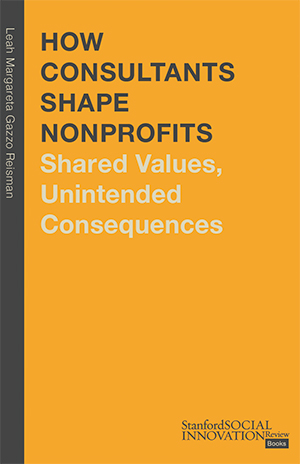
How Consultants Shape Nonprofits: Shared Values, Unintended Consequences
Leah Reisman
264 pages, Stanford Business Books, 2024
In moments of crisis, question, and opportunity, many nonprofits and philanthropic foundations turn to consultants. These strategic advisors come in many shapes and sizes, from large, multinational firms derived from corporate consulting firms—like The Bridgespan Group, for example—to small firms and sole proprietor consultants. They provide a wide variety of services to nonprofit and philanthropic clients, from strategic planning to program evaluation, fundraising support, and board development, among others. However, despite their ubiquity in the nonprofit sector, little is known about the content or process of consultants’ day-to-day work with nonprofits, or the impact of their work on the sector. The work of small consulting firms is especially unknown, given that larger firms dominate public perception and imagination when it comes to consulting in the nonprofit sector.
My new book, How Consultants Shape Nonprofits: Shared Values, Unintended Consequences unpacks the work of strategy consultants to nonprofits, to help both consultants and the nonprofits and foundations that hire them work more productively together. Based on 14 months of ethnographic fieldwork and 180 interviews with consultants, funders, and client nonprofits, the book both illuminates the work of consultants, especially those in small firms, and reveals the potential impacts—and consequences—of their work in the sector. While many in the academic and professional worlds believe that consultants import ideas from the business world into nonprofits, I show that this often is not the case. Instead, driven by their own commitments to social impact, many consultants significantly customize their frameworks and processes to align with their clients’ particularities. While this customization helps nonprofits better implement consultant recommendations, it also tends to cause profit problems for firms, who end up providing more work than they are compensated to perform.
However, despite these good-faith efforts, consultants also replicate and re-embed problematic status-quo practices into their clients’ plans. As they work to build stakeholder buy-in to their clients’ ideas, consultants consistently prioritize the opinions of those with power over nonprofits—namely funders, donors, executives, and powerful partners—over the voices of lower-level staff and communities. In doing so, they replicate entrenched power hierarchies between funders, nonprofits, and communities into their clients’ plans for the future. Consultants also often conflate best practices with common practices in their efforts to compare their clients to similar peer organizations, which reinforces status-quo approaches to social purpose work.
To better understand—and figure out what to do with—the opportunities and risks posed by consultant partners, it’s essential to examine both the history of consultant involvement in the nonprofit sector, and the dynamics of the day-to-day work that brings consultants and nonprofits together. The following excerpt from How Consultants Shape Nonprofits outlines both the context and the stakes of consultant involvement in the nonprofit sector, setting up the larger argument of the book.—Leah Reisman
* * *
Before digging into the world of consultants to nonprofits, it is important to understand a few more basic questions—what is consulting in general, where did it come from, and what is already known about consultants’ work and impact in the corporate, public, and nonprofit sectors? In 1969, the Association of Consulting Management Engineers defined management consulting as the professional service performed by specially trained and experienced persons in helping managers identify and solve managerial and operating problems.... This professional service focuses on improving the managerial, operating, and economic performance of... institutions. (Kipping and Clark 2012, 1–2)
Management consultants are independent individuals and firms that are hired by organizations to carry out and facilitate management-related projects and services and deliver reports and recommendations, generally on a fee-for-service basis.
Some scholars trace the emergence of management consulting to Taylorism and the scientific management movement of the early 1900s, which focused on workflow efficiency gains (Ruef 2002, 76). Others argue that early engineering and accountancy firms were the most direct precursors of modern management consulting (McKenna 2006, 13). According to historian Christopher McKenna, these consultants offered small corporations economies of knowledge—consultants gave corporations fast and cheap access to organizational innovations corporations could not pursue on their own. As business schools grew, the management consulting field differentiated from its roots in accounting and engineering (Ruef 2002, 77). These schools produced ever-increasing numbers of generally trained managers, and gave the field legitimacy through university affiliation (David 2012).
Management consulting arrived in the nonprofit sector in the 1950s (McKenna 2006). As Christopher McKenna describes in his 2006 history of management consulting, at that time the prominent firm Cresap, McCormick and Paget, recognizing the nonprofit sector as an unexploited client base, began marketing its services to large nonprofit organizations such as universities. Consulting likewise spread from the private to the public sector in the 1980s via the rise of “new managerialism,” a paradigm that assumed that the same techniques ought to apply to the public and private sectors (Saint-Martin 2000). Under the assumption that external intervention was necessary, public officials turned to for-profit management consulting firms to help public agencies improve their processes and outcomes; these firms’ expertise in the for-profit world brought them credibility in the public sector (Saint-Martin 2000).
Legislation accelerated management consulting industry growth by opening new topics and types of organizations with which consulting firms could engage, growth that continued as corporations downsized and theories of corporate management began to spread across the corporate sector (partially via consulting firms) (David 2012, 81-83). The concurrent expansion of the business press raised awareness of the consulting industry and generated cycles in management fads and styles, which in turn created demand for consulting services. Over time, consulting activity in the nonprofit sector also expanded with the corporatization of areas of nonprofit practice, particularly health care.
What We Know About Consultants
Out of this trajectory and in the context of the rising importance of the service sector to Western economies, scholars and researchers turned their focus to consultants, driven by a shared curiosity—what are consulting firms, and should consulting be considered a profession? Consulting is knowledge work—that is, “companies where most work can be said to be of an intellectual nature and where well-educated, qualified employees form the major part of the workforce” (Alvesson 2000, 1101). While some consultants charge hefty fees for their services, the substance and quality of their work is often unclear and difficult to evaluate. Scholars agree that management consulting does not rest on a basis of traditional professionalism, in that consultants’ expertise does not stem from the possession of a particular credential (Saint-Martin 2000) and is instead often derived from reputation. Historically, consulting firms have been considered either con artists, selling companies substance-less solutions at outrageous prices, or bringers of positive organizational change (Gunter, Hall, and Mills 2015); correspondingly, other researchers writing on consulting have argued that executives often hire consultants either to generate legitimacy for managerial decisions or to facilitate organizational change (Sahlin-Andersson and Engwall 2002).
Zooming out, at a more general level organizational sociologists have argued that consultants facilitate the diffusion of ideas, organizational structures, and practices across groups of organizations that do similar work, promoting homogeneity in organizational structures—a phenomenon known as structural isomorphism (DiMaggio and Powell 1983). Applying this work to the case of corporate consultants, sociologists have argued that consultants help transmit and apply business ideas and fads—for example, the Total Quality Management fad in the 1980s—to organizations. Other researchers have since suggested that consultants’ roles in organizational fields are in fact more complex than serving as carriers of external ideas and managerial fads into organizations (Sturdy, Handley et al. 2009), but simultaneously lamented that “we still do not have a good understanding of what consultants and clients do... especially what they do jointly” (Sturdy, Clark et al. 2009), or whose perspectives are privileged in consulting processes (Sturdy, Handley et al. 2009).
Consultants and Corporations
Given the visibility of consultants in the field, nearly all scholarly work on consulting examines large, often multinational, management consulting firms that primarily consult for corporations. In addition to Christopher McKenna’s seminal history of management consulting in the twentieth century, there is a robust literature of largely peer-reviewed articles in this area, including work on consultants’ contributions to cycles of management fads (for example, Strang, David, and Akhlaghpour 2014), the negotiation of client relationships and other consulting practices (for example, Sturdy 1997), the social production of consulting knowledge (for example, Hargadon and Bechky 2005), and consulting as contingent work (Barley and Kunda 2004). The handful of studies that consider consulting for government similarly focus on firms that specialize on corporations and on the tight link between business schools and prominent consulting firms (for example, Saint-Martin 2000).
Despite this ample evidence base about the work of consultants to corporations, little is known about consulting firms that focus on nonprofit organizations. What then, can be learned from studies of corporate consulting? Beyond framing consultants as carriers of management knowledge, these studies (1) identify and dissect consultants’ contributions to corporations—as providing managerial solutions or legitimacy for client firms and managers, as managing uncertainty for clients and simultaneously creating additional uncertainty through their work; (2) point to the client-consultant interaction as a key analytical site in understanding consulting (Alvesson 1995) and highlight the centrality of impression management and interpersonal work in consulting (Bloomfield and Best 1992; Sturdy 1997); (3) underscore that consultant-produced insights are socially produced; and (4) identify salient organizational practices, for example the “leverage” staffing model in which senior managers delegate the majority of client engagements to lower-level staff, who follow prescribed models to complete tasks (Meriläinen et al. 2004), and illuminate common difficulties encountered in professional service work.
The dearth of insight about consultants who work for nonprofit organizations appears to stem from an erroneous assumption that baseline consulting practices, sensibilities, and goals are uniform across sectors. This assumption perhaps stems from management consulting’s strong association with global processes of rationalization and neoliberalism (Faust 2012; Hwang and Powell 2009). However, the assumption that management consulting practices and goals are consistent across sectors is incongruous with the growth in number, in the United States, of consulting firms devoted exclusively to nonprofit organizations led by individuals whose expertise comes not only from business schools, but often from careers in the nonprofit and public sectors. In a preliminary analysis, Chapman (1998) suggested that consultants to nonprofits engage in more facilitation work and rely more heavily on consensus-building skills than do corporate consultants, given the mission-oriented nature of nonprofit work, and that nonprofit consultants conduct more general-management-focused projects than corporate consultants.
Building on existing insights about corporate consulting, this book delves directly into the world of consultants to nonprofits to map the relationships between consultants’ work, the recommendations they produce for nonprofits, and the sector at large.
Consultants and Nonprofits
In recent years, professionals and scholars have observed that nonprofit organizations have more and more begun to resemble their for-profit counterparts—put otherwise, nonprofits are “becoming businesslike” (Maier, Meyer, and Steinbereithner 2016). “Becoming businesslike” involves the adoption by nonprofit organizations of the rhetoric, core organizational structures and processes, and goals of for-profit corporations, resulting in an increasing reliance on corporate management ideas as the source of best practices for managing nonprofits (70-71). There exist a variety of contributors to this phenomenon—factors internal to the field, including field characteristics, board makeup, and grantmakers, and external factors, including global managerial-rational ideologies, political reforms, economic conditions, and actors such as consultants, who carry business ideas into nonprofits (73).
Scholars often call this process “nonprofit rationalization.” In a 2009 study, Hokyu Hwang and Walter Powell argued that rationalization, which they defined as the formalization of nonprofit organizations as actors with clear identities, discrete rules, and staff acting in professional roles (272), stems from the increasing activity of a new kind of managerial professional in nonprofits—those with specific training in or knowledge of administration and management, beyond or instead of substantive expertise in the content of organizations’ work. These managerial professionals share common norms and training, facilitating the spread of organizational standards and consistent methods for nonprofit practice. They influence nonprofits through work as internal managers or “external proselytizers who urge the diffusion of business tools”—often funders or consultants.
Hwang and Powell point to consulting firms as key actors in the diffusion of corporate-inflected management ideas into nonprofits. As they put it,
Consultants have become highly active in the nonprofit sector, facilitating the spread of projects such as program assessment, public relations, fundraising, and earned-income efforts. Established consultancies... have set up nonprofit branches or institutes, and nonprofit consultancies and intermediaries have also grown rapidly.... Though consultants may be involved with different tasks, their use reflects a widespread effort to improve productivity and render nonprofit activities more methodical. These varied practices and efforts contribute to both an image and a mind-set. (272)
In addition to identifying consulting firms as important facilitators of the professionalization of nonprofits, Hwang and Powell also proposed more fundamental effects of this shift on the nonprofit sector: “As these formerly expressive settings become more calculable and instrumental, broader expectations about what practices are appropriate and modern are reshaped” (293). Hwang and Powell argued that consultants contribute to the expansion of managerialism in nonprofits, leading to consistent, profound, and wide-ranging changes in the nonprofit sector.
These shifts have given rise to pressing challenges for nonprofit organizations, and have added energy to thorny perennial questions. As nonprofits adopt—or try or are pushed to adopt—some of the practices of for-profit organizations, they are increasingly subject to comparison to their for-profit counterparts in terms of efficiency and effectiveness (Salamon 2015). In this environment, typical or status quo practices in the nonprofit sector are often criticized by funders, intermediaries, policymakers, and public figures as insufficient and in need of reform. Given the complexity and labor intensiveness inherent in evaluating the impact of nonprofits’ work relative to for-profit organizations (since proving social impact is much more complex than is measuring financial return on investment), nonprofits often fall short in comparison to for-profits, leading to redoubled efforts to measure impact and assess effectiveness. In the context of economic instability and increased attention to nonprofit effectiveness (and efficiency), the unsustainability of long-standing funding models for nonprofit work come into sharp relief. The hierarchical reliance of many nonprofits on philanthropy to fill gaps in shoestring budgets challenges nonprofit leaders and those who help them to carve a path toward predictability in a highly unpredictable, short-term, and unstable funding landscape. And along with debates about money come corresponding challenges related to how that money gets used—the degree to which nonprofits are accountable to and representative of the communities they serve, and who makes decisions regarding organizational priorities (Salamon 2015).
In their engagements with nonprofit clients, consultants naturally grapple with these challenges, as they attempt to solve their clients’ problems and support them in strategizing about their work. Take for example the musings of Kennard Wing, a Philadelphia-based consultant, in an essay offering seven “issues” facing the field of nonprofit capacity builders. Wing (2004) asked, How can an abstract concept [capacity building] be concretely measured?... How can we measure performance improvement when we cannot measure performance?... Against whose goals should we measure improvement?... What can be done about unrealistic timetables for both capacity building and its evaluation?... How can we document how soft people relate to hard systems?... Should we measure participants’ behavior change or clients’ internal learning?
Despite their ubiquity in the nonprofit sector, there exists little research on small and medium-sized consulting firms like Wing’s. These smaller firms make up the bulk of practitioners in the field and, due to price and availability, are often the most accessible option for nonprofits seeking support. Understanding these small firms and their work and impact—on nonprofits and in the larger debates facing them—is therefore critical to building a comprehensive picture of the nonprofit sector today.