


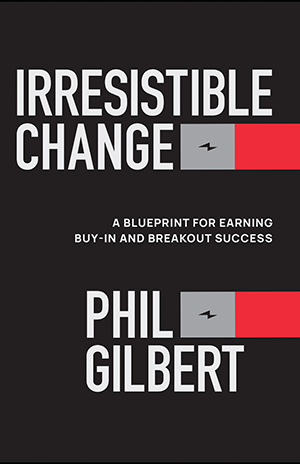
Irresistible Change: A Blueprint for Earning Buy-In and Breakout Success
Phil Gilbert
224 pages, Wiley, 2025
The pandemic didn’t change human nature—it just changed the burden of proof. Where once employees had to justify working from home, now leaders have to justify why anyone should come to the office at all. And “because I said so” isn’t cutting it.
At IBM, when we set out to reimagine how 400,000 people worked, we learned something simple but profound: People don’t come to offices for proximity—they come for purpose. They come for connection, for creativity, for that sense of belonging to something bigger than themselves. If they’re not finding those things, no mandate or policy is going to fix it.
What’s often missing in the RTO debate is the recognition that collaboration takes different forms. Some of it—what I call transactional collaboration—can be done beautifully through video calls and AI tools. But the real value of place lies in everything else: The mentoring, the energy, the spontaneous moments that build trust and culture.
At IBM, we designed spaces that created what one of our designers called intentional serendipity. The goal wasn’t efficiency—it was engagement. We built places that made people want to be there, because they offered something you couldn’t get through a screen: authentic human connection.
That’s what this excerpt from Irresistible Change: A Blueprint for Earning Buy-In and Breakout Success explores. It’s not about enforcing attendance—it’s about designing physical and virtual environments that deliver personal value for your employees. If you want people in the office, build a place they choose to come to, not one they’re forced to.—Phil Gilbert
* * *
The pandemic of 2020 changed everything about how we think about office work, but it didn’t change human nature. People still crave connection, still want to feel part of something bigger than themselves. What changed was the burden of proof. Where once employees had to justify working from home, now leaders must justify why anyone should come to the office at all. And “because I said so” isn’t cutting it.
Today’s leaders mandating return-to-office (RTO) policies are solving the wrong problem. They’re focusing on attendance rather than engagement. If your people don’t want to be in your space, that’s not their failure—it’s yours. The spaces you’ve created aren’t compelling enough. Full stop.
I get so frustrated by management claims that mandated office time fosters “better collaboration” when most cross-functional teams are distributed across multiple locations. If meeting face-to-face is required for better collaboration, then why is it okay for teams to be distributed? It doesn’t make sense. In studying post-pandemic work, I’ve started to think about collaboration differently.
The work we do with our teammates to get a job done is what I now call transactional collaboration. And let’s be honest, most of this can be done extremely effectively via the video-conferencing and artificial intelligence (AI) tools that emerged from the pandemic, maybe even more effectively than the alternative. Leaders who are using the “better collaboration” argument for these situations are largely mistaken (or, perhaps, disingenuous).
The value of places is everything else.
At IBM, instead of focusing solely, or even mostly, on this transactional collaboration, we focused on other aspects of our culture that needed help: creativity, connection, morale, mentorship, accountability. Or in other words, active engagement for the betterment of someone’s personal career, their work community, and their connection to IBM’s mission. To do this, we built spaces that stimulated interaction via experiences that couldn’t be accessed digitally. We intentionally made the physical place something that people wanted to be at.
We also made choices that guaranteed a certain level of what one designer liked to call intentional serendipity. The spaces were designed to force interactions. When you exited the elevator bank, for example, we closed off what had been direct access to the kitchen area. We wanted people to be forced to walk the long way around, through the studio, where they would encounter people and work artifacts from other teams, many of whom they’d never met before. That was one of the simpler choices we made in floorplan design, where the other way would have been more efficient but less supportive of our cultural aims.
Authentic work culture transcends purely transactional spaces. This became clear when one Thursday I was approached by two of our new graphic designers who told me that a local print shop was selling off their old equipment and asked if we could buy it. The next Monday I came in and was shocked at the sight of a giant screen-printing press set up with a 10-foot stretch of wire drying racks! As it happened, that press drew in people from all over the campus who wanted to see it and try it. From all across the Austin campus engineers, finance folks, marketers, IBMers with no connection to the design studio other than being in Austin were now in the space, attending one of the Thursday night poster-making classes and soaking up the new atmosphere. Most who’d never known what screen printing entailed found that it was fun and satisfying to make something by dragging a squeegee through a slab of ink and over the screen. In the spirit of maker culture, the rule sprang up that you could get a lesson on the press if you promised to teach the next person how to do it.
Another designer had the idea to start a radio station. Some front-end developers using open-source frameworks built the station—IBM Community Radio!—with very little trouble. People in the studio could sign up and schedule half-hour blocks to play their favorite music. And, like almost every good idea, it exploded… globally. Expanding way beyond just music, there were call-in shows, podcast-type interview shows with design leaders, discussions about design and emerging technologies.
The station was accessible to everyone behind the IBM firewall, and it wasn’t long before IBMers in other time zones were requesting slots for their programming. In November 2016, Fast Company magazine published a story, “IBM’s Unlikely Silo Buster: An Intranet Radio Station.” Miroslav Azis, one of the designers on our transformation team told the magazine, “This has really flattened the organizational structure. You meet people in other organization silos.”
These and other activities in the studio that were not directly productive and outcome-oriented were nonetheless fundamental to our making change irresistible at IBM. They demonstrated the transformational impact of play and creativity on the culture. They were instruments of change, not mere by-products of it. They weren’t passively “cool”—they were cool only because they actively engaged people, which signaled change and our new interdisciplinary way of working.
But places are more than the physical offices. Place, in my mind, certainly includes physical space but it’s shorthand for something more like “the environment within which you work.”
With all my emphasis on the physical components of our studios, it’s easy to miss that much of the work at IBM is done via distributed teams, sometimes from all over the world. One challenge of workplace design is remembering that modes of remote work are aspects of place, and the customs of remote work should offer the same level of engagement for the people and the practices as any physical space. We found we needed to be more intentional about virtual settings that were required to serve the teams in delivering outcomes.
It was another case where we learned by watching employees using the tools for remote connection, and not always the tools we anticipated. Someone had bought a number of old, discarded IV stands from a medical supply place and then devised a little sling for each one so that an iPad could hang on the stands.
With that simple tool, our team members could do Facetime calls with teammates in other cities and adjust the height according to whether they were standing or sitting. We found that some would maintain that connection all day, just to have company and avoid the bother of calling or texting. Two people would be working as though they were side by side, and checking in with each other occasionally, showing each other a graphic or chart on the iPad and then going back to work. We’d never seen anything quite like it before.
And here’s the thing about hybrid work that many miss: it’s not about splitting time between home and office. It’s about creating environments—both physical and virtual—that make work better. Our security team working with special ops? They were almost never all in the same room. But when they were in our space, we made sure it supercharged their distributed collaboration. The IV stands with iPads weren’t just cute hacks—they were deliberate tools to make remote teammates feel physically present.
The mandate shouldn’t be “Employees: return to office.” The mandate should be “Employers: create spaces so magnetic that people choose to come in.” And when they do come in, the space needs to actively support their hybrid reality—great videoconferencing, quiet areas for virtual meetings, and technology that makes remote teammates feel present. Ironically, in today’s world, if your physical office doesn’t make virtual work better, you haven’t built the right office.
Excerpted with permission from the publisher, Wiley, from Irresistible Change: A Blueprint for Earning Buy-In and Breakout Success by Phil Gilbert. Copyright © 2025 by John Wiley & Sons, Inc. All rights reserved. This book is available wherever books and eBooks are sold.