


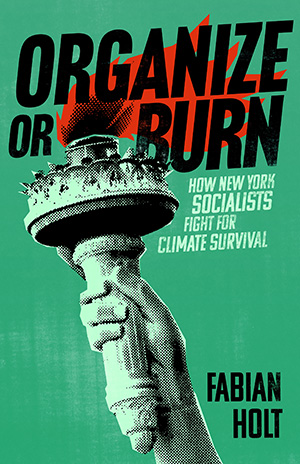
Organize or Burn: How New York Socialists Fight for Climate Survival
Fabian Holt
312 pages, NYU Press Publication, 2025
To the climate movement, which emerged in the 2010s in response to decades of accelerating climate change, a skepticism of political institutions, combined with a sense of urgency and desperation, has created a narrow focus on protest and direct action. The movement’s skepticism about institutional politics is amplified by the more general crisis of democracy, which also at least partially explains its decline as a mass movement.
In this context, democratic socialist movements have emerged and created new opportunities for climate politics. For one thing, these movements have challenged apolitical understandings of climate change by highlighting the fossil fuel industry’s outsized influence and the externalization of environmental costs of economic growth. But the organizational outlook of these new movements is no less notable, combining movement and party politics to become “movement parties,” a particular type of hybrid political organization that tends to grow when established parties struggle to sustain linkages with the public. Particularly relevant to the climate movement, movement parties create more long-term organizational capacity than movements.
This distinct movement party approach explains how a small organization such as the Democratic Socialists of America (DSA) could take on a leading role in developing and winning transformative climate legislation in New York State. The excerpt below from my Organize or Burn: How New York Socialists Fight for Climate Survival shows how the organization’s climate working group, the Ecosocialist Working Group, worked strategically with movement and electoral politics over a seven-year period and won the nation’s first Green New Deal legislation, the New York State Build Public Renewables Act. The ESWG became a vibrant organizational environment of its own and a central force in NYC-DSA, eventually taking over the organization’s electoral operations in 2022 and expanding the perspective from the city to the state level. It also helped make climate the number one priority for members in the organization.—Fabian Holt
* * *
The Ecosocialist Working Group (ESWG) was a distinct environment in NYC-DSA from the outset in 2017. Geographically, the group was attached to Lower Manhattan and not as exclusively concentrated in Brooklyn as other parts of the organization have been. Meetings were held in places such as the LGBT Center in the West Village, and several active members lived in Lower Manhattan. The ESWG became a small and focused space, somewhat removed from the more mass-public spaces in NYC-DSA and the conversations between political factions. The first leaders of the group were instrumental in bringing in talented and diverse people and creating this focused space. Over time, the group developed into a semiprofessional entity.
ESWG members mostly did not have expertise in the climate area, and few were experienced organizers. The group tapped into resources of its broader urban and media environment. It took inspiration from Naomi Klein’s This Changes Everything and Jane McAlevey’s writings, and the authors interacted with the group, especially Klein, who lived in New York from 2018 to 2021 and came to see the ESWG as the frontier of a new ecosocialist movement.
One of the group’s leaders, Gustavo Gordillo, describes its organizational development and strategy as follows:
Gordillo: We put a lot of importance on democratizing strategy within the group and developing a deep bench of leaders. We had lots of strategy retreats, sessions, and conferences, both in New York City and also nationally later.
Author: What were some of the decisions on strategy resulting from this work?
Gordillo: We knew that a lot of the tactics that nonprofits were using would not really work. Many other organizations, many nonprofits, have this understanding that when you work in coalitions, you’re supposed to defer to some other authority. We rejected that. We thought that it was more important for us to develop our own strategy and our own demands. That was how we developed our own direction.
A few experienced climate professionals played a key role in developing the group’s political project and a coalition beyond the socialist movement. Shay O’Reilly and Patrick Robbins had worked in the climate field for years and joined the ESWG shortly after its founding. Shay and Patrick helped steer the ESWG toward the energy sector, proposed an idea for a climate bill with exemplary potential, and managed the relationship with key institutional actors in the political process. Why did Shay and Patrick participate in the ESWG?
Robbins: I joined DSA in 2017 after being a part of the movement against fossil fuel infrastructure for a good part of my life, and I had worked professionally for climate-oriented nonprofits. This was the first time I’d seen such a surge of people concerned about the climate crisis with an anticapitalist analysis and a socialist analysis. There were plenty of groups around the country that had an anticapitalist analysis but didn’t necessarily have a strategy that reflected it. There was not a fully fleshed-out plan, but there was an orientation to strategy that I appreciated.
Shay has a different social background but similarly joined the ESWG because it was a new and powerful alternative to existing climate organizations.
O’Reilly: I developed a relationship with environmentalism when I was doing economic justice work. I got involved with an anti-pipeline direct-action campaign and then got a job at the Sierra Club, which is this very institutional NGO. The fall of 2016 was an incredibly apocalyptic time, and my NGO world was supporting private companies in getting offshore wind contracts in New York State. I was like, “Wait a minute, we’re going to build these offshore wind projects in ten years, and in the meantime, we’re going to miss the window for keeping warming within 1.5 Celsius? We need to do everything that we can to not miss that window. That’s why the ESWG was so exciting to Patrick and me. We felt that the ESWG and not the local Sierra Club was going to propose action on the scale that was needed commensurate with the crisis.
From the beginning, there was this understanding that only thing that really matters is if you have the votes and are making a credible threat every time you say to people with power that you’re going to remove them from power unless they do what you want them to do.
The Bill and the Coalition: A Turning Point (ESWG, 2019–2021)
Shay helped develop the idea of expanding the New York Power Authority to build and operate renewable energy. The idea became the group’s main priority. The group began developing the broader concept of public power, with the goal of taking the energy sector out of the hands of fossil capitalism and putting it under more democratic control and redefining it as a public good. The group adopted the name Public Power for its vision of creating long-term organizational capacity for the socialist movement in the climate crisis. The end goal is not just the individual bill or electoral victory. The New York State Build Public Renewables Act (BPRA) is the first legislative project within this campaign. The bill was workshopped around with existing climate justice groups, which had national sway. Patrick and Shay had worked with these groups in their previous work. They also helped develop a formal coalition and distinct project organization named Public Power NY in November 2019. The coalition includes twenty environmental community and advocacy organizations, chief among them the New York Energy Democracy Alliance of community organizations and policy experts. The ESWG needed partners across the state to win BPRA.
The ESWG began to work strategically with changes in the national political environment. It framed BPRA as a path to reaching the goals of the state’s Climate Leadership and Community Protection Act (CLCPA) of July 2019, which set goals for the state’s greenhouse gas reductions. Supportive legislators argued over and over that BPRA was necessary to reach the goals of the CLCPA. The Inflation Reduction Act of 2022 became important, because it provided federal funding for the project.
The Electoralization of “Public Power” (ESWG, 2021–2023)
The first attempt to pass BPRA in 2021 was derailed by the Chair of the Energy Committee, Kevin Parker, also known as “the Joe Manchin of New York.” The ESWG felt betrayed and responded by blocking the street outside the government’s offices in Manhattan. The protestors held big poster boards with Venmo pages showing how much money powerful politicians in state government had received from fossil fuel corporations. The pressure campaign intensified further when the bill was derailed a second time in 2022. Thousands of activists campaigned in the months leading up to the budget negotiations, and more than fifty thousand phone calls were made each week encouraging citizens to ask their representatives to support BPRA.
To further escalate pressure, the ESWG decided in 2021 to “electoralize” Public Power into six electoral campaigns, one of which primaried Kevin Parker. The electoralization evolved from the frustration with the 2021 legislative session and from a campaign in Queens the year before, when Zohran Mamdani had won a seat in the state assembly on a BPRA platform. Mamdani joined protests to close a peaker plant in Astoria owned by the corporation NRG Energy, adopting the “Public Power” narrative in his platform: “No Astoria NRG peaker plant. Build public renewables instead!”
The growing number of DSA-backed electeds further motivated the electoralization. In 2020, NYC-DSA went from one to six electeds in state government; in 2022, eight. They worked tirelessly to pass the bill, especially Mamdani and Sarahana Shrestha, sometimes “texting ten o’clock at night to figure out how to get this bill through the budget with all the language and tact that [they] needed.” This relationship with a growing number of electeds made the electoralization more meaningful. The success of a movement party culture depends on such close relationships across movement and institutional contexts. Patrick remembers,
We have a relationship of mutual support where you’re not thinking about the elected officials as some separate entity but working with them as comrades. Having elected officials who could help us understand who to approach and the order in which to approach different politicians was enormously important—who they respond to, what kind of messaging they respond to, and keeping that drum beat up. The electeds did a very good job of supporting the BPRA. There was real dedication on their part. That changed the attitude that a lot of people in the climate movement took towards the ESWG and DSA as a whole. I had people that I’ve worked with in my professional capacity coming to me and being like, “Well, do you think DSA will support this? Do you think the DSA electeds will support this?
The electoralization thus involved the translation of “Public Power” into the institutional contexts of local districts and state government. This process was supported by the project’s translation into institutional genres of communication. In particular, the rationale for BPRA was promoted by the 2021 report A New Era of Public Power by the leftist climate think tank Climate + Community Project’s 2021, coauthored by three ESWG members. The Public Power campaign transformed in the process. The perspective expanded beyond the urban movement world. Julianne Feaver of the ESWG’s design team explains how this change was articulated visually:
We came up with the “Green New York” design system. We wanted to communicate our positive Ecosocialist vision of the future, incorporating windmills, solar panels, greenery everywhere, and public transit. We also wanted a New York attitude that encapsulated the entire state and wasn’t just focused on New York City. One of the main designs has an image of a beautiful Hudson Valley landscape that has trees and hills and rivers with windmills, and then it flows into a New York City skyline with the Statue of Liberty in the forefront. We use the Statue of Liberty to convey a sense of hope for a better future.
The success of the Public Power campaign was made possible by the critical mass of talented activists, some of whom had professional experience in the climate field, and by the hybrid movement party organization that provided the political independence to propose ambitious policy and the electoral organization and institutional platform in state government to build power beyond an urban movement world.
The goal of building long-term movement capacity in the climate crisis has turned out to be more challenging. The electoralization of “Public Power” helped NYC-DSA secure a political victory, but the organizational capacity that had been developed since 2017 was drastically punctured after the elections in 2022. The ESWG temporarily transformed itself into an electoral organization, channeling most of its resources into developing and running electoral campaigns, and this exhausted the group’s resources. It did not help that four of the campaigns lost and that the COVID-19 pandemic had raged for two years. The ESWG was almost completely exhausted by the time BRPA passed in 2023, and NYC-DSA membership hit a low point at around two thousand. Incidentally, membership now stands at eleven thousand, and Mamdani’s mayoral campaign involves 85,000 volunteers.
At a moment of low point, such as the exhaustion in 2023, some may be tempted to declare the failure of NYC-DSA and movement party organizations more generally. The constructive approach to movement leadership offers a different evaluation. It focuses on constantly evaluating successes and failures to make small but significant changes in alignment with fundamental goals, as opposed to writing off valuable lessons and small successes, not to mention the principle of combining movement and party politics, which is fundamental to building bridges between grassroots democracy and political institutions. Impatient anarchist thinking about political organization can be fatally disruptive in the current crisis.