


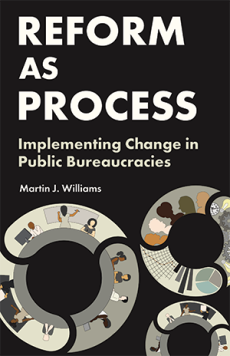
Reform as Process: Implementing Change in Public Bureaucracies
Martin J. Williams
400 pages, Columbia University Press, 2026
When governments try to strengthen bureaucratic performance, reform pushes too often lead to new policies being adopted on paper but having little impact in practice. Ideas that seem promising in theory get watered down and experienced by rank-and-file civil servants as tick-box exercises, and huge amounts of political capital, time, and money can get spent with little sustained impact to show for it.
In Reform as Process: Implementing Change in Public Bureaucracies, I explore why public service reform initiatives so often fall short of their goals—while sometimes still having positive impacts—as well as how leaders can approach reform in ways that maximize their chance of achieving sustainable improvements. A key theme is that reform failures—not only in government, but also in NGOs and even private firms—often stem from approaching reform as a one-off project to change formal rules and structures. But these types of projectized reforms rarely lead to sustainable improvements in employee behaviors and organizational culture. This is particularly so in complex contexts where effective performance requires not just rigid compliance to standard operating procedures, but all the un-formalizable work of adaptation, coordination, and innovation (that can’t be captured in a set of KPIs or an annual performance appraisal).
Successful reforms are usually those that create an ongoing process of continuous improvement within the organization. Rather than formulating a perfect vision and then trying to elicit compliance from others, effective reform leadership looks like catalyzing: finding ways to help individuals and teams solve their own problems and lead change in a decentralized fashion. Reform as Process lays out some simple rules of thumb for how reformers can achieve this in practice, which this excerpt (drawn from chapters 1 and 8 of the book) touches on. Elsewhere in the book, I also discuss how the activities of external partners (such as funders and advocacy organizations) can inadvertently exacerbate the tendency to projectize reforms, and what they can do to support and sustain internally driven change efforts.—Martin J. Williams
* * *
Congratulations! You’ve just been appointed an advisor to the Head of the Civil Service. Your job is to recommend how to improve the effectiveness of dozens of government ministries and departments. These organizations in turn are responsible for delivering public services, developing policies, building infrastructure, implementing regulations, and nearly everything else the economy and society depend on. But your civil service is widely perceived—by civil servants, politicians, and ordinary people alike—as ineffective, even dysfunctional. Budgets are tight, and there are major political and legal constraints on your ability to hire or fire personnel. How would you advise the Head of Civil Service to go about designing and implementing reforms to improve the performance of the civil service?
This question represents one of the most pressing practical problems facing governments around the world. But it also poses an intellectual challenge of the first order. Ultimately, civil service reforms aim to change the day-to-day behavior and routines of the huge number of people that collectively make its decisions, enforce its rules, and deliver its services. But government is not a machine with simple levers that produce predictable responses when pulled. It is a complex system of interdependent organizations and teams inhabited by a diverse range of people, each with their own interests, preferences, experiences, and biases. The wrecks of failed reforms that litter the junkyard of public administration history can testify to the difficulty of transforming bureaucracies. What can we learn from this history of reform efforts about the prospects for systemic reform to improve the inner workings of government?
This book aims to answer these questions by documenting and analyzing how six countries in Africa have repeatedly sought to reform their civil services over the past three decades. These countries have been global hotbeds of experimentation in public administration reform, collectively undertaking over one hundred performance-oriented reforms during this period. The types of problems they have sought to solve and the solutions they’ve attempted to adopt and implement will be familiar to reformers around the world. These reforms have been driven at times by public servants and other times by donors or politicians, or often combinations of two or three of these. And they have been influenced by global trends as well as homegrown ideas. So public managers and researchers from around the world have much to learn from the history and patterns of reform in these six countries.
To do this, I use a rich range of primary data and secondary literature to document the content, process, implementation, outcomes, and politics of each of these reform efforts. I then use this comprehensive portrait of reform efforts to identify repeated patterns in design, implementation, and outcomes that recur across many reforms, across all six countries, and across time. Of course, every reform effort and context is unique to some extent, and when we look at each reform in isolation there are many potential explanations for why events unfolded as they did. But if we don’t look historically and comparatively across efforts and across contexts, we risk missing the forest for the trees. Beyond these particularities and idiosyncrasies, are there repeated patterns we can identify and learn from?
I argue that there were two features that characterized the vast majority of large-scale reform efforts, and that helped explain the persistently disappointing results of these reforms. First, most reforms focused mainly on changing formal structures, rules, and processes. This took different forms across different reforms, but the common thread was an emphasis on creating formal processes that would compel or incentivize bureaucrats to behave differently. Second, reforms were typically conceived of and executed as discrete, one-off, often time-bound interventions. This meant that reforms often ended up as projects with their own pre-defined workplans, acronyms, timetables, budget lines, and implementation teams. In other cases they took the form of new laws or structures on paper that in practice were implemented halfheartedly (if at all), or that had purchase for a year or two before fading away. Together, these constituted reforms’ two main mechanisms of failure. I demonstrate how and why this approach was largely ineffective at changing the complex system of organizations, rules, and perceptions that constitute government bureaucracy, and undermined the potential of reforms to change the way that bureaucrats think about and carry out their work on an everyday basis.
At the same time, the history of reforms is much more than a story of failure—most reforms did achieve something, even if they fell short of their lofty goals. While reforms tended to make more changes on paper than in practice, some reforms did have positive and meaningful impacts on actual day-to-day work practices of civil servants. When they did so, it was usually through two linked mechanisms of success: creating opportunities for civil servants to discuss performance and how to improve it, and building energy and momentum to do so. These mechanisms of success worked not because they forced unwilling bureaucrats to improve their performance, but because they helped create an environment where bureaucrats who wanted their teams and organizations to work better were able to find ways to make this happen. Though these mechanisms of success often coexisted with mechanisms of failure within the same reform effort, they usually took a back-seat role in the dominant reform approach.
If this is the diagnosis the explains the track record of past efforts at reform, what is the prescription for how future reformers should approach their work differently? What can we learn from this history to help us better advise a Head of Civil Service or other prospective reform leader how they should go about improving performance across a whole bureaucratic system?
I argue that instead of treating reform as a one-off change to formal processes, reformers should approach it as catalyzing an ongoing process of continuous improvement in actual practices.
This alternative approach reframes the goal of reform as the improvement of day-to-day bureaucratic behaviors, both in terms of adherence to formal processes as well as the undertaking of the many tasks that are important for performance but can’t be fully codified on paper. It reconceptualizes how to implement reform, as a process of collective learning-by-doing that must be open-ended in order to get people to make these behavior changes. And it casts the task of reform leadership in a different light, as a matter of enabling and supporting decentralized change at numerous points throughout the bureaucratic system rather than of trying to legislate it or force it from above. This approach of reform as process aims to minimize the mechanisms of failure and maximize the mechanisms of success that have characterized past reform efforts, and serve as a viable alternative for the many reformers and researchers who are seeking a different—and hopefully better—way to make change in public bureaucracies.
The key insights of this approach can be captured in three simple rules of thumb for reformers:
- Focus first on what can be done within existing formal rules and processes, so that changing formal rules and processes is a last resort rather than a first step. Prioritize improving the implementation of existing processes that are useful but under-utilized, and on getting people to undertake helpful informal practices that are possible within existing rules. Alternatively, if certain processes are being implemented too rigidly, find ways to relax or re-interpret their application. Working within existing formal structures minimizes the time delay and procedural obstacles to getting workers to change their behavior. Build up towards changing formal processes, rather than starting with it.
- Approach change as a process of collective learning-by-doing, rather than as rolling out a pre-designed blueprint. The priority should not be to make the perfect plan up front but rather to start changing actual practices—even small or apparently minor ones—as early as possible. This makes it possible to simultaneously and iteratively build up credibility around reform efforts while also defining their content in a participatory fashion. This allows work teams to take ownership of the changes, build better relationships with each other, and focus on what would be most useful in their specific contexts. Removing the “design phase” also lowers the barriers to starting the change process, and treats reform and improvement as part of core operations rather than an add-on.
- Decentralize the leadership of reform as much as possible. The role of the leader is to catalyze dispersed improvement across the system rather than to drive it. This not only aids in broadening ownership and buy-in to changes, but also reduces the risk that leadership turnover (which always occurs, sooner or later) will undo everything the reform has achieved. Decentralizing reform helps to create new tiers of future reform leaders who can sustain progress in future, and shifts the institutional culture from one of compliance to one of improvement and innovation. Leaders have a range of tools for achieving this, including creating opportunities for discussing performance and how to improve it, creating energy and momentum for change, providing information to teams, helping solve problems that are beyond each team’s remit, and empowering lower- and mid-ranking workers and managers to initiate improvement efforts.
Excerpted from Reform as Process: Implementing Change in Public Bureaucracies by Martin J. Williams. Copyright (c) 2026 Martin J. Williams. Used by arrangement with the Publisher. All rights reserved.