


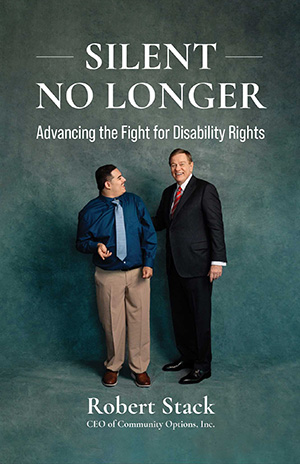
Silent No Longer: Advancing the Fight for Disability Rights
Robert Stack
272 pages, Matt Holt Books, 2025
For decades, people with developmental disabilities have been segregated, institutionalized, and stripped of dignity and human rights. Although strides have been made, thousands remain confined within these government-sanctioned purgatories. Now, we are confronted with a new, more capitalistic approach to exploitation, and in Silent No Longer: Advancing The Fight for Disability Rights, I expose a new and deeply troubling threat: the insidious encroachment of private equity into disability services.
These firms, driven not by mission but by margin, are quietly acquiring disability providers across the country. They cloak their takeovers in the language of efficiency and innovation, but behind closed doors, corners are cut, staff are underpaid, and care is compromised. Their only concern is to deliver returns to investors.
As someone who has spent over 40 years fighting for independence and dignity for people with disabilities, I contextualize the private equity takeover, offer an alternate way forward, and call policy makers to action. Human lives cannot be commodified. The disability community deserves more than passive concern. My book incites readers to make an unflinching commitment to justice.—Robert Stack
* * *
In the United States in 2020, there were more than 8 million people with an intellectual or developmental disability.
My entire career has focused on supporting people with intellectual and developmental disabilities, so I am often asked: “What is your definition of disability?” In simple terms, it is a trait that limits a person’s cognition or independent functioning. Examples include people with intellectual disabilities, such as Down syndrome or autism, and others who have exclusively developmental disabilities, such as cerebral palsy or spina bifida.
Another term that I use a lot in this book deserves clarification: institution. A wider definition refers to just about any religious, educational, or social organization, including prisons, for instance. In the book, I use what we call the burrito definition—if you are unable or not permitted to leave the house at three in the morning to go buy a burrito, chances are you are either a child or living in an institution. In my world, institutions are where people’s dignity of choice and freedom go to die.
Sometime ago, I visited a large institution in Corpus Christi to interview a resident with the goal of placing her into one of our small family homes. The Corpus Christi State Supported Living Center is a hundred-acre campus housing two hundred people. Once on the grounds, I lost my bearings and couldn’t find the building to rendezvous with my contact person. I saw a man weeding a flower bed and asked for directions. He stood up from his work, removed his cap and muddy gardening gloves, smiled, and said, “Follow this path until you come to a fork and then bear right. Walk down there for about a quarter of a mile, and the building should be adjacent to an enormous pecan tree on your right.”
I thanked him and asked, “How long have you worked here?” He replied, “Oh, I don’t. I live here.”
We talked for a few minutes longer, and as I walked away, I thought, I could get that guy a job tomorrow, and he could live in his own apartment with minimal assistance.
This is an example of a forgotten soul warehoused in an institution, living like a minimum-security felon for no reason other than he has a disability. His life was being stolen by an archaic system. We should never force individuals who have never committed a crime against society to live in an institution. It’s that simple.
Silent No Longer brings attention to how the United States has consistently failed, and continues to fail, people with developmental disabilities. I highlight the dangers your family, friends, and loved ones face from shameful relics of failed public policy, misinformed government leaders, outdated institutions, and archaic thinking—and how a modern, but dangerous, trend sees private equity firms purchasing organizations that currently support people with disabilities. This is an attempt to monetize these individuals, and the result is profits for private equity lenders and, in my experience, compromised care. I have yet to meet anyone other than the principals of these corporations who believe private equity involvement in the care of people with disabilities is a positive step.
I outline a new way forward, one that is better for people with disabilities, their loved ones, and taxpayers. My goal is to change perceptions while giving people with disabilities a voice and a platform to prevent them from becoming lost in a broken system.
It has been my privilege to work with people with disabilities for more than forty years. My mission has been and continues to be the rescue of as many people as possible from the dangers of being institutionally warehoused. In these facilities, people are mistreated, segregated, and divorced from society. My work proves that people, even those with significant disabilities, can thrive in the community, living in apartments and single-family homes where they receive the level of care they need for up to twenty-four hours a day, seven days a week. My nonprofit organization, Community Options, currently supports over five thousand people across the country, providing care for people with disabilities in hundreds of small group homes and within their own homes. Since 1989, we have helped over ten thousand people. Our philosophy is that all people, including those with the most profound disabilities, should enjoy basic rights such as inclusion, self-determination, dignity, and access to opportunities for growth.
In the last five decades, landmark legislation has changed the landscape for people with disabilities. The Civil Rights Act of 1964 prohibited discrimination based on gender, ethnicity, color, and religion—but did not include a word about people with disabilities. Nine years later, the Rehabilitation Act of 1973 enshrined in law that people with disabilities would be treated equally regarding employment opportunities in federally funded organizations and programs, including vocational training. In 1990, President George H. W. Bush signed the Americans with Disabilities Act (ADA) into law to ensure that people with disabilities had the same entitlements and opportunities as anyone else. Federal court action, which precedes legislation, has also improved the rights of people with disabilities. In 1999, the US Supreme Court’s Olmstead decision “found the unjustified segregation of people with disabilities is a form of unlawful discrimination under the Americans with Disabilities Act (ADA).” The intent was that people with disabilities should be placed, and receive services, in the most integrated setting best suited to their needs.
However, no matter how many guardrails have been codified into law, the rights of people with disabilities, and particularly those with profound disabilities, remain compromised. Let’s revisit Arron from our opening story. An institution shipped this young man across the country shackled by his hands and feet like a mass murderer. The question I continually ask, and to which I have yet to receive a satisfactory answer, is why are institutions still warehousing seventeen thousand people with intellectual and developmental disabilities? Why are some of these horror houses continuing to use cattle prods, aversion therapy, restraints, and corporal punishment, including electric shock treatment?
You may know or know of someone with an intellectual and developmental disability. Maybe your son, daughter, nephew, or niece has autism, Down syndrome, ADHD, cerebral palsy, or some other disability. If so, then you know it does not have to define them. One has to look no further than the famous physicist, Stephen Hawking, who had ALS (also known as Lou Gehrig’s disease). Despite experiencing this neurodegenerative disease, Hawking discovered that black holes release detectable radiation, enabling in-depth research into these celestial phenomena. In 2021, Elon Musk announced on national television that he has Asperger’s syndrome, a form of autism spectrum disorder.
Every person has potential, including those with significant disabilities. Whether they reach it depends on the level of support they need and receive. We, as a community, need to recognize the value in humanity, all humanity. We need to be patient and tolerant enough to search for every human being’s potential and bring it forth.
In my experience, a large percentage of those who have been written off as unsuitable for transitioning into the community, even those who have been regularly restrained in an institution, are prime candidates for not only living in a small group home but also employment and educational opportunities. That may sound like hyperbole, but there are astounding individual success stories throughout this book. Arron, for instance, after just a few months of acclimating to his new home with our professional staff, started visiting a local grocery store with a support staff person to select his favorite foods and snacks. Although practically nonverbal, he waves to the clerks he recognizes and to neighbors who live nearby. They know him not as Hannibal Lecter but as that sweet young man at number 622.
Recent history has proved that systems that favor the isolation and neglect of people with disabilities don’t work. They are not sustainable, they are not humane, and they are not cost effective. In these pages, I prove beyond doubt that people with disabilities belong in the community. With the appropriate level of support, they can thrive in our neighborhoods, walking our streets, shopping in local stores, learning in our schools, working in local businesses, and interacting with members of the wider community. Every day, in towns and cities across the United States, my staff change attitudes and perceptions, one neighbor and one community at a time.
As I mentioned earlier, there are more than 8 million people with intellectual and developmental disabilities in the United States. More than 70 percent are under the age of twenty-one. A significant percentage have received an autism diagnosis. Most of these individuals are fortunate enough to live with their families or in small group homes. Unfortunately, some remain warehoused in institutions.
Surveys show that more than 87 percent of couples who have children with disabilities wind up in a divorce. All too often, this leaves their child in limbo. Some family caregivers become ill or disabled themselves; others simply lack the resources to care for their children. And what happens when a child reaches their twenties, thirties, or forties and their aging parents can no longer manage their care? If they have the financial wherewithal, they may hire private caregivers. If not, they place their loved one on a state waiting list for placement into care.
Unfortunately, waiting lists for community-based programs are long. KFF (formerly the Henry J. Kaiser Family Foundation) and state entities say that the average wait list is forty-five months. However, this is a shell game because states remove people from waiting lists once they receive a single hour of service. For example, according to KFF, New Jersey has no waiting list. The trouble with that assertion is that if you add back those people waiting for 24/7 care in housing placements, the number is not zero—it’s closer to four thousand. Another issue with KFF is that its data becomes corrupted when states don’t participate in its surveys. There is often a wide discrepancy between the services people need to live independently and the paltry stopgap measures the state provides to avoid scrutiny and appease wait-list watchdogs.
So, what’s the answer? There needs to be more residential care provided by nonprofit organizations, such as Community Options, that are licensed by individual states to provide services to people with intellectual and developmental disabilities.
As large state-run institutions close, the Case for Inclusion report shows that around 590,000 people are on waiting lists for home- and community-based services. Interestingly, seventy-eight percent live in just five states (Texas, Ohio, Louisiana, Florida, and Illinois). One of the challenges noted is staffing. Nationally, a little over twelve percent of full-time DSP positions were unfilled at the end of 2020, an increase of forty-five percent year-over-year. The cause? DSPs are undervalued and underpaid. This needs to be rectified, and soon.
Society has exploited people with disabilities for hundreds of years. The question was and, in large institutions remains, what do we do with people with disabilities during the day?
In the 1960s and 1970s, devious entrepreneurs working in this field realized residents could create income. For example, the institutionalized can be “employed” growing fruit, vegetables, and flowers for sale in on-site greenhouses. Remember the stereotypical image of disabled individuals weaving baskets? Small occupational training centers—also known as sheltered workshops or, as I think of them, sweatshops—were created so that hundreds of people with disabilities could sit at tables doing piecework for nonprofit agencies like Easterseals, supervised by institutional staff. Ten million widgets packed by hand? No problem. Frighteningly, they still exist. A 2022 ProPublica report investigated workshops in Missouri that employ over five thousand people with intellectual, developmental, or physical disabilities and pay them less than $1 per hour. Although disability rights activists have called these workshops discriminatory and exploitive, they are legal.
With patience, tolerance, and open minds, we can uncover each person’s potential. Frighteningly, there are those in our society who believe the world would be a better place if people with disabilities did not exist or, at the very least, they were hidden away behind closed doors—out of sight, out of mind. This attitude is not new. The United States has been failing people with disabilities for a long time. I hope I can do my small part to reverse this trend.