


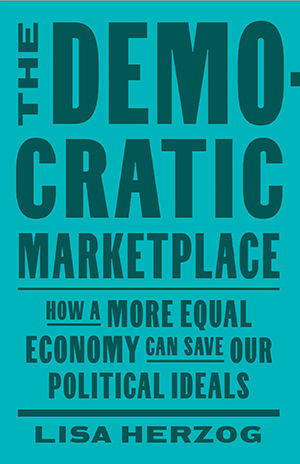
The Democratic Marketplace: How a More Equal Economy Can Save Our Political Ideals
Lisa Herzog
248 pages, Harvard University Press, 2025
My new book, The Democratic Marketplace: How a More Equal Economy Can Save Our Political Ideals, suggests a new paradigm for the economy: economic democracy, the idea of bringing democratic principles—especially the equal moral worth of all members of society—directly to the economic system. This provides new criteria for how to design markets, how to organize companies, and how to regulate work time. It suggests a move away from a blind trust in economic growth and, instead, returns to the old question about the functions of the economy, thereby also integrating environmental concerns.
Such proposals—and especially those that are meant to reduce economic inequality—are often met with suspicion: They are seen as potentially illiberal, and as thwarting innovation. In the excerpt below, I discuss egalitarian strategies and respond to such charges, arguing that a more egalitarian society would likely be freer and friendlier to innovation. This is not only because with more equality of opportunity, more talent can be discovered among children currently too disadvantaged to become innovators. It is also because people would have stronger safety nets, which would reduce fear of failure and thus encourage innovation. And in a more egalitarian society, people from different backgrounds would be more likely to encounter each other, instead of being segregated by socio-economic barriers. This increased sense of lived freedom and the experience of a plurality of perspectives in everyday life are like to make people more open to innovation and change than the status rat races of highly inegalitarian societies.—Lisa Herzog
* * *
What should democratic societies do? There is no shortage of proposals for inequality-reducing policies, apart from simply increasing taxes on high income and wealth (and closing tax loopholes). One policy that could be a powerful counterweight to the inequality of wealth is a combination of an inheritance tax and a capital grant for young people who do not inherit, for purposes such as financing an education, starting a business, or making a down payment for a mortgage. It could be designed differently depending on the specific needs of different societies, with variations in not only the amount of money but also the purposes for which it could be used. There is a tradeoff between individual freedom and paternalism here: on the one hand, giving people more leeway in what they want to do with the money sends a strong signal that they are seen as autonomous members of society. On the other hand, some restrictions on permissible uses might help sell the policy to the broader public, because it would reduce the fear of money going wasted. But in any case, such policies would work against the gulf that has opened up between those from monied families and those from other backgrounds, and that risks undermining democratic equality in the long term. In the context of the United States, where wealth is also extremely unequally distributed along racial lines, it would also be a way to contribute to racial justice and to help repair past injustices in access to wealth.
Another strategy is to withdraw more of the goods that matter most to people’s lives, especially education and health care, from market forces. If such goods are publicly provided, conditions can be made the same for everyone, and people of different backgrounds can interact and form social ties in these public institutions. Generally speaking, it is wise to use policies of predistribution instead of redistribution wherever possible, and set up the framework of markets and other institutions in ways that prevent the concentration of wealth in the first place. This can head off resentments of wealth being “taken away” from richer individuals. Philosophically speaking, of course, that is not a valid complaint since there is no reason to think that people have an automatic moral right to their pretax income. Still, it is a very real phenomenon, known to psychologists as the “endowment effect,” that people cling to what they think of as “theirs.” “Predistribution” can also mean that all new economic policies are evaluated not according to their potential for “economic growth” in an undifferentiated way, but in their effects on different income brackets.
Another element of egalitarian economic policies is a reliable and sufficiently generous safety net, which takes the character of social insurance as insurance seriously. Economic systems in which a certain degree of innovation and change happen bring risks for everyone: their jobs might become redundant because robots or algorithms get better at these tasks, or their region might enter an economic downturn because the goods that were produced there go out of fashion. And then, there are the many things that can simply happen, in all economic systems: illness, divorce, death, whatever life throws at you. Privileged individuals have many financial, social, and psychological support structures for such situations. For disadvantaged ones, such events can be the step into the abyss. Democratic societies have a duty of care toward their members, to make sure that they can get quick and unbureaucratic help in such situations. A job guarantee, as discussed earlier, could be an extremely valuable instrument in this context, but it needs to be supplemented by other instruments for those who cannot work or face additional challenges.
The greatest worry that many people have about such an egalitarian future is that it would lead to an economic system in which these elements are precisely missing: innovation and change. The concern is that without the chances to get rich, individuals would not take the risk to start a business, or would not even be motivated to work hard in existing jobs. The fear of economic failure, bad as it may be, is seen as having a positive effect after all, as the stick that accompanies the carrot of economic success. And, a critic might add, didn’t many of humanity’s greatest artists and inventors work under the most dire economic circumstances, in extreme insecurity, and yet create masterpieces? Wouldn’t a more egalitarian economic system lead to bleak, grey homogenization, without any space for those risk-takers and innovators to whom we owe so much?
If this picture were true, a trade-off might have to be made between equality and innovative power—and it would still not be clear whether the way in which societies currently make this tradeoff would be justifiable. What is the point of technological and artistic innovation by the few if the many live in poverty and insecurity? But this claim should be challenged at a more fundamental level: it is not true that innovators can be motivated by riches alone, let alone that fear and insecurity are the best drivers of innovation (of the socially useful kind, that is). A more egalitarian society would be more, not less friendly, to innovation; it would give more individuals access to the conditions under which they can develop their creative and intellectual talents. We have no idea how many Einsteins, Curies, and Kahlos humanity has lost because their scientific or artistic curiosity was nipped in the bud during childhood. We also do not know how many more fantastic entrepreneurs might start socially useful businesses if more young people had a chance to even consider this. What we do know is that the founders of startups come predominantly from rich backgrounds, providing them with safety nets. Also, it seems highly unlikely that financial considerations are the main driver of exceptional intellectual, artistic, or organizational work—such work requires focusing all energies on the task itself, and thinking about possible financial benefits is a mere distraction.
When it comes to egalitarian economic policies, it is important not to be misled by outdated economic theories that are based on overly narrow accounts of human motivation, or that leave out important dimensions of economic reality. Take minimum wage legislation: it was, for a long time, rejected by economists with the argument that it would reduce the number of jobs available to poor people and thereby ultimately harm them. But empirical research found that its introduction did not have this effect. In 2021, the Nobel memorial prize in economics went to a group of economists who used empirical methods—so-called natural experiments—rather than theoretical models for understanding the economy. One of them was David Card, who had in the 1990s studied the introduction of minimum-wage legislation and had been chastised, together with his coauthors, for allegedly deviating from economic common sense.
Of course, this does not mean that there could never be unintended consequences of badly designed policies. For example, if too many veto points are built into a system, innovation might indeed be stifled. Democratic systems, in which majority decisions play an important role, always need to watch out for the rights of individuals, especially of minorities—this is why the rule of law is so crucial as a counterweight to majoritarian decision-making. It probably would not be a good idea to require democratic committees to first approve of all proposals for new products or services. For economic innovation (of the kind that is really useful) to happen, there need to be spaces in which individuals, especially young ones, can experiment with new things. This also holds for other realms, especially arts and culture.
On the other hand, there are reasons to think that the members of a more egalitarian society might also be more open to innovation, and hence allow for a more dynamic economic and cultural life. After all, resistance to change often comes from fear. If individuals had more security—for example, if the specter of unemployment could be killed once and for all by a well-designed job guarantee—they might be more open to welcome change. What if one’s social status were no longer tied to one’s position in a financial rat race? If instead it were firmly grounded in egalitarian citizenship, then one might be more tolerant toward those who experiment with different economic or cultural models. Of course, a complete end should not be expected to the distrust, and even resentment, of those who try out radically different things. But that is not necessary. An egalitarian democracy is not a like-minded community in which all dissident opinions would be stifled. It is a society in which different communities, with different ways of life, can flourish, as long as they stay within the framework of shared democratic values.
How equal exactly should a democracy be, then? It is difficult to provide numbers in the abstract, because so much depends on the overall design of institutions. If institutions in areas such as education, health care, and pensions are publicly provided at a generous level, then somewhat higher inequality of income or wealth is tolerable. An interesting idea for funding such institutions is for an independent government fund to acquire shares in companies and to channel the income to public uses. As discussed in Chapter 2, the ownership in companies can also be spread out more evenly through employee-ownership-plans or by encouraging the transformation of companies into co-ops that are owned and run by employees. Different measures could be combined in different ways, depending on the economic traditions in different countries. Overall, the unequal distribution of wealth needs to be brought back from the current excess, the ratio of lowest to highest incomes to something more in the ballpark of 1:10 than 1:300.
Ultimately, a more egalitarian society would be a freer society. If economic inequality could be regulated, then many other regulations that currently try to keep money out of spheres where it does not belong would be less necessary. If certain social spheres, such as education, were organized fully as public institution, there would be no need for additional support for poorer families in this area. There could be more cross-pollination between ideas and practices of people working in different fields, whose paths hardly ever cross in today’s societies. And you really wouldn’t be able to tell, when meeting someone on the streets, whether they are rich or poor—because they all belong to a solid middle class.
Excerpted from THE DEMOCRATIC MARKETPLACE: HOW A MORE EQUAL ECONOMY CAN SAVE OUR POLITICAL IDEALS by Lisa Herzog, published by Harvard University Press.