


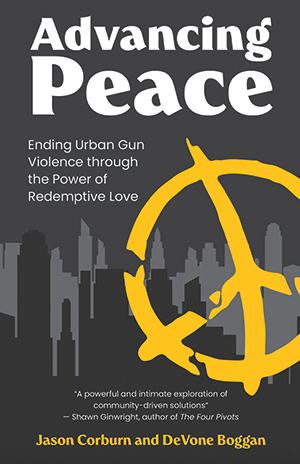
Advancing Peace: Ending Urban Gun Violence Through the Power of Redemptive Love
Jason Corburn & DeVone Boggan
264 pages, The MIT Press, 2026
In 2005, with eight dead from gun violence in just two weeks, the City Council of Richmond, California, considered declaring a state of emergency. Mayor Irma Anderson was among the many who balked, arguing for more lasting solutions: “A local declaration of emergency is used when you want to bring in the National Guard, impose curfews, and suspend constitutional rights and due-process procedures,” she said. “I do not believe that any of those actions would resolve the crisis we currently face.”
Even police brass admitted that the proposed approach could decimate already-tenuous trust within the city’s historically Black neighborhoods. While Richmond was never “redlined,” African Americans who made the great migration to work in Richmond’s World War II-era shipyards found themselves similarly hemmed into substandard housing, in neighborhoods starved of economic investment (while exposed to disproportionately high levels of industrial pollution). Relations with police had always been fraught: In the early 1980s, self-described white supremacist officers known as “The Cowboys” were revealed to have been killing unarmed Black men with the tacit approval of Richmond’s police chief.
Richmond’s councilmembers rejected the state of emergency. The following year, the city created the first government-led effort in the country to focus on reducing gun violence while explicitly disavowing law enforcement collaboration.
Wounded Healers
The Office of Neighborhood Safety would be led by DeVone Boggan, one of the authors of Advancing Peace: Ending Urban Gun Violence Through the Power of Redemptive Love. What has come to be known as community violence intervention (CVI) was then in the early stages of treating gun violence as a public health problem. When Boggan set out to learn from programs in Boston and Chicago, he discovered that they relied on law enforcement (as many still do today), using leverage from “call-ins”: Offenders on probation or parole who were believed to be gun violence “influencers” would be summoned and instructed to reduce the violence or suffer harsh consequences.
While clergy and other community leaders participated in such programs, Boggan’s background in trauma-informed care led him to believe that threats of carceral force, even if they might temporarily reduce shootings, were incompatible with healing. Transforming those responsible for gun violence into healers in their own right, he believed, required unconditional love, mutual respect, and high-touch mentoring.
Boggan began by hiring interns who were actively engaged in gun violence, a focus group, as he writes in Advancing Peace, that was “willing to tell me, and they often did, ‘that [shit] ain’t gonna work.’” Most of their peers felt trapped, they told him: “If they could find a way, an excuse, anything that protected their ‘name’ but allowed them to get out of the game,” he writes, “they would likely do it.” These interns also helped vet the program’s street outreach workers, Boggan’s “neighborhood change agents,” or NCAs—all formerly incarcerated men (and some women) from the same streets who through rigorous self-reflection and post-traumatic growth could signal a way forward for youth engaged in violence.
The program had limited success until Boggan made a breakthrough. After learning that nearly three-fourths of the previous year’s 45 homicides were attributed to just 17 people, Boggan in 2010 resolved to focus specifically on that core group of active shooters. The result was an intensive 18-24 month “Peacemaker Fellowship,” now at the heart of the Advance Peace model, that surrounds its participants—who are deemed to be both responsible for the greatest violence and empowered to broker the greatest peace—in love and support.
Boggan’s Advancing Peace coauthor, Jason Corburn, was an early ally of the controversial project, as a professor of public health and city and regional planning at UC Berkeley. Together they went a step beyond public health to public healing. Rejecting the notion that those at the center of gun violence are “diseased,” they aimed to make them and their communities whole by empowering them. The very act of staffing a city agency with “formerly incarcerated Black and Brown people from Richmond’s neighborhoods,” they write, “reoriented the face of local government”: Their presence on the city payroll empowered neighbors, family, and friends who had felt ignored by the city to participate and help shape policy.
Nearly two decades later, the program remains embedded in municipal government, and the results speak for themselves: There were just 8 gun homicides in 2023, down from a high of 47 in 2007, a trend that held even during the pandemic, when other urban centers saw gun violence spike.
The Absence of Violence Is Not the Presence of Peace
In 2016, Boggan spun the program off as a nonprofit called Advance Peace, with Corburn leading a learning and evaluation process aimed at national replication. As the model has been implemented in a dozen cities, all have seen dramatic decreases in gun violence. Sacramento, for example, experienced an 18 percent reduction in gun homicides and assaults over 18 months in the neighborhoods targeted by the Peacemaker Fellowship. (When the city declined to renew the Advance Peace contract in 2021, shootings increased.)
When a trauma-informed approach shifts the question from “What’s wrong with you?” to “What happened to you?” the answers go back generations.
The overarching purpose of Advance Peace isn’t to stop gun violence, or at least not per se, the authors note, but to “communicate to a population of mostly young men of color that has been forgotten, left to kill, die, or be incarcerated,” that they are seen, valued, and loved—that they are family. That approach leads to reduced gun violence, but it does so by transforming the lives of those at the center of it.
It is highly labor-intensive: NCAs act as a continuous presence on the streets and get face time with Fellows at least three times a day, bringing food, meeting family members, and sharing their life stories. Committed recruits work with mentors on goals in personal safety, education, employment, conflict resolution, parenting skills, and more. Fellows are assessed for trauma exposure, but also their positive traits: critical thinking, charisma, work ethic, marketable job skills, artistic talent. Drawing on cognitive behavioral therapy, the NCAs help mentees identify trauma triggers, develop new coping skills, and navigate social services, as well as facilitating job training, gatherings in elder circles, and participating in neighborhood beautification.
Doubling as violence interrupters, NCAs visit barbershops and other gathering spots daily, scroll social media for indications of brewing conflicts, and intervene when possible to prevent retaliation when necessary.
As described by Freddie, who now coaches other NCAs for Advance Peace:
Doing this job, keeping the peace, and mentoring young people to be and do better, it’s like Double Dutch. You got to know where to jump in and where to stay out. … You got to know the rhythms of those holding the rope; feel what they doing and their pace. ... When it looks easy, it’s like you dancing over that rope, but that takes practice and mastery.
As an “antiracist” strategy to ending gun violence, a trauma-informed approach shifts the question from “What’s wrong with you?” to “What happened to you?” The answers go back generations. Fellows gather collectively with NCAs to discuss redlining, racially restrictive housing covenants, and urban “renewal” projects that fractured neighborhoods, as well as the history of Black-led resistance and peacemaking.
Fellows who meet certain milestones in the program receive a monthly allowance, rewarding participation, demonstrating respect, and easing stressors in ways that data reveal to be well worth the cost. Group travel is another strategic reward, though Fellows must agree to travel with a street rival, which means once-sworn enemies attend conferences together, visit museums, and meet with politicians.
Where to Now?
One of the first Fellows to travel out of state with a crosstown rival—who went on to land an internship in Washington, DC and attend Florida A&M University—described his experience this way:
They walked with me, they held me, they caught me before I could fall too far, and you know, they still with me. As a father, I’m taking all of that love they showered on me and giving it to my kid now. I ain’t gonna let them fall too far, and if they do, I’m right there to pick ’em up, hug him and get ’em going again. That’s family. That’s what Advance Peace showed me.
The strength of Advancing Peace lies in the humanity of these personal testimonies from Fellows and NCAs, which underscore how accountability, self-worth, and healing can ripple through generations, the way trauma does. But the data is compelling, all on its own: Of 627 participants across the country, 95 percent were alive at the end of their 18-month fellowship, and nearly 98 percent had avoided arrest on new gun charges. A majority reported improved mental health, anger management skills, and sense of safety, and most crucially, nearly all said they had a trusted adult in their lives to talk to, whether daily or in times of crisis.
Corburn and Boggan end Advancing Peace with a caveat: “[G]overnment must be on board and have financial skin in the game.” Nonprofits can’t go it alone. Richmond’s experiment confirms this. Yet, in 2025, as the authors warn, “the future of federal funding for Community Violence Intervention (CVI) remains uncertain.”
That reality is already painfully clear: In April 2025, the federal government abruptly canceled grants to programs across the country, among them Advance Peace initiatives in Fresno, California, and Lansing, Michigan. Whether local and state governments will embrace a program rooted in radical love and anti-racism remains an open question. To carry this work forward, they must.