


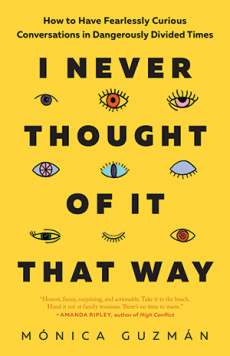
I Never Thought of It That Way: How to Have Fearlessly Curious Conversations in Dangerously Divided Times
Mónica Guzmán
288 pages, BenBella Books, 2022
“If there’s one thing that most people on the Left and Right can agree on,” journalist Mónica Guzmán asserts, “it’s that the way we treat and talk to the other side is broken.”
America’s ideological divide has become entrenched and reflected in our collective refusal to speak to one another. To even consider crossing the political aisle in the spirit of compromise and consensus is to risk public criticism. “Why are you still speaking to them?” friends repeatedly asked Guzmán about her Trump-supporting, Mexican-immigrant parents. Such rigid partisanship inspired her first book, I Never Thought of It That Way: How to Have Fearlessly Curious Conversations in Dangerously Divided Times, a guide to fostering productive conversations between ideologically opposed people.
Guzmán contends that we must use our “built-in curiosity,” rather than approach conversations antagonistically, if we truly want to understand our differences. Curiosity “keeps our minds open so they don’t shrink,” she explains. “Nothing busts through the walls we’ve built between us like a question so genuine and perceptive it cannot be denied.”
In I Never Thought of It That Way, Guzmán offers more than 30 practical tools and recommendations to implement in difficult conversations, culling her material from a dozen interviews and from personal stories, as well as from her work as the director of digital and storytelling at Braver Angels, a nonprofit launched as a citizens’ movement dedicated to depolarizing America. Using the analogy of climbing a mountain, she explains that each person needs a map—what she calls a “curiosity starter kit”—to know where to begin a difficult conversation. Each person must start with “minding the gap” in their knowledge by “turning assumptions into questions” and rejecting easy answers. To prevent the tendency of making assumptions, Guzmán encourages readers to take note of the “assumption assistants,” or the stereotypes and other forms of cognitive shorthand, that cause them to prejudge their interlocutors, rather than enter a conversation with an open mind.
If people find themselves caught in a contentious conversation, she recommends “the traction loop” as a process to steward conversations into a more positive direction. The steps in this process include listening for repetitive language if you find yourself stuck rehearsing the same points and boosting both your and your interlocutor’s curiosity by asking them about their thought method and how they arrived at their point of view. Prioritizing listening deeply to understand the other person’s values and perspectives can help lessen the risk of triggering their defensiveness or shutting the other person down entirely. If both interlocutors navigate these potential barriers successfully, they will both arrive at the top of the mountain, with a framework for listening attentively to each other based in respect and the potential for a new personal or professional connection.
Guzmán insists that we remember the humanity of people who we condemn to “the other side.” “Siloing goes too far when the stories we tell about each other are not only wrong but demeaning,” she writes, warning that “when we spend so much time in spaces that intensify our basest judgments … we believe the other side is not only wrong but inhuman.” As Guzmán discovered in her own interactions, once she stopped being afraid to ask questions, relinquished her defensive barriers, and committed to getting to know people on “the other side,” she realized that “everyone’s so goddamn interesting.”
A self-identified liberal, Guzmán acknowledges that nearly all forms of conservatism are labeled “toxic” by the Left and regards these characterizations as unproductive. “This kind of abject, cold dismissal,” she argues, “makes people hide who they really are” because “when we focus so much on the righteousness of our side, we stop thinking straight [and] lose the ability to truly consider what’s different.” More than that, such stereotyping functions as a barrier to establishing authentic connections with other people.
At Braver Angels, Guzmán’s role is to find creative solutions through storytelling and communication to heal the divisions that have dehumanized “the other side.” Braver Angels conducts workshops, debates, and other public events where people come together not to change each other’s minds but to better understand each other and find common ground. “Bridging conversations don’t pit arguments against each other so much as they look beyond the arguments to the paths people walk to arrive at their perspectives,” she writes of her work at the nonprofit.
Guzmán writes in a casual, accessible tone when sharing her interviews and personal stories to explain how the tools like tone-setting and how to craft and publish personal views on social media work in action. The most potent tools, she finds, are those that help people uncover the root of the conflict, which Guzmán identifies in a fundamental difference in values. For example, disagreement about COVID-19 federal mask mandates might be best understood as a difference in values—individualism versus collectivism—and this recognition could foster mutual feelings of respect, Guzmán intimates, rather than upholding dismissive attitudes, such as that mask mandates are intended to make people suffer.
Honesty does not mean weaponizing truth as a bludgeon but using it as a rudder to guide conversation away from shouting matches and toward connection.
Some of these tools include privileging listening over speaking, seeking to ascertain knowledge rather than fodder for scoring points, and sharing personal experiences and encouraging interlocutors to do the same in order to ground opinions in experience instead of hypotheticals. This last tool coincides with Guzmán’s recommendation to begin a conversation by locating your standpoint—e.g., “This is what I’m thinking right now”—to indicate open-mindedness, which can help others not become defensive. Our culture shames people for changing their mind while it demands conformity and consensus. When politicians change their perspective on an issue, for example, they are often chastised for “flip-flopping.” But changing our mind—or, put differently, having a growth mindset—should be celebrated if we are to collectively build a better world.
Guzmán advocates for honesty even amid disagreements. True honesty here does not mean weaponizing truth as a bludgeon but rather using it as a rudder to guide conversation away from shouting matches and toward connection. Such truthfulness is fundamental to building trust—a critical component of authentic, meaningful relationships that, research demonstrates, are essential for living longer, healthier lives. “If we’re not honest together,” Guzmán writes, “we’re not really together at all. We’re not connecting or building traction. We’re just in touch.”
However, speaking honestly can exacerbate antagonism, widening division. The difference depends on tone, word choice, and delivery. To ensure that truthfulness is effective, Guzmán suggests thinking out loud, showing humility through curiosity, and repairing disagreement with candor. Being curious also means asking CARE questions—those that are Curious, Answerable, Raw, and Exploring. “Curiosity is worthless without honesty,” Guzmán says. “If people hold back in conversation, release little, put on a mask, is anyone really learning?”
Still, honesty is a delicate practice, and Guzmán does not consider how the fear of being “canceled”—or public shame and professional retribution or punishment—can prevent people from speaking honestly. She also does not reflect upon how the rhetoric of honesty—for example, qualifying remarks like “I’m just being honest!”—often functions to excuse harmful behavior.
I Never Thought of It That Way gives readers the support they need to be more intentional in their conversations. Guzmán does not promise that the process or practice will be easy, only that it will be more fulfilling than jeopardizing your personal and professional relationships. She maintains that while we cannot change another person’s mind through argument, we can facilitate this change through conversation. Guzmán believes in the power of conversation to be a catalyst for change if we practice humility, curiosity, deep listening, and vulnerability with the tools she offers in her book.
For people working in philanthropy and the social sector, changing the ways we engage with “the other side” is essential to sustaining the efforts to bring healing, justice, and compassion to the communities we serve. Guzmán’s book can help people communicate effectively despite disagreement even as they work on shared goals, by giving them the tools to acknowledge and face conflicts instead of suppressing them, which, in turn, only causes them to fester and worsen.
But what happens if no bridge can be found? Guzmán’s optimism is refreshing, yet it also prevents her from addressing scenarios where bridge-building fails and division persists. For example, Sophia, a woman who was raised in a communist country but who now lives in Boston, tells Guzmán that she believes the best solution to America’s polarization is a “peaceful divorce” that would establish “a Conservative States of America and a Liberal States of America.” Sophia is among the majority who believe that polarization has become increasingly insurmountable. Are Guzmán’s tools enough to convince people otherwise?
Guzmán does not offer a response to Sophia’s comment, so readers are left uncertain about how to bridge such implacable positions. It’s also unclear whether she believes there is any occasion that warrants severing dialogue or a relationship, particularly when relationships are abusive. Further, Guzmán does not address the possibility that I Never Thought of It That Way might be interpreted as recommending that a person persist in such harmful relationships. Finally, Guzmán does not return to political questions about America’s polarization that catalyzes her project, consequently infusing her optimism with ambiguity.
Despite having no answers to these pressing questions, I Never Thought of It That Way has the potential to improve the way people with irreconcilable views talk with each other. Given the bubbles of our social and digital networks, which were compounded by the isolation of working from home during the COVID-19 pandemic, salvaging our methods of communication is urgent work.