


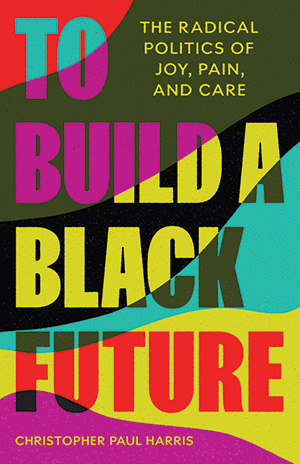
To Build a Black Future: The Radical Politics of Joy, Pain, and Care
Christopher Paul Harris
272 pages, Princeton University Press, 2023
Photos and videos of Black people killed by the police have become ubiquitous on social media in the past decade. This proliferation of Black pain on public display has led to a broader consideration about what it means to bear witness to anti-Black violence without losing the ability to imagine a future for Black people that is unmarked by brutality. How do we envision a joyful future amid centuries of violence?
In To Build a Black Future: The Radical Politics of Joy, Pain, and Care, scholar and activist Christopher Paul Harris argues that to create this kind of Black future, we must acknowledge “Black pain, champion Black joy, and practice a radically inclusive ethics of care.” For Harris, care is a “countercivilizational force, pushing us away from liberal and capitalist social relations.” It is, in other words, a way of regarding people not as units of labor or pawns in one’s personal advancement but as humans with dignity, and whose dignity deserves our respect.
At first glance, relying on pain, joy, and care to speculate about a Black future may seem abstract—and, arguably, unserious—to readers. However, the book’s strength lies in how it situates these components in specific cultural moments and Black traditions that pose a critique to capitalism and anti-Blackness. Harris profiles the work of influential activists and organizations across Black liberation movements to demonstrate how these three factors have taken shape in Black protest movements and have materialized most recently in the age of #BlackLivesMatter and primarily the Movement for Black Lives (M4BL), a large network of organizations, activists, and cultural workers—including Black Lives Matter—who are committed to abolishing all racist institutions and to an anti-capitalist approach to the liberation of Black people.
Harris is currently an assistant professor in global and international studies at the University of California, Irvine, and previously spent more than three years as a grassroots organizer of the advocacy group Black Youth Project 100 (BYP100). His experience as an organizer lays the groundwork for his theorization of “the politics of the wake,” what he calls “an emergent strategy marking the contours of the current conjuncture in Black political development” toward the abolition of all systems of oppression, from prisons to policing to tech-enabled state surveillance. A “politics of the wake” demands that people “knowingly inhabit the total climate of anti-Blackness and forge new ways of seeing and doing that inform and reconstitute our critical practices away from the historical trace of slavery and toward not just imagining but pursuing a world otherwise.” This demand consists of a deliberate effort to acknowledge and learn from the past to break free from it—not in the sense of erasing or forgetting how centuries of slavery and other forms of racism have informed the current moment of anti-Black violence but so that this past doesn’t foreclose a future of Black joy. And it is in this capacity that abolition figures centrally in Harris’ politics of Black liberation.
The incessant and pervasive culture of anti-Blackness is why expressions of Black joy are acts of rebellion.
Harris’ “new way” of telling the history of protest movements to devise the “politics of the wake” is rooted in the collective experience of centuries of Black protest. He invokes the Black radical tradition—a term he borrows from political scientist and Black studies professor Cedric Robinson, who in Black Marxism defined it as “the continuing development of a collective consciousness informed by the historical struggles for liberation and motivated by the shared sense of obligation to preserve the collective being [of all Black people].” The ongoing development of a collective consciousness is the essential idea underlying Harris’ premise of the politics of the wake, since it is this collective consciousness that threads together centuries of Black activism and protest. It also represents the shift in mindset that Harris discusses—of acknowledging and inhabiting a world saturated and structured by anti-Blackness in order to move beyond that systemic and cultural violence.
Harris also writes in conversation with and builds upon the work of other global Black scholars, thinkers, and cultural producers, such as Saidiya Hartman, Aimé Césaire, and Frantz Fanon, to demonstrate how today’s Black organizers are the latest iteration in a centuries-long tradition of global Black protest. Harris places M4BL inside the Black radical tradition to highlight two important tenets of protest movements: that Black protest is historically a collective endeavor that depends on knowledge production as integral to the process of Black survival. Harris thus depicts M4BL as the present-day version of the Black radical tradition when he asserts that “M4BL has created an ideological terrain for people to move according to this refusal [to ignore Black pain] and embrace and simultaneously attend to the contradictions that underscore Black Living, thought and movement.”
This ideological terrain encompasses the expansive range of sources that counteract negative perception about Blackness. In contrast with traditional modes of scholarship, Harris’ sources are drawn from Black culture—memes, music, visual art, parties, and fashion. Harris operationalizes the Black radical tradition’s approach of valuing the knowledge that emerges in protest to challenge how Black knowledge production has historically been undervalued and discredited.
Despite a clear reverence for past Black protest movements, To Build a Black Future does not shy away from pointing out their historical shortcomings. Harris carefully exposes the movements’ contradictions between the pursuit of freedom and actions that limited access to that freedom for certain Black people—women, queer, low-income, and disabled Black people. “Black political thought has always centered the marginalized,” he explains. “But it has done so primarily in a paternalistic manner, reproducing their marginal status by adopting and transforming Western ideological frameworks that, ultimately, reinforce [supremacist hierarchies] rather than correct [them].” As an example, Harris describes how the Black middle class adopted a politics of respectability—“the belief that education and self-help were routes to becoming recognized as worthy of citizenship”—in response to white abolitionists’ paternalistic belief in Black inferiority.
The politics of respectability morphed as movements continued to be led by straight cisgender men who sought to prove their equal status and worth to white men. To displace and decenter this politics of respectability, Harris elevates the work of cultural producers who have been historically excluded from status-quo narratives about Black civil rights movements.
The historical exclusion of certain groups of Black people within larger liberatory movements offer lessons for those doing the work of justice and inclusion. Historical perspectives are explicit about how Black resistance movements have failed and continue to fail women, poor people, and the queer community. As a source for both reflection of our own complicity and inspiration to break from it, Harris quotes lesbian poet and activist Audre Lorde, who in a 1982 Harvard University speech asked her audience, “In what way do I contribute to the subjugation of any part of those who I define as my people?” Harris’ critical history illustrates the contradictions of what communities purport to do and what they actually do for the most marginalized among them. As Harris shows, “the past is both a source of pride and a cautionary tale that should inform our present growth and build a better and different future.” Studying the past, specifically the contradictions present in protest movements, is essential to creating an ethics of care that can help define a Black future for all Black people.
The most intriguing aspect of the “politics of the wake” is Harris’ examination of Black joy, which he defines as “a feeling and a practice aimed at creating spaces to discuss how all Black people can, should, and do live despite the long shadow of slavery, as well as the possible futures we might build through that dialogue.” His definition highlights the seemingly inherent impossibility of Black joy. Yet it is from within this history of pain and death that joy emerges. Indeed, Harris argues that “Black joy is illegible without acknowledging the edging force of racial violence in all its forms.” The incessant and pervasive culture of anti-Blackness is why expressions of Black joy—in music, literature, art, and media—are acts of rebellion, because they are active forms of presence in a hostile environment. As Harris contends, these expressions of Black joy are “expressions of Black Presence and … a prelude forecasting a future yet to come.”
Yet, if Black joy is a prelude that is so intricately interwoven with pain, what kinds of joy are available to Black people? Perhaps this paradigm reflects the pragmatism that comes with being a historian and organizer. But I wonder what we lose—what Black people lose—in this framing. And this question connects to a larger critique of Harris’ book: The intellectual labor of creating a politics of the wake—the internal work it takes to understand the dynamic between Black pain and joy—is not fully mapped out for readers. I interpret this as a consequence of the book’s disciplinary focus on history. Consequently, Harris’ emphasis on the development of a critical consciousness remains underdeveloped and thus not fully persuasive.
Ultimately, To Build a Black Future is Harris’ conversation with Black people about other Black people doing the work of resistance and the work of joy. Harris calls for overhauling the existing systems of capitalism to achieve an ethics of care. “Appeals for empathy and recognition within the current order of things will not save us,” he warns. “Instead, the historical and spatial legacies of anti-Blackness must be undone, which requires a collective desire to abolish all its vestiges and, in its place, reconstitute the community.” Harris’ argument is beautifully incisive. A Black future is guaranteed only if we are willing to dismantle oppressive systems using all the tools at our disposal, including our pain, and our joy.