


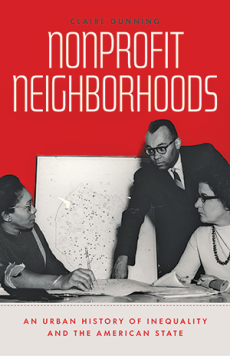
Nonprofit Neighborhoods: An Urban History of Inequality and the American State
Claire Dunning
336 pages, University of Chicago Press, 2022
There is little doubt that one of the most significant developments of the US nonprofit sector was its expansion in the 1960s, as it absorbed federal funding to implement Great Society social welfare and anti-poverty programs. Yet, even as that expansion remains an indisputable landmark, its significance with respect to broader political and ideological currents is much less settled. Should it be interpreted as a step toward the growth of the welfare state or a march toward the privatization of public goods? Was it a progressive victory or an anticipation of neoliberalism’s triumph?
These questions drive Claire Dunning’s new book, Nonprofit Neighborhoods: An Urban History of Inequality and the American State, which chronicles the partnerships that developed between community-based nonprofits in Boston and city, state, and federal authorities over the last half century. For Dunning, an assistant professor of public policy at the University of Maryland, the ability of these partnerships to hold different value for different sectors was a major reason for their initial spread. For some players, they represented the prospect of an urban government responsive to community needs, while for others they signaled the power of private action and the market to remedy social ills. Ultimately, Dunning argues, this latter vision prevailed. By the final decades of the 20th century, the popularity of these partnerships stemmed from their ability to promote the interests of the corporate, financial, and political elite who profited from the inequality these partnerships purported to address.
Dunning takes Boston, “the vanguard of social welfare experimentation,” as her primary case study of a “governance revolution,” in which federal grantmaking to nonprofits delegated governance but failed to remedy racial and economic inequities. “There is perhaps no better place to trace how high economic and racial inequality and an extensive nonprofit infrastructure not only coexisted but grew in tandem over the twentieth century,” she contends. Boston’s working-class communities of color exemplify what Dunning calls “nonprofit neighborhoods”: “places where neighborhood-based nonprofit organizations controlled access to the levers of political, economic, and social power and mediated the local manifestations of the state and market.”
Nonprofit neighborhoods also held broad political significance, as elected officials relied on them to respond to the “urban crisis,” the catchall, highly racialized term that policy makers often used to refer to the rising crime and poverty rates that cities confronted in the post-World War II decades. In the face of such crises, nonprofit neighborhoods represented a sort of concession from political elites, a way “for traditionally excluded groups to participate in governance,” Dunning suggests. Although she recognizes the long history of charitable associations partnering with local governments, Dunning identifies novel elements in the development of nonprofit neighborhoods, most significantly the close relationships that were established between federal agencies and neighborhood-based nonprofits.
While it exhibits an admirable granularity, Dunning’s book is also adept at panning out—depicting how the political pressures, policy frameworks, and public-funding programs that shaped nonprofit neighborhoods originated at the federal level. Her focus on federal grantmaking highlights the network of links extending from unincorporated community groups to community-based nonprofits and community development corporations (CDCs), to citywide nonprofit intermediaries, to local and national philanthropic funders, and to city, state, and federal agencies. In the case of Boston, she argues that these links both empowered and restrained the city’s community organizations.
By the final decades of the 20th century, the democratic and progressive promise of nonprofit neighborhoods seems to have largely faded.
Nonprofit Neighborhoods begins with postwar efforts at “urban renewal.” Under a 1954 amendment to the 1949 Housing Act, Congress required community participation in order for cities to receive federal funding for urban redevelopment. In response, Boston officials created new agencies such as the Boston Redevelopment Authority, new initiatives such as the Boston Community Development Program, and new intermediary nonprofits—most prominently, Action for Boston Community Development (ABCD)—to supervise engagement with community-based nonprofits. By the late 1960s, ABCD managed more than 75 federal grants and channeled millions to Boston nonprofits, often making subgrants to neighborhood groups to distribute themselves.
Yet, in a theme that runs throughout the book, Dunning shows that the devolution of power and resources to neighborhood groups was incomplete at best and illusory at worst. Even as some African American and immigrant activists representing nonprofit neighborhoods initially saw community development as an opportunity to advance community control, the city government maintained its power through monitoring and overseeing grants and by circumscribing the types of activities they would fund. So, amid the crisis surrounding the court-ordered desegregation of Boston schools through busing, the city authorized funding to community groups to provide security for schools but not to address any of the systemic issues that created the segregation in the first place.
President Lyndon Johnson’s anti-poverty agenda that called for “maximum feasible participation” from community groups provided another boost to Boston’s nonprofit neighborhoods. It also led to the emergence of a new form of nonprofit organization dedicated to community development in a specific locale—the CDC—and to a host of nonprofit intermediaries such as Greater Boston Community Development to provide financial support and technical assistance to CDCs and other community-based development organizations.
Boston became a model for these intermediaries, and one of the strengths of Dunning’s book is the attention she directs to such institutions, which have often been overshadowed in the historical accounts of the grassroots nonprofits and funders whose relations they mediate. “Intermediaries encouraged community development but soon became ends unto themselves with their own organizational processes, budgetary pressures, networking opportunities, political access, public visibility, and priorities that just as often clashed as aligned with the goals residents espoused for their neighborhoods,” she explains. Ultimately, according to Dunning, these intermediaries steered CDCs in Boston’s nonprofit neighborhoods toward investments focused on profit-making, rather than community benefit.
The recession and the fiscal austerity that constrained state and local budgets in the 1970s, followed by the conservative ascendency of the 1980s, further incentivized a turn to public-private partnerships. In Boston, for instance, corporate and financial leaders backed the Boston Compact, a partnership between the business community, schools, city government, and local universities to improve education and help provide graduates with jobs. Massachusetts politicians with national profiles, such as Governor Michael Dukakis and Boston’s Mayor Ray Flynn, embraced these partnerships and helped to install them as critical components of centrist Democratic politics, signaling a commitment to diversity and minority empowerment, along with a fealty to market-based approaches to social policy.
Dunning conveys the excitement with which many of those more recent programs were received as archetypes of social innovation, yet it’s difficult not to read her book as a story of decline. That’s because the more democratic, participatory promise of nonprofit neighborhoods supported by local activists initially provided some resistance to the forces that sought to use these nonprofits for the consolidation of elite power and the pursuit of corporate profit. Nonprofit neighborhoods often did represent, as she notes, “Black governing spaces” that functioned as sites of protest, pushing government to be responsive to community needs, and serving as “platforms to critique the social, political, and economic order.”
That democratic promise, however, was always a precarious one. In 1965, for instance, when Martin Luther King Jr. visited Boston, he criticized the lack of meaningful roles granted to poor people within the city’s community-based anti-poverty programs. Even more broadly, Dunning underscores the tensions inherent in a strategy of “privatized inclusion,” which she defines as relying on private organizations and their unelected leadership “to represent the diverse perspectives and needs of neighborhood residents,”
and which “placed public deliberations outside formal governance channels.”
Yet, by the final decades of the 20th century, the democratic and progressive promise of nonprofit neighborhoods seems to have largely faded—or at least Dunning seems to have lost faith in it. The continued presence of nonprofit neighborhoods in urban governance from the 1960s onward, she concludes, represents a “policy failure: the failure to create a more inclusive and responsive government, failure to adequately meet the needs of low-income residents, and failure to dismantle the racism of the city’s and nation’s political-economic structures.”
In that analysis, as elsewhere in the book, Dunning frames her indictment of nonprofit neighborhoods largely in terms of inadequacy—they could not sufficiently address the deep-seated structural injustices rooted in Boston’s African American and immigrant communities. But she also hints at a more active role that nonprofit neighborhoods took in perpetuating those injustices. The grants and financing that sustained nonprofit neighborhoods made, she says, “strange bedfellows of bankers, bureaucrats, and activists,” who shared a skepticism about the government’s ability to address the problems confronting US cities and a faith in nonprofit capacity. These alliances ultimately bolstered a neoliberal governing agenda that exacerbated those problems and diminished the inclination and capabilities of the residents of nonprofit neighborhoods to build grassroots movements to agitate for structural reforms. “Local power and local control are essential elements to moving toward a more equitable future, but they are not, as those with power have sought to convince those without it, an end unto themselves,” she contends.
In the book’s conclusion, Dunning observes the “sobering if not shocking research finding” that in the late 2000s the census tracts in Boston with the richest nonprofit infrastructure were also those in the city’s most economically and socially distressed neighborhoods. In pointing out this finding, she intimates a causal relation between the two data points: that the nonprofit infrastructure, tied to local government and corporations, played a role in further entrenching inequality.
It is a bold, powerful argument. Still, it is dogged by the counterfactual: In the absence of those nonprofits, would Boston have been more equal? Would grassroots activism have been more robust?
Dunning does not offer definitive answers to these questions, in part because she does not present the reader with an in-depth portrayal of that activism. But her sober, carefully researched, and elegantly crafted book provides a salutary complication of the Tocquevillian myth that still colors much conventional thinking about the US nonprofit sector: that there is an easy and clearly intelligible congruence between democratic vitality in the United States and the nation’s rich associational life. It is difficult to read Nonprofit Neighborhoods without one’s faith in that congruence being permanently shaken.