


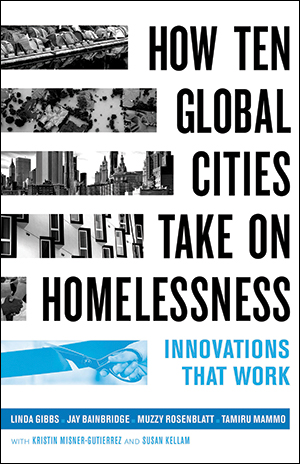
How Ten Global Cities Take on Honelessness: Innovations That Work
Linda Gibbs, Jay Bainbridge, Muzzy Rosenblatt, and Tamiru Mammo
288 pages, University of California Press, 2021
Homelessness is on the rise around the world, from San Francisco to Hong Kong. While research indicates that there is no single solution to reducing the number of people who experience homelessness, recent innovations can help reverse this devastating global trend.
How Ten Global Cities Take On Homelessness: Innovations That Work presents some of the most promising interventions addressing the homelessness crisis. The four coauthors are a New York City-based team with decades of experience in social services and housing: Bloomberg Associates principal for social services Linda Gibbs, Marist College associate professor of public administration Jay Bainbridge, president and CEO of housing nonprofit Bowery Residents’ Committee Muzzy Rosenblatt, and Bloomberg Associates consultant manager of social services Tamiru Mammo. “Passion”—a word the book mentions nearly three dozen times— drives their project. They believe that “creat[ing] a culture of collaboration marked by trust, accountability, and a driving passion [can] bring more people to a place where they can find safety, dignity, and joy.”
Case studies of 10 global cities—Bogotá, Mexico City, Los Angeles, Houston, Paris, Nashville, Baltimore, Edmonton, Athens, and New York City—inform the innovations that frame each chapter, from how to engage homeless people to how to develop an affordable housing strategy. The final four chapters concentrate on macro- and systems-level concerns, such as how to build political support for more funding, how to respond to emergencies, and what role performance-management approaches might play in facilitating systems improvement.
Ten Global Cities arguably will not impart new information to experts who have worked in homeless services or have conducted research on the unhoused. However, its real-world examples provide digestible and valuable information to the public—especially to advocates who are beginning a vocation in the field.
The vignettes showcased in each chapter demonstrate how cities are employing emerging and proven innovations to address homelessness. The cities with the greatest success, the authors explain, are those that had a combination of “effective management, sufficient resources invested in evidence-based practices, and skilled leadership that rallied the troops through triumphs and failures.” The authors advance two service-model innovations focused on practices and programs—what they call Housing First and Engaging People on the Street—and two ecosystem innovations focused on cross-sector collaboration—systems-level thinking and unified, digital data infrastructures to coordinate and streamline strategy and services—that combined can reduce bureaucratic and organizational barriers to addressing homelessness.
To most readers, the claim that providing “housing first,” without provisos or prerequisites, may seem obvious. However, not so long ago, the housing services sector espoused the philosophy that an unhoused person earned permanent housing only after, the authors explain, “ascending a staircase, from living on the streets, to shelter, to temporary housing, and then, to the last step, achieving permanent housing.” This “housing ready” outlook considered housing as “a reward for compliance and progressive improvement.” But such an approach often left many people in temporary housing or falling back to the streets.
By the turn of the century, however, practitioners such as Sam Tsemberis, Pathways to Housing founder and executive director, developed the housing-first approach, where housing was provided without a previous requirement of sobriety or adherence to a medical intervention. This supportive housing model gave needed social services to people within the context of a stable housing situation. This model was rigorously tested and proven to create more long-term housing stability over time. In addition, just as important to the widespread adoption of this model is the work of social scientist Dennis Culhane, who demonstrated that its cost was only $1,000 more than alternative approaches that provided services as needed. The additional $1,000 to obtain much better housing outcomes was money well spent.
The success of the housing-first model has led many places to try housing-only interventions that grant some type of housing voucher as both an intervention and a prevention strategy. Take, for example, the new, nationwide program highlighted by the National Alliance to End Homelessness called Rapid Re-Housing, which offers quick, short-term housing assistance. Evidence from the US Department of Housing and Urban Development 2019 Family Options Study suggests that Rapid Re-Housing vouchers were “40 percent more effective at preventing returns to homelessness” than shelter options, the authors note. This evidence was so compelling that many US cities—including all the US cities featured in this book—have expanded their voucher programs.
In perhaps the authors’ most significant contribution to the field, they devote a chapter to the service-model innovation for effectively engaging unhoused people living on the streets. The methods in outreach are subtle but important to understand and apply, because newer outreach workers are often confused by unhoused people initially refusing a housing offer. The authors describe how previous trauma experienced by the unhoused can create psychological barriers that result in refusal. “It is all too common in their personal histories for chronically homeless individuals to have not completed high school and, as children, to have experienced trauma—physical or psychological or both—in their home,” they observe. To navigate this issue, they argue, outreach workers must build trust developed with trauma-informed principles that require empathy and sensitivity. An offer of shelter can never be a onetime, take-it-or-leave-it opportunity, and the authors emphasize that coercion is “not an effective strategy.”
The book documents successful examples of outreach in New York City, Bogotá, and Athens that offer guidance on how workers can “do what the person asks, within the bounds of clinical appropriateness and professional conduct.” What this breakthrough work entails, the authors explain, is dedication and patience by outreach workers who are “willing to withhold judgment and to listen, show respect, lend support, and motivate” in order to foster “a meaningful and trusting relationship.”
Some of the innovations needed to end homelessness, the authors assert, focus on improving the ecosystem in ways that enable service-delivery models to be more targeted and effective. The authors comment that “systems-level thinking” in this context extends far beyond simple coordination and collaboration, because most cities have a complex infrastructure of departments that serve people experiencing homelessness. Los Angeles is a terrific, albeit cautionary, example: The city provides shelters, public safety, and sanitation services, while the county oversees most health and many other social services. In addition, networks of large and small nonprofits are on the frontlines with public agencies engaging people experiencing homelessness. In the example of Los Angeles, the authors mention how the Los Angeles Chamber of Commerce and the United Way have curated a collective impact approach to coordination and innovation among these many different system leaders, called Home for Good. Funded in large part with a grant from the Conrad N. Hilton Foundation, Home for Good convenes social service players and public and private partners “for monthly staff-level conversations … with the United Way providing a comfortable conference room and feeding participants a good, locally prepared meal.”
A second significant ecosystem innovation of homeless services concerns the ability to upgrade and connect data systems from the homelessness management information systems to various health and employment data systems. New York and Los Angeles, for example, have access to sophisticated data systems, while Bogotá does a sufficient job linking multiple sources of data. However, the authors overlook the fact that these networking innovations are all in the early stages of development and implementation. While early wins in using data to prevent high-risk individuals from becoming homeless show promise, these data systems continue to have a lot of missing elements, such as demographic information and housing histories.
Readers may feel that the book overpromises. Many early-stage innovations teach important lessons but do not lead to successful solutions.
Because of the breadth of the book’s case studies, Ten Global Cities leaves the reader wanting more details about each city in order to understand the contexts in which the innovations work. The authors demonstrate a depth of knowledge about changes and innovations in New York City—which is unsurprising, since they work there—but they fail to do so in their vignettes about the other nine. In particular, the case studies of Edmonton, Bogotá, Athens, and Paris need additional context to help readers understand how their innovations are connected to broader city infrastructure and social systems of change.
Readers may also feel that the book—as indicated by the subtitle, “Innovations That Work”—overpromises. Many early-stage innovations teach important lessons but do not lead to successful solutions. It is important to distinguish what innovations have succeeded and how they emerged from the ways that new early-stage innovations have been designed and are currently being implemented. The lack of these distinctions in the book could lead to some faulty conclusions—perhaps a more fitting subtitle would have been “Innovations That Might Work.”
Relatedly, several cities included as case studies, such as Los Angeles and Mexico City, have experienced increased homelessness, while others, like Houston and New York, have seen small declines. This discrepancy speaks to issues—such as systemic racism and city government bureaucracies that have stymied housing development—that are outside the purview of homeless-service systems. The authors do briefly mention these developments, but they should have returned to them in a more focused conclusion examining how the improvements in the homeless-service system have not kept pace with the growing numbers of people at risk of becoming unhoused.
Instead, the book concludes with a mélange of codas that discuss homelessness in the context of contemporary events and broader social concerns in order to provide takeaway lessons for other cities. One chapter highlights the success of the “Everyone In” campaign in Los Angeles that aims to build public support for expanded efforts by the public sector to reduce homelessness. Further chapters add details on the system of social services for the homeless and play up the importance of performance management. The final coda describes how communities have responded in times of crisis, like the COVID-19 pandemic, environmental disasters, and public-health emergencies. In many ways, the final chapter provides lessons for how communities can quickly mobilize to address the human rights crisis that exists in so many of our cities. But the authors could have provided a more fitting reflection by explaining how such lessons can help transform the system of social services for the homeless by, as the authors unhelpfully suggest, “solving the crisis of the moment and altering the system for the longer term and the greater good.”
Ultimately, the book demonstrates that, thanks to the passion and determination of homeless-service system actors, innovative approaches in outreach and housing-first models have emerged and been successful. However, there remains much more work to be done in integrating systems to alleviate the crisis on a global scale.