


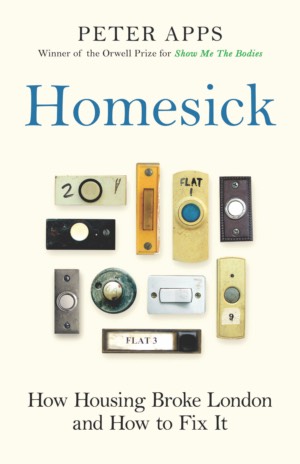
Homesick: How Housing Broke London and How to Fix It
Peter Apps
352 pages, Oneworld Publications, 2025
Peter Apps’ first book was an award-winning investigation into the causes and consequences of the 2017 Grenfell Tower high-rise fire in London. His second book, Homesick, begins with the basic unit of the housing crisis: a bedsit (a studio apartment, maybe with a shared kitchen or toilet) in a cramped building, with “whitewashed walls, numbered doors with individual locks, fire-exit signs and emergency lighting.” There is mold. Going for £1,000, it’s less a home than the staging area for its gig-worker resident, its 120 square feet adorned by “chunky, weatherproof coats with the branding of a popular food-delivery app” and an e-bike plugged into a charger. It’s ghastly, anonymous, and deeply recognizable.
The author then reveals that this bedsit is on the street he grew up on and that it was converted from a family home to a tenement after he left for college. “The community has gone,” he writes. “It has been replaced by transience, unfamiliarity, and atomization.”
Apps tells the story of “How Housing Broke London and How to Fix It,” as the subtitle goes, from two distinct angles. Against a decade-by-decade big-picture history, from the Thatcherite 1980s through David Cameron’s 2010s, he intersperses vignettes from such a dizzying variety of working-class renters that those less familiar with London geography may find themselves in need of a map (or even a cast of characters). The kaleidoscopic approach helps approximate the Hobbesian war of all against all that so many experience when trying to find a place to live. It also helps show how the housing crisis is not only manufactured but wholly unnatural, the function of so many individuals being extracted from their communities of care. The alchemy that transformed homes into housing units not only shattered existing communities but hasn’t yet found a satisfactory replacement.
Making of a London Crisis
Homesick is emphatically a London story. When Apps describes social housing as “the ‘wobbly pillar’ of the welfare state,” for example, he is harking back to a post-World War II order in the United Kingdom that has no real equivalent in the United States, nor in the Spanish or Austrian examples he cites later on in his book (in the United States, we might be more likely to call it public housing). Yet by following two generational turns in London—the turn to housing privatization in the 1980s and then a speculative free-for-all in the 2010s—Homesick's narrative resonates with broader global economic history, a story of how ever-increasing commodification of housing has fractured the communities people live in.
In the United Kingdom, Margaret Thatcher’s loosening of “Right to Buy” laws first allowed tenants in social housing to buy their public units outright, and then, naturally, to sell those units to the buyers of their choosing. It was described to residents as a way for families to transition to ownership and take pride in their homes; in practice, it allowed investors to crack into the tens of thousands of publicly owned units that had, until then, been administered by housing councils, democratic bodies that answered to their neighbors. Instead of dealing with council politics, investors could buy a unit off a widower here, another from a bickering family there, piecemeal, but at a citywide scale. Social housing was seen by the Tory government as being in conflict with the imperative to grow the private sector as much as possible; as Apps quotes a University College London professor, the state’s logic was, “In order for it to grow further, it was important now that the public sector needed to be exposed to competition.”
Planners and activists can hammer out zoning restrictions and implement rent control measures, but the most important decisions don't get made at city council. As much (if not more) urban policy is made by investors and banks.
Because tenants with means could buy their public housing units (while those without could not), London’s public housing community went from 42 percent “economically inactive” (whether disabled, retired, or unable to find work) to 61 percent, within a decade. As a result, housing councils needed more subsidies to keep people in their homes, which necessitated that costs be cut. Yet by showing how a local handyman could be replaced by an outsourced repair company—picture a Mr. Fix-It, perhaps played by a Bob Hoskins type, fixing the plumbing and then staying for tea, before making his way back home across the green—Apps gives us nostalgic glimpses of the community that was whittled away by economic necessity.
The commodification that took place a generation later was, again, the direct result of government policy: “To spark the economy back to life” during the 2008 recession, the Bank of England cut interest rates in an attempt to encourage investors to look for growth. “But in reducing interest rates,” Apps writes, “the government was creating an enormous demand for other safe investments … Those with capital didn’t want to take risks by investing in new projects with uncertain returns. Instead, they wanted another safe haven for their money. And this meant property.”
A flood of investor money reshaped the London housing market. Some of this was sui generis—international builders, overseas landlords, and foreign buyers taking units off the market to sit empty was a truly unmatched spectacle: “London flats became the equivalent of a fine wine, kept in a billionaire’s cellar and never drunk; just another way of storing wealth.” Perhaps true for London, probably not so for your hometown. Yet what is true the world over is that, as Apps quotes an economist, “however fast you can build, banks can create new credit faster.”
The Global Ripple of Capital
Housing is broken across the world, however different the shatter zones may look. But for all the different housing policy discussions occurring in different regions and countries—and Apps points to a few of them, in their local minutiae, in London, Europe, and elsewhere—some things are the same, everywhere. Local planners and activists can hammer out zoning restrictions, implement rent control measures, or advocate for fewer staircases, but the most important decisions don’t get made at city council. It’s a bank officer deciding whether to agree to a construction loan and what tenants are assumed to pay in the developer’s proposal.
In other words, as Apps emphasizes, investors and banks are doing as much (if not more) urban policy as planners and activists. What does this kind of investor urbanism look like? For one thing, cohesive neighborhood planning is far more difficult when investors must be coaxed parcel-by-parcel. The fractals spin out from there, as whole communities are bashed apart and reformed piecemeal. Maybe that means a home refit for short-term Airbnb-style tenancies; maybe, instead, it’s the bedsit that introduces Homesick, where gig workers lie down between shifts, too tired to meet their neighbors (or maybe too terrified of the next immigration dragnet).
Though Apps closes out the book by dwelling on the bleak housing future for the Anthropocene—can there be rent control in a melted London?—it would have been interesting to tease out the second-order effects of this slicing and dicing of community. As he notes, the Reform Party thrives among both ex-Londoners who feel forced out of their community as well as the Home Counties English who are offended to include an exotic mix of Caribbeans, Asians, and Israelis in their shires. There is much more to be explored in the rhyming couplets of the world’s all-against-all housing markets and their rising nationalisms. And for all the breadth of this work, something feels unsaid about who benefits from this arrangement. “London was also starting to feel more and more like it was going to be a place only for the very rich and very poor,” says one of Homesick's interlocutors, who left London for Bristol.
However, he is only half-right: A moldy room with a cold shower that takes most of one’s wages is hardly a home built to suit, and neither is bouncing six months between subsidized tenancies while your children learn new commutes to school. And the very rich do not seem to find London a place for them, either. Complaints about drug use, homelessness, a lack of public resources, and of course all those gig workers who don’t mind the queues make up the bulk of conversations about city life. The same could go for most any city: Investor urbanism does not build for communities, hardly even for people. The London that Apps describes is less inhabited than haunted, by the city it isn’t.
However unsolvable the problem may seem, Homesick does provide some remedies that don’t all feel like throwing rocks at a battleship. There are promising returns in the United States on public investment such as Montgomery County’s Housing Production Fund, and Chicago’s Green Social Housing Fund is designed to complement as much as supplant private investment vehicles. Rent control, understood less as a rallying cry and more as a place-and-need-calibrated metric, could be used to make housing as stable as health insurance and public education can be (when done right).
But for policies to provide relief, they have to go beyond, simply, “housing.” A London worth living in has well-built housing for the statistician-preferred 30 percent of your household income, certainly. It also has pubs, schools, museums, and parks: not just neighbors, but also things worth doing with your neighbors. While none of this is quite gone, Homesick
is full of past and present Londoners who understand their housing precarity as the broken rung of a ladder that is keeping them from living the good life. But a London for all Londoners is not only made by providing more and better apartment viewings, and more and better apartments. And anyway, who determines who gets to be a Londoner? It’s hard to put “Global macro-level problems are not solved at the local planning office” in a slide deck for investors.