


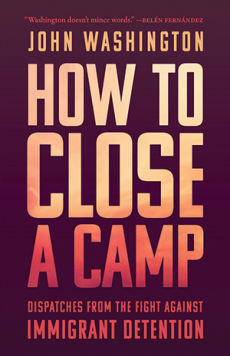
How to Close a Camp: Dispatches from the Fight Against Immigrant Detention
John Washington
272 pages, Haymarket Books, 2026
This article is from SSIR’s forthcoming Fall 2026 print issue. Subscribe today for full access online and to receive your own print copy.
* * *
Journalist John Washington’s How to Close a Camp arrives at a time of widespread and growing backlash to the Trump administration’s immigration-enforcement regime. A former immigrant-rights organizer, Washington has written what feels like an attempt to seize this moment, welcoming new adherents even while the movement grapples with a dramatically altered terrain. For this reason, it’s both a primer on immigrant detention centers (and a how-to organizing guide that examines long-running campaigns against them) and a theoretical manifesto that places them in a longer history of racist repression and confinement, which Washington calls “the camp.”
The book is written with a palpable urgency, in response to how rapidly the Trump administration has supercharged the immigrant detention system. Even seasoned members of the immigrant-rights movement whom Washington interviewed for the book find the scale difficult to comprehend. And yet, running through it is the simple argument that the immigrant detention system has been an untenable moral stain on the country for as long as it has existed and that it connects directly to the darkest chapters in the country’s history. When people were arrested by ICE in Minneapolis this winter, they were held at the Bishop Henry Whipple Federal Building at Fort Snelling, Minnesota, the location of a concentration camp for the Dakota people in the 1860s. Many were taken from Whipple to Camp East Montana, the largest detention center in the country, opened in 2025 on the grounds of Fort Bliss outside El Paso, Texas, where, as Washington notes, Japanese Americans were interned during World War II.
Washington doesn’t mince words on what this historical continuity portends. “Fear, hate, punishment, torture, banishment, death,” he writes: “That is the logic of the camp.” The lives lost in them, now triple the pace of previous years, should be viewed as “not aberrations but auguries” of what is yet to come, but well on its way. If these are the stakes, he insists, the call must be for abolition. “Not if or why or when, but only how.”
By the Numbers
The growth of the immigrant detention system in just one year is staggering, starting with a 2,450 percent increase in the number of migrants without criminal records who were arrested. There were just over 100 immigrant detention centers in January 2024; today there are around 220, located in every state and most US territories. Some are formerly shuttered prisons; others, like Florida’s “Alligator Alcatraz,” were built in as little as eight days. Trump’s so-called One Big Beautiful Bill set aside an unprecedented $45 billion for new detention centers, including funds meant to support the construction of several facilities twice the size of Camp East Montana and the expansion plans for thousands of new detainees. If the last year is any sign, many of them will be racially profiled and indiscriminately arrested at their schools, hospitals, job sites, and places of worship as ICE, Border Patrol, and other federal agents are deployed en masse to conduct enforcement in US cities. In 2024, 40,000 people were held in detention centers. Now there are at least 73,000.
The rules are changing fast: Last year, a ruling against “discretionary releases” made the camps effectively mandatory, while a 20-day limit on the detention of children was removed, and a rule on how long migrants could be detained in small holding cells was relaxed. Deaths, medical crises, missing persons, and human-rights violations are all on the rise, and at least a dozen Democratic members of Congress and other elected officials have been barred from entering for inspections. Since the start of the second Trump administration, 52 people have died in ICE custody.
Liminality Breeds Abuse
Once the infrastructure of incarceration is built, Washington argues, there will be “an inertial pull” to use it to solve social crises.
These grim numbers are due in part to the fact that immigrant detention has always existed in “legally liminal space,” not limited by normally due process. Through what is legally known as the “entry fiction,” a person is deemed not to have legally “entered” the country until they are formally admitted, and thus they are not guaranteed constitutional rights even if physically present on US land. After anti-Chinese sentiment prompted a series of Supreme Court decisions in the 1890s, immigrant detention was pushed deeper into this gray area by making it a civil, administrative process. As a result, because it is not a crime to be undocumented in the United States, those ensnared in the immigration system aren’t granted due process, and they do not receive sentences. Discretionary confinement is therefore unlimited, and potentially indefinite.
The laws governing conditions within the camps are equally opaque. The Supreme Court ruled in 1979 that detention facilities cannot have “an expressed intent to punish,” but any attempt to actually regulate conditions runs into the “plenary power” doctrine, which cordons immigration off into a zone of legal exception, resistant to judicial input, and creates what one legal scholar whom Washington cites described as “a state of lawlessness.”
How to Close a Camp is filled with stories of what lawlessness looks like. In Florida, detainees who had not eaten for hours were fed with their arms shackled behind their backs, like dogs; in New Mexico, toilets were so clogged with human waste that they would not flush, and detainees relieved themselves on paper plates. Washington broke a story in 2020 about women at a camp in Georgia who reported receiving unwanted gynecological surgeries, and in a 14-month span, from 2024 to 2025, over 10,000 people in detention centers were held in solitary confinement, an average of 38 days per person.
The lack of oversight is partly because immigrant detention centers are almost entirely privatized: 90 percent of immigrant detainees are in facilities owned by corporations like The GEO Group and CoreCivic. In practice, the camps are functionally operated by subcontractors, who provide things like food, medical care, transportation, surveillance, communications, cleaning, and other services.
It is here, in the nuts and bolts of staffing, contracts, permits, and licenses, where organizers have identified the camps’ pressure points. “A camp doesn’t just exist,” writes Washington. “It’s constructed and maintained by hundreds of signatures, inspections, and backroom approvals.”
Economic Pressure Points
Like prison towns, camp towns exist through a web of perverse economic incentives. Hollowed-out jurisdictions often welcome the camp as an employer of last resort, since both firms and local governments receive a certain amount of federal money whether or not their beds are filled. In Louisiana, sheriffs have warned that their municipal budgets would be in danger without them. In one example from New Mexico, CoreCivic was paid $2 million a month for 505 beds to detain just three people.
Government largesse has made these firms a lot of money. The GEO Group expects to make $60 million in revenue for their first year operating New Jersey’s Delaney Hall. But while camps are often presented as a financial lifeline for communities, Washington argues they do not improve economic development in the long run. Communities become dependent on “a single, politically volatile revenue stream” that they have little control over. Meanwhile, the fallout of a camp is substantial, from overworked public health services to weakened community trust.
Because short-term necessity can block out harms further down on the horizon, Washington cautions that moral suasion is vital but insufficient: Anti-camp organizers must be grounded in the particularities of local politics so they can better leverage the latent resentment that exists toward the camp and stitch together an alliance that can present an alternative vision.
An example he explores is in Leavenworth, Kansas, where CoreCivic repurposed a formerly shuttered federal prison as a camp. While 60 percent of the town had voted for Trump—and his promises of mass deportations—they did not like what had happened at the former prison under CoreCivic’s watch. A coalition that included former prison guards, Catholic nuns, business owners, and immigrant-rights organizers held meetings, knocked on doors, and successfully pressured the City Council to pass a zoning ordinance and file lawsuits to block the camp.
Campaigns like Leavenworth and others that Washington highlights—such as in Etowah County, Alabama—form a playbook that can be applied across the country, across differing local contexts. Start by documenting the abuses inside camps by forming relationships with detainees. Organize a coalition, including those who may agree on nothing more than their opposition to the camp. With enough people on board, pressure can be applied on the regulatory state against the camp, to gum up the process of contracting, licensing, and permitting.
The grassroots campaigns contain important lessons, though both have less-inspiring codas. In 2025, Etowah was reopened after a three-year hiatus, and after a yearlong fight, CoreCivic opened the Midwest Regional Reception Center in Leavenworth in March. One can understand why the book wasn’t titled How to (Temporarily) Close a Camp, but it is dispiriting to discover that the book’s shining case studies led only to short-term wins.
Still, the durability of victories underscores a point that Washington makes early on: that the camp is fundamentally a “distraction from entrenched political failure.” Once the infrastructure of incarceration is built, there will be “an inertial pull” to use it as a solution to social crises. That the current administration appears hellbent on an unprecedented expansion of camps should prompt us to heed Washington’s marching orders: Slow down the detention machine by any means available while cultivating a world where the camp is never a consideration.