


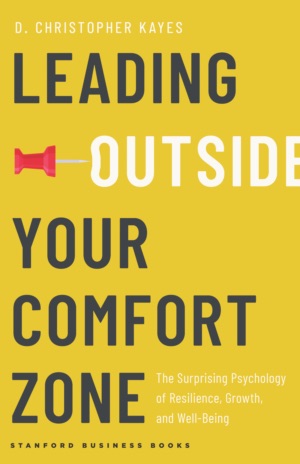
Leading Outside Your Comfort Zone: The Surprising Psychology of Resilience, Growth, and Well-Being
D. Christopher Kayes
231 pages, Stanford Business Books, 2025
Over the last decade, leadership books have increasingly acknowledged what any harried manager could tell you: They’re sweating under the weight of an increasingly disengaged workforce, caught between C-suite demands that workers return to the office and employees who’ve become accustomed to a commute-free workday. In short, it can be lonely at the top. (Or even in middle management.)
This constant stress incurs significant emotional fallout: burnout, anxiety, even shame. D. Christopher Kayes, a professor of management at The George Washington University’s School of Business who has written and edited several books on leadership, believes these pressures are mounting in the 21st-century workplace. In his new book, Leading Outside Your Comfort Zone: The Surprising Psychology of Resilience, Growth, and Well-Being, Kayes contends that to surmount these challenges, leaders “must embrace new approaches to leading and learn resilience themselves in the face of inevitable everyday adversities,” from work burnout to a lagging sense of purpose or meaning.
Leading Outside Your Comfort Zone offers tools for navigating leadership challenges and methods for nurturing well-being and resilience for both leaders and their teams. (For Kayes’ purposes, a leader can be a team, a department, or an entire company, rather than just one individual.) Yet, despite his belief that his solution is “novel,” Kayes offers only a patina of psychology over the well-trodden ground linking emotional self-regulation and a growth mindset to effective leadership.
Kayes bases his framework on psychologist Lev Vygotsky’s idea of the “zone of proximal development,” in which we learn “when we push ourselves out of our immediate comfort zone.” He renames this idea the “learning zone,” which he situates between the “comfort zone” (that which is familiar and easy) and the “anxiety zone” (that which is stressful and overwhelming). That sweet spot in the middle is a psychological safe space where leaders are able to optimize “the tensions inherent in learning” without becoming overextended or exhausted. Learning how to manage feelings of discomfort is not only essential to achieving higher levels of leadership but, Kayes argues, conducive to it: “Psychological research suggests that some unpleasant experiences, especially slightly unpleasant experiences, serve as catalysts for learning.”
Learning how to lead from within the learning zone is urgently needed for today’s executives and managers facing unprecedented workplace turmoil, burnout, and lack of engagement. “Leading in an age of anxiety is demanding,” Kayes writes. “Existing leadership training is not adequate for the task.”
Kayes’ intervention offers a path between two extremes—static comfort zone and breakneck anxiety zone—to establish a sustainable middle ground where leaders can build new skills and improve the ways in which they collaborate with their teams without being required to exert an exhausting level of perpetual over-striving.
Developing this resilience, he says, can be achieved through four strategies: cultivating novel experiences, accepting unpleasant emotions, implementing learning strategies, and motivating yourself to learn.
Here is the first of several places where the book flounders. It fails to make a cogent argument regarding why this time is so different than others or what specific impetus in the larger world has made leaders, specifically, so much more anxious. Other titles dealing with similar themes in the last few years, such as Jennifer Moss’ The Burnout Epidemic and Cal Newport’s Slow Productivity, have tagged a variety of suspects, including the COVID-19 pandemic, the corporate backlash against the rise of remote work, automation, the advent of artificial intelligence, and increasing political and social division. Kayes shies away from identifying a reason why a tipping point of anxiety has been reached, which diminishes some of his argument’s urgency and leaves readers wondering, Why this book, and why now?
The text then offers repetitive direction on what this discomfort looks like and how to respond to it. Kayes relies heavily on examples from the corporate world, as well as anecdotes from sports, politics, and even entertainment. Tom Hanks—yes, the A-list actor—is used to illustrate how resilience leads to professional success. Earlier in his career, Kayes recounts, Hanks was frustrated with the jobs he was being offered (NPR host Terry Gross called them “one-dimensional characters”) following his initial success in affable but dull roles in the 1980s and early ’90s. Hanks displayed resilience by passing over high-paying work until Apollo 13, which “led to a series of complex, challenging, and exciting roles, eventually leading to two Academy Awards for Forrest Gump and Philadelphia.” Kayes is clearly aiming to provide readers a relatable example with Hanks—the problem, however, is that Apollo 13 was released in 1995, a full two years after Philadelphia (1993) and a year after Forrest Gump (1994). Furthermore, this example might ring hollow to readers; a multimillionaire actor taking a temporary pass on additional millions may not garner sympathy or admiration from middle managers who are being asked to eliminate whole sections of their workforce.
Kayes’ use of straw men weakens his argument about the characteristics of effective leaders. In one case, he surprisingly claims that thought leaders are still lionizing GM’s Jack Welch as the epitome of leadership. “The reverence shown for Welch may be deserved, but we should not hold up post-Cold War leaders like Welch as examples of the leader we want to foster now.” Given the frequency with which Welch is held up as the personification of out-of-date leadership—his name is synonymous with bullheaded refusal to listen to input and shortsighted firings—it’s hard to understand who nowadays regards Welch as an icon of modern management.
The psychology presented is anything but surprising, and readers are unlikely to find much new between the covers. This is a fairly generic leadership guide threaded with some basic psychology.
Some of Kayes’ advice feels initially counterintuitive—few people volunteer for additional, unpaid workplace labor—but his exhortation to embrace a reasonable level of discomfort is ultimately convincing. For example, take his classification of frustration as a learning experience: “Frustration may activate learning. Because frustration starts as a slightly unpleasant internal experience, it motivates knowledge-searching behaviors associated with learning.” The descriptions of unpleasant experiences as useful in the long run frame discomfort as just part of the long game; power through the messy middle, he says, and emerge a better leader. In other words: Keep your eyes open, don’t rest on your laurels, and don’t let the bastards grind you down.
Readers would be hard-pressed to find issue with this recommendation but would be similarly stymied in trying to find something new in it. Rare is the leadership guide that suggests that doing the work is sunshine and roses or that all negative emotions are to be eschewed. If anything, it would be hard to identify a leadership book of the last several decades that doesn’t suggest, to one degree or another, that successful management of challenging emotions is essential to inspiring and earning the trust of others and that self-management must come before team management—see Adam Grant’s Think Again and Daniel Goleman’s Emotional Intelligence, among many other such treatises. “Leading outside your comfort zone,” Kayes says, “requires accepting unpleasant times when you feel stress, anxiety, or frustration. Resilience is formed when you learn from these situations and turn these unpleasant experiences into opportunities for learning and growth.” This point is both self-evident and widely understood: that developing resilience—or grit, for the Angela Duckworth fans reading this—requires persevering through adversity. But Kayes makes this point dozens of times without adding fresh perspective, potentially leaving readers to wonder why they’re reading a book rather than a magazine article.
Business books need not provide an entirely novel message. In this genre more than most, there is rarely much new under the sun. The familiar call to view leadership as a learning experience and to operate from a place of curiosity and stability could still hit home were it delivered in a particularly engaging manner, or with a sufficiently cheerful or encouraging approach. But Kayes’ writing is dry and plodding: “The single biggest challenge that leaders face arises from unpleasant emotions. Unpleasant emotions lead to negative consequences if not adequately addressed.” Too often, Kayes falls into a didactic monologue that feels chiding rather than inspiring: “Leaders must concede that self-awareness does not equal self-care or self-sacrifice. Instead, leaders should focus on improving self-awareness, which can result in profound insights into how actions impact the organization.” Leaders must. Leaders should. If these leaders are feeling as downtrodden and anxious as he posits, this joyless scolding can hardly help.
Kayes shines when it comes to the concrete and the pragmatic. His advice around setting tiered rather than static SMART (Specific, Measurable, Achievable, Relevant, or Time-Bound) goals—allowing workers to set progressive objectives well-suited to growth within the comfort zone—is thought-provoking and useful; workers who have chafed at hefty objectives will benefit from the increased clarity lent by the manageable steps. Similarly, the chapter-ending exercises are well thought out and targeted to help readers identify their points of stress and find ways to work around them. For example, Kayes asks readers to take a current hobby or work project to map out how they could best use any challenges that crop up as learning experiences: “I select a challenging way to approach the activity”; “I look for opportunities to develop new skills and knowledge in the activity.” Were these exercises presented as a workbook, it might achieve a different level of success, scaling down to the relatively slim advice and focusing on the more successful practical exercises. As it stands, the examples overpower the advice they seek to illustrate.
At the end of the day, the book’s subtitle is misleading: The psychology presented is anything but surprising, and readers are unlikely to find much new between the covers. This is a fairly generic leadership guide threaded with some basic psychology. The helpful steps and advice provided aren’t ultimately enough to make this stand out in a very crowded marketplace. Then again, a casual business reader who has not made their way through the leadership canon may find this an easy-to-digest reminder that growth without burnout is within reach.