


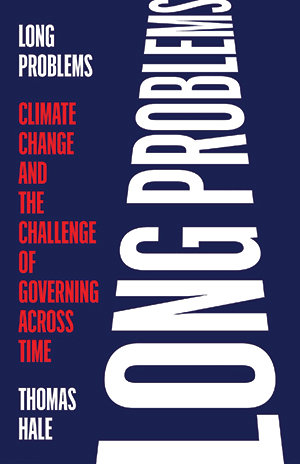
Long Problems: Climate Change and the Challenge of Governing across Time
Thomas Hale
256 pages, Princeton University Press, 2024
While reading Oxford University professor Thomas Hale’s Long Problems: Climate Change and the Challenge of Governing Across Time, I kept thinking of evolutionary biologist Stephen Jay Gould’s observation that “we have become, by the power of a glorious evolutionary accident called intelligence, the stewards of life’s continuity on Earth. We did not ask for this role, but we cannot abjure it. We may not be suited to such responsibility, but here we are.”
Countless scientists have referred to climate change as part of a class of issues called “wicked problems,” a term used to describe issues that do not neatly fit the conventional models of analysis. While we may not be suited to solve the wicked problem of climate change and may despair that we will never be, Hale offers an analysis of how we might better understand and therefore address it.
Hale predicates Long Problems on the general observation that some political issues span not only national borders but also time horizons. His central claim is that climate change is a “long problem,” a challenge that “spans more than one human lifetime.” He acknowledges that while “length is not the only meaningful way to understand climate change, … a focus on this one characteristic can fundamentally reshape our understanding of politics” by challenging us to establish policies on longer time horizons and to account for the future in ways we have not previously done. Reenvisioning policy is important because long problems are becoming more prevalent, he argues, for three reasons: our growing technological ability to bump against limits within the environment, our growing understanding of those distant effects, and our increasing willingness to address the needs of the future in the present.
Long problems, Hale asserts, challenge us to “govern across time,” rather than in the short terms of election cycles and quarterly returns. He warns that such challenges become more difficult to address the longer we ignore long-term governance. Indeed, as long problems become more urgent, we become more immediate and short term in our political orientation. Put differently, when we are drowning, we are less concerned with fixing the cause of the flood than we are with surviving. Hale calls this a paradox that “is another of the various cruel ironies of climate change [because] it threatens precisely the political support for longer term governance functions that can best address it.”
The book offers a valuable discussion of long problems and their importance for solving climate change in both academic research and government policy.
Long Problems brings needed attention to all the aspects of the temporal dimensions of climate change.
At times, however, discerning the thrust of his arguments requires the reader to connect disparate pieces. For example, his definition of long problems is presented piecemeal over the course of several pages. The result is a fragmented definition that makes comprehension unnecessarily difficult: Long problems are “amalgamations of different problems,” involving an extended chain of cause and effect with an increasing “number of intervening factors” and “a multiplicity of processes to shape outcomes,” and are often (but not always) irreversible. Hale’s penchant for lists—I count at least eight in the first chapter—also impedes the reader’s ability to understand the logical flow of his argument because the lists feel like stoppages in the narrative. Lastly, there are places where the writing devolves into minutiae that will leave readers outside the discipline confused and places where the writing makes obvious observations that will frustrate experts in the discipline—a tension of any author trying to straddle audiences.
Regardless of these issues, the book is an enlightening read that adds depth to our approach to climate change. Hale claims that long problems present society with three daunting political and governance challenges. First, they require actions well in advance of outcomes. But the costs of present action are known, while the future benefits are uncertain. He calls this “the early action paradox” that leads to obstructionism, particularly from those who will bear the larger brunt of present costs. We have certainly seen this dynamic at play with oil companies spending vast amounts of money to confuse and stymie debate on climate change because addressing it represents an existential threat to the fossil fuel industry. The second challenge is that people in the future who will reap the benefits of today’s actions do not have a voice in our present-day deliberations—a concern he terms “shadow interests.” Third, any political response enacted today may suffer what he calls “institutional lag”—it may remain in place but no longer be useful later as the long problem evolves.
To overcome these challenges, Hale proposes that scholars define climate change not as a distribution or cost problem but as a transition problem, focusing on “rates of change rather than final outcomes” and applying “empirical techniques that allow us to develop probabilistic knowledge about the future.” This reclassification will be an especially great challenge since social science research is often conducted using existing models and theories and has been historically reluctant or unwilling to look forward and make predictions, preferring instead to study past patterns. But Hale’s recommendation for scholars indicates how long problems pose a new type of challenge, requiring new types of approaches—not just for research but for governance as well.
Hale states at the outset that he will not offer any new policy solutions to climate change but will instead assess the tools that already exist to examine how well they attend to the three main challenges. But he does not stick to that initial promise, offering some welcome and necessary provocations for new forms of governance. Hale proposes that governments should develop something akin to sci-fi writer Kim Stanley Robinson’s idea of a “ministry for the future,” an organization that would be mandated to consider long-term interests insulated from short-term pressures. This organization could help governments adopt informational tools to better understand the future and make it salient in the present for shifting society’s preferences over time, yielding policies that must remain fluid for the long term, maintaining robust goals based on forward planning processes while also being subject to constant updating.
Bringing the future into our short-term mindset to make long-term policies is ambitious, and Hale is honest about the tensions and trade-offs this would create. He points out that his proposals could, at times, unwisely privilege long-term interests over those in the present and that some attempts to understand the future will inevitably get things wrong. Further, resources might run out over the duration of a long problem, and, importantly, the ministry for the future would at times—like all institutions—work to maintain its own interests and the status quo, resisting the need to evolve over time.
Yet I believe that Hale’s ideas raise other interesting questions for debate. For example, could it be that the core challenge of anticipating the future consequences of our actions and ameliorating them may always be beyond our reach, not just temporally but also politically? Our growing understanding of our distant effects on the natural world relies on the “vast machine”—climatologist Paul N. Edwards’ term that Hale employs to refer to the complex models and big data sets we need to understand issues as complex as climate change. As these models and data become more complex, they become increasingly inaccessible to novice observers. Believing requires trust, which is in short supply these days, and the result is suspicion and denial. Some—particularly those who lean more conservative—see climate science as an excuse for government to tamper in the market and diminish our freedom. This kind of political resistance becomes even more pronounced if we consider policy debates about non-human life.
While Hale does not discuss the challenge of considering the interests of non-human life in his notion of “shadow interests,” others have. For example, Ecuador amended its constitution in 2008 to grant nature legally enforceable rights. Bolivia, Uganda, the United States, Canada, Brazil, New Zealand, Mexico, and Northern Ireland have also granted some legal recognition for the rights of nature. An effort is even underway to draft laws for the legally enforceable crime of “ecocide” and criminalizing the destruction of the world’s ecosystems.
These questions conjure deeper ones about the precise obligations we owe to future generations. For example, proponents of weak sustainability, such as economists Robert Solow and John Hartwick, argue that we do not necessarily have an obligation to fix the problems of future generations as long as we provide them with the resources to fix such problems themselves. This perspective assumes that natural capital and manufactured capital are substitutes and that no difference exists between the kinds of well-being they generate, as long as we leave future generations with an aggregate improvement. So, it does not matter whether the current generation depletes nonrenewable resources or emits greenhouse gases into the atmosphere as long as future generations have a greater source of wealth and technology to fix these problems.
Proponents of strong sustainability, of course, disagree. They contend that natural and manufactured capital are not substitutable, and that the natural environment is far more complex than we understand. Although he doesn’t say it, my sense is that Hale falls into this camp, since he observes that burdening the future with depleted natural resources or an excessive pollution load may inadvertently cross environmental tipping points, leading to irreversible damage that future generations cannot fix. Certainly, scientists’ warnings that if we don’t reverse our current trajectory of atmospheric greenhouse gas increases by 2030, damage to the global climate will be irreversible. Some scholars agree—including, ironically, Solow, who in 1992 asserted that “no generation ‘should’ be favored over any other” and that the common use of discount rates to measure the value of money is “a concession to human weakness or as a technical assumption of convenience (which it is).”
In the end, climate change is an existential threat to life on the planet, one that challenges our institutions in new and unprecedented ways. Can we rise to the challenge that Gould presents to us and solve it? To answer this question, I turn to systems scientist Sir Geoffrey Vickers, whom Hale quotes: If human civilization is to survive, “it will have to be controlled—that is, governed—on a scale and to a depth which we have as yet neither the political institutions to achieve nor the cultural attitudes to accept.” Long Problems brings needed attention to all the aspects of the temporal dimensions of the issue, helping us move in the direction of creating new political structures for solving it.