


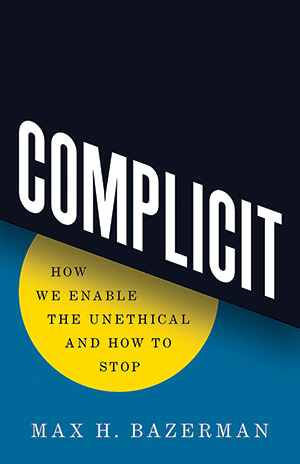
Complicit: How We Enable the Unethical and How to Stop
Max H. Bazerman
264 pages, Princeton University Press, 2022
About 20 years ago, an undergraduate business major told me he was dropping my introductory ethics course—not because he didn’t enjoy the class but because, he said, deep ethical analysis had no place in his career aspirations. It was around this time, according to Harvard Business School professor Max Bazerman, that business schools began incorporating ethics into their curricula. Bazerman was part of this movement, which eschewed traditional normative ethics exploring how people should act in favor of behavioral ethics that focuses on how people actually behave.
Bazerman continues this pursuit in his latest book, Complicit: How We Enable the Unethical and How to Stop, to understand the puzzling cases of why seemingly decent people ignore, deny, or enable the harmful behaviors of their bosses, colleagues, and business partners. He surveys a wide range of notoriously bad actors—among them, principals at opioid-purveyor Purdue Pharma, founder and CEO of Theranos Elizabeth Holmes, cofounder and CEO of WeWork Adam Neumann, and former film producer and convicted sex offender Harvey Weinstein—not to explain their behavior but rather to examine the ways in which they depended upon the complicity of others.
Complicit is animated by three aims. First is the descriptive aim, which illustrates what different kinds of complicity look like. Second, the explanatory aim employs concepts from behavioral ethics to answer the question of “why people collaborate with harm doers.” And third is what might be called an ameliorative aim, or the offer of “ideas for reducing complicity.” Bazerman’s rich case studies certainly satisfy the descriptive aim and may even encourage readers to consider the ways in which they have been or could be complicit in wrongdoing.
On the explanatory and amelioration fronts, however, Bazerman is far less successful. The concepts and terminology of behavioral ethics turn out to be merely gimmicky ways of re-describing the actions he seeks to explain. His recommendations for how individuals can avoid being complicit, therefore, amount to little more than an invitation to think before they act. And his suggestions for how “leaders can create less complicit” organizations run serious moral risks of their own.
Bazerman begins by distinguishing between “obvious complicitors” and “ordinary complicitors.” Obvious complicitors go along with a primary wrongdoer because they share the same values and goals with that person, or simply because going along is strategically useful for them. Ordinary complicitors, by contrast, are “regular people who allow harm to develop as a result of their implicit, non-deliberative behaviors.” These people are Bazerman’s main focus. He convincingly exposes the risk and reality of complicity in everyday life—for example, the biases that make well-meaning people unaware of their own racist behavior, from white saviorism to microaggressions. Bazerman even offers a chapter-length anecdote about his own complicity in the publication of a paper—since retracted—that rested on fraudulent data.
Bazerman dedicates most of the book to ordinary complicitors. He identifies five profiles of ordinary complicity: perpetuating structural injustice on account of being unaware of one’s privilege; suspending one’s critical faculties under the sway of “false prophets” like Holmes or Neumann; overly deferring to authority from a place of unwarranted loyalty, such as when university administrations ignore reports of sports coaches’ sexually predatory behavior; putting too much trust in professional relationships, as when Bazerman describes his coauthorship of a problematic paper; and creating or adopting unethical practices, such as when physicians accept gifts from drug companies to prescribe certain medications.
Bazerman addresses his explanatory aim primarily in the chapter on the psychology of complicity, in which he delineates several “psychological mechanisms” at the root of ordinary complicity. Yet, while an appeal to psychological mechanisms might lend a patina of scientific rigor to behavioral ethics, those that Bazerman discusses are quite superficial. For example, in attempting to explain why financially sophisticated investors and large corporations fell for the charismatic hype of Holmes and Neumann, Bazerman appeals to a distinction between faith and reason. Faith, he says, is “a strong or unshakeable belief that exists without proof or evidence”—a definition that is in effect nothing more than a definition of falling for a false prophet. Hence, claiming that people had faith in Holmes and Neumann leaves readers none the wiser about why they did.
It is not enough to assert that complicity is a fact of human nature. People are not puppets of their psychology. They are conscious agents.
A similar vacuity attends Bazerman’s treatment of people who enabled the chronic sexual abuse perpetrated by Harvey Weinstein, Larry Nassar, and Jerry Sandusky, and of midlevel managers and engineers who did not blow the whistle on industrial malfeasance at Boeing, General Motors, and Volkswagen. Here, Bazerman suggests that a toxic combination of fierce loyalty and deference to authority underlie such behavior. But again, since he defines loyalty “as a commitment to act in the interests of another person, other people, or an organization without deliberating about whether such actions are rational or ethical,” and deference to authority as putting great value “on existing institutions and tradition,” readers remain uncertain why people fail to think about what they are doing or fail to question the values of certain institutions and traditions.
More troubling than these unsatisfying “explanations” is that by focusing on these mechanisms, Bazerman ignores the fact that ordinary complicitors are not mindless, passive victims of their psychology. Rather, they are active agents who assess situations, make judgments, and choose to act—as his own examples demonstrate.
Consider, first, Bazerman’s report “that when we create harm indirectly and benefit from that harm, we more readily justify it than when we create harm directly.” He does not discuss this mechanism in relation to Weinstein’s assistants who knowingly “filed the women he preyed on as ‘FOH,’ or ‘Friend of Harvey,’ [in their phones] and compiled ‘bibles’ of advice for their successors on how to arrange such encounters,” but it is surely relevant. However, these assistants knew—or had a very good idea about—what was going on and made judgments about how to act. Perhaps some reckoned that since they were not abusing other women, their hands were clean. But many, surely, just wanted to keep their jobs and avoid the ire of their boss. Indeed, Bazerman himself cites fear as motive in a good deal of complicit behavior. This is hardly, however, the kind of “complex psychological theory” he claims is required to explain ordinary complicity.
Or consider the “slippery slope to complicity,” which is when, he writes, “people are more willing to engage in unethical conduct when they have the opportunity to gradually increase their level of unethicality.” This is a common enough description of human life. An employee hears from colleagues that they don’t report all the times they leave the office early and so begins to falsify his own time record. If others are doing it, I can too, they might think. Again, the complicitor makes a deliberate judgment—no subtle “mechanisms” are required to explain this behavior.
Ordinary complicity is, well, ordinary. People can be selfish, greedy, rationally afraid of losing their jobs, or desirous of impressing a boss or being proximate to power. They are deliberatively lazy, engage in wishful thinking, and are easily distracted. Catchy terms like “bounded ethicality” and ethical “blindspots” may describe these behaviors, but they do not provide answers to the central “why” question of this book. It is not enough to assert that complicity is a fact of human nature. People are not puppets of their psychology. They are conscious agents capable of thinking for themselves and acting on their own judgments.
At the same time, the descriptive frameworks like those advanced by Bazerman might provide realizable instructions for reducing or eliminating the incidence of unethical behavior and complicity with it.
To be less complicit, Bazerman says, people need to be “courageous, deliberative, inclusive, persistent, effective.” They should “engage their cognition” and “consider which values” are most important to them, and thereby be more likely to “reject and confront unethical behavior” and to think about their “personal moral code.” If people questioned their assumptions, their reflexive and outward-directed judgments might be more ethical. In short, it would be better if people thought.
Such is the advice Bazerman offers to individuals. He also offers broader solutions to complicity to his intended audience: leaders. He is right to emphasize the relevance of institutional and organizational contexts to the incidence and management of complicity, but he adds that leaders “accrue a broad … ethical mandate,” whereby they “have abundant opportunities to affect the ethics of others for the better.” By itself, this statement should give us pause. There is no obvious reason to believe and scant evidence to support the idea that individuals who assume leadership positions, particularly in profit-driven sectors, will be especially insightful about or mindful of ethics. As many of Bazerman’s examples show, a healthy dose of skepticism should be directed at leaders’ moral pronouncements.
At least two of the strategies Bazerman recommends to leaders to exploit these ethical “opportunities” are also worrying. Leaders, he says, should “empower … group action” and “create mechanisms that encourage organizational members to band together to stop unethical action.” And leaders can “break the ice” in personnel evaluation discussions, for example, so that people in the room feel safe to “unload their concerns” about other employees. In the current climate of calling out, public shaming, and “gotcha” moments, and given their power and influence, leaders run terrible moral risks in arrogating to themselves positions of unwarranted ethical authority.
People behave badly. It would be better if they didn’t. But the route to making that happen is to treat ethics with the seriousness it deserves and to educate and reward people for the hard work of reflection and change. Bazerman, like many in the business-ethics space, thinks that “people reject philosophical arguments on ethics because the sacrifices required to be ethical appear too great.” And, yes, any absolutist moral theory will be too demanding for mere human beings. Sometimes telling a lie is the morally right thing to do. Sometimes one cannot maximize the good for the greatest number.
Yet, moral theories and moral principles can be action-guiding. Learning about them, thinking about them, and even using them as regulative ideals is challenging—as a professor of moral philosophy, I’ll be the first to admit that. But it is worth the effort—one my student, it seems, correctly recognized that he would not have to invest in to succeed in the business world.