


America is one of the wealthiest nations on Earth, yet it has more poverty than any other advanced democracy. One in nine Americans lives below the poverty line, and 38 million people can’t afford basic necessities. Despite America’s GDP growing to $26 trillion in 2022, its poverty level hasn’t significantly budged since 1970. Why, in a country so affluent, does poverty persist?
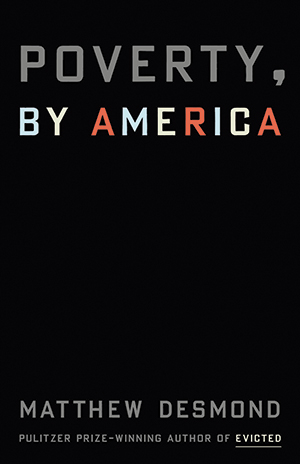
In Poverty, by America, Princeton University sociologist Matthew Desmond contends that America’s poverty has resulted “not in spite of [America’s] wealth, but because of it.” We profit off the systemic and structural factors that produce poverty—he intentionally employs the “we” to implicate all of us as creators of this nation’s poverty economy. Desmond claims we benefit from poverty in three specific ways: economic and labor exploitation, which meet our demand for cheap products; a US tax system that subsidizes affluence; and, relatedly, US programs offering bailouts and safety nets to the wealthy.
“The American government gives the most help to those who need it the least,” Desmond argues. “This is the true nature of our welfare state, and it has far-reaching implications, not only for our bank accounts and poverty levels, but also for our psychology and civic spirit.”
Poverty, by America arrives seven years after Desmond’s Pulitzer Prize-winning book, Evicted: Poverty and Profit in the American City, which examined how America’s housing-eviction model exacerbates poverty. Both books are rooted in his own childhood experience of losing his family home to foreclosure after his father lost his job. Questions arising from this experience—Why does our nation punish, rather than help, people who suffer? And why do the rest of us accept this treatment?—have inspired Desmond’s research and writing.
The in-depth ethnographic research for Evicted—Desmond lived among eight low-income families in Milwaukee, Wisconsin, for several months—that won him a Pulitzer is less abundant yet still effective in his new book. Poverty, by America is at its most powerful when Desmond pairs his research with personal stories. Peppered among the paragraphs packed with statistics are snapshots of the people Desmond has interviewed throughout his career. These accounts put a human face to poverty—arguably included to make readers feel empathy for those who experience it and responsible for their plight. Part of the reason, Desmond contends, we care so little about poverty is that it remains invisible in our culture. “Poor people are omitted from movies and television shows and popular music and children’s books,” he observes, because American prosperity is threatened by poverty’s exposure.
Poverty, by America does not give readers the option to look away.
Desmond shares the story of Crystal Mayberry, who was born prematurely, after her mother had been stabbed in a robbery, in 1990. She was sexually abused as a child and taken by Child Protective Services and put into foster care, where she bounced between several group homes. She was diagnosed with post-traumatic stress disorder and bipolar disorder and placed on Social Security benefits, 73 percent of which went to rent. As a Black woman, she had been denied housing in the white and Hispanic areas of town on several occasions. She soon fell behind on rent payments and was evicted. Stories like Mayberry’s demonstrate how poverty is a “tight knot of social maladies” drastically shaping a person’s life.
Will Americans choose to stop benefitting from the poor? Will they ever agree to the tax rates needed to abolish poverty for good?
Desmond uses data and personal stories to debunk cultural myths about poverty. For instance, he dispels the racist and xenophobic belief that immigration threatens the economy by pointing to data showing that “states that have taken in the most immigrants over the last half century … have grown more prosperous.” Between 1970 and 2019, two of these states, Texas and Florida, both experienced drops in poverty by 5 and 4 percent, respectively. Desmond also disproves the fable that an increase in the minimum wage would increase unemployment. He reveals that the fallacy originates in “hypothetical data” from 1946 and then cites dozens of studies proving “that increasing the minimum wage has negligible effects on employment.”
These myths perpetuate the prevailing politics of blame and marginalization that encourage Americans to believe, Desmond says, “aid to the poor is poison.” He invites us instead to consider the possibility that people are trapped in poverty not because they are lazy or uneducated but because the country’s economic system and culture uplift people who don’t need help. Desmond directs our attention to America’s economy of poverty and specifically to those who profit from it. Profits from the poverty economy come from exploitative rents, banking fees, and labor practices. America’s Amazon complex—our addiction to products delivered within days to our door—comes at the cost of people being paid a livable wage: Cheap products require cheap labor. At least 50 to 70 percent of poor Americans’ wages goes to rent and utilities, with landlords making more profit on apartments in poor neighborhoods than on those in rich ones. Wages are also lost to banking and finance-related fees; Desmond calculates that there are “over $61 million in fees collected predominately from low-income Americans each day.”
Your daily life, shaped by social segregation, probably reinforces this exploitation. If you live in an affluent area, and especially if you own a home, you benefit from and passively support the zoning laws that keep multifamily homes and subsidized housing out of your neighborhood. If you own a car or regularly take Uber, you probably aren’t using the public infrastructure that poor communities depend on. Desmond argues that these structural separations between indigence and affluence result in a national “trend of private opulence and public squalor.” And government policies reinforce the division by failing to invest in public goods, which are then only used by the nation’s poorest citizens.
By far, the most damning evidence in support of most Americans’ passive reinforcement of the poverty economy is the fact that poor people do not receive the most aid from the government: Affluent families do. Subsidies on mortgages, tax loopholes, and job benefits combined equate to the richest Americans receiving “40 percent more government subsidies than the poorest American families.”
Because Desmond’s examination is centered on class, other contributing factors and contexts of poverty are sometimes lost in the equation. Poverty looks different depending on where you live and what you look like. But because Desmond’s analytical framework is not intersectional, Poverty, by America can offer only an incomplete account for how American poverty has propagated along racial lines or how class myths and American Dream narratives work together to reinforce both poverty and racism. Despite not having this intersectional lens, Desmond’s robustly researched book remains persuasive.
Desmond concludes his book with a radical solution to upend America’s poverty economy: If the system is corrupt, disrupt the system. Desmond estimates that the cost to abolish American poverty—meaning to elevate everyone above the national poverty line (in 2023, $30,000 for a family of four)—is $177 billion, or “less than 1 percent of our GDP.” He argues that this money could be procured easily but only if the government ended tax codes and incentives that amounted to a $1 trillion annual tax avoidance per year for America’s wealthiest individuals and corporations. Desmond asserts that abolishing poverty cannot happen with social-welfare spending alone but must also occur in tandem with structural changes that address the systemic issues underlying the poverty economy, including reforms to the tax system.
Each solution Desmond proposes maps onto a problem he presents in the book. He says Congress should raise the minimum wage to eradicate subminimum pay and “ensure that workers will never again have to fight to earn a living.” He also proposes that government increase its investment in public goods—from public housing to public education—and introduce policies that make banking less predatory. He says citizens should petition Congress to enact a new set of labor laws for America’s modern corporate labor system. Within our own communities, he recommends that we advocate for the removal of zoning laws to reintegrate America’s rich and poor. We should become, he writes, “poverty abolitionists,” who conduct “an audit of our lives, personalizing poverty by examining all the ways we are connected to the problem—and to the solution.” Cumulatively, Desmond believes we can create a society that doesn’t depend on poverty for its prosperity.
But will Americans choose to stop benefiting from the poor people we don’t even see? Will Americans ever agree to the tax rates needed to abolish poverty for good?
By the end of the book, I found myself cautiously hopeful that a cultural shift is on the horizon—even Desmond cites a 2020 Pew Research Center poll indicating that for the first time more Americans blame poverty on structural conditions rather than individual failures. Part of my hopefulness, too, comes from my own personal stakes in Desmond’s argument. After witnessing the poverty economy prey upon my rural community—in the form of predatory overdraft fees, $7-an-hour jobs, and snowballing debt—I want to think that things can change, that I can one day stop sending money back to Texas because my parents will finally be paid a livable wage.
Desmond believes “the end of poverty would bring a net gain in broad prosperity.” The use of “would” here reveals this future’s conditional reality. What Desmond imagines is an idealized outcome, where Americans truly understand that their individual well-being and prosperity depend on the well-being and prosperity of other Americans. Even if unrealistic, this idealism is an intentional and necessary choice: We should imagine a better world to work toward, because dreaming in the present gives us a place to start from in building America’s poverty-free future.