


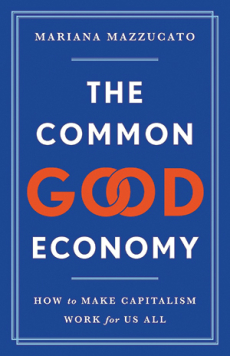
The Common Good Economy: How to Make Capitalism Work for Us All
Mariana Mazzucato
352 pages, Basic Venture, 2026
This article is from SSIR’s forthcoming Fall 2026 print issue. Subscribe today for full access online and to receive your own print copy.
* * *
In 2020, Mariana Mazzucato cochaired a Renewal Commission, which gave residents of the London Borough of Camden an opportunity to shape priorities for local government. One institutional innovation that came out of it was a £30 million ($40.4 million US) Camden Community Wealth Fund, which offers loans, equity, and support to local enterprises, with residents helping to decide where the money should go. It’s the kind of institution her new book is written to celebrate: democratically governed public wealth used to reshape the local economy toward more inclusive social outcomes.
The Camden Renewal Commission was also, by Mazzucato’s own account, an experiment running against the tide. Despite containing enormous wealth, Camden is a place of “under-resourced [public] housing estates and reliance on food banks,” and one of the commission’s four headline missions was simply that by 2030, everyone in the borough should have access to affordable food. Yet even after long years of hollowed-out council budgets, a chronic shortage of social housing, and queues at the food banks, Mazzucato is resolutely optimistic that initiatives like this one can do much to turn the tide of economic inequality and social exclusion.
Across four influential books, Mazzucato has argued that the state is not a clumsy latecomer to markets it should otherwise leave alone, but an entrepreneurial risk-taker (The Entrepreneurial State), a creator and not merely a consumer of value (The Value of Everything), and a setter of ambitious collective missions (Mission Economy), as well as an institution whose competence has been hollowed out by outsourcing and consultancy (The Big Con). The Common Good Economy gathers those constituent arguments into a single frame, organized around the “common good compass,” five complementary principles meant to keep economic decisions pointed toward shared ends: purpose and directionality, cocreation and participation, collective learning and knowledge sharing, access for all and reward sharing, and transparency and accountability.
There is a great deal of good sense to admire in The Common Good Economy, and a plethora of intriguing examples. By focusing on how markets are made—shaped by law, procurement, patents, and public investment—Mazzucato rejects the false choice between a “free market” and a “managed” one, emphasizing, instead, the difference between economic relationships built around private accumulation and those built around shared goals. To this end, she argues that the state can often better secure the common good by shaping who benefits from public investment before the fact, rather than by using taxes to redistribute wealth after the event. If redistribution and predistribution are partners rather than rivals, then intelligent governance of the economy will make use of both.
Mazzucato locates her “common good” approach as close to the communitarian tradition that grew up over the past 40 years in response to liberalism. However, she distinguishes herself from thinkers like Harvard University political philosopher Michael Sandel, who would seek to limit market penetration, keeping certain goods out of the market altogether. Mazzucato’s theory of “market shaping, not fixing” seeks to improve the terms on which a market operates, rather than to ask whether there should be a market in particular domains at all.
This is a consequential position: Would not care, health, housing, and water often be better served by taking them substantially out of the market, through direct state provision? Public libraries, for example, are valuable because they are free at the point of use and open to all; their worth would be diminished, not improved, by a cleverer pricing model. Questions about the limits of markets, and about which goods should be decommodified outright, are questions of justice and cannot be “cashed out” through market design. While the influence of Sandel on her thinking is evident, this difference in emphasis seems revealing.
Who Is ‘We’?
Early on, Mazzucato suggests we are failing to solve our shared problems of economic inequality and social exclusion because “we have chosen not to work together.” Yet who, exactly, chose this? For a book about collective action, she rarely addresses the machinery of collective political agency: parties, elections, unions, and the patient construction of political power from below. Mazzucato favors consultation and “co-production” but often conceives it as a matter of institutional design at which this imagined “we” must arrive (rather than something to be wrested from the powerful).
Can such a unified “we” be assumed at all? After all, citizens disagree, often reasonably and often permanently, about how to live. The individual rights and neutral procedures that Mazzucato treats as thin or merely corrective were embraced by liberal thinkers as a way for people to live together without the most powerful, or the most numerous, imposing their vision of “the common good” on the rest. The book is sometimes too quick to presume a plausible shared view that could avoid these difficulties.
The book’s optimism is bracing, and inspiring, but can sometimes feel overdrawn; you cannot conjure an ethos by describing it, nor assume away the structural forces that create unequal economic power.
To her credit, Mazzucato names a connected problem that her argument faces: Policies that challenge concentrated wealth and power, she writes, “inevitably encounter resistance from those whose interests are most directly affected.” But while the resistance of the powerful is probably the deepest difficulty faced by Mazzucato’s “common good economy” approach, circumventing that resistance is not explored in great detail.
While the book explores a variety of plausible and attractive policy instruments—conditional public loans, narrow patents, bans on share buybacks, community wealth funds, and participatory budgeting—Mazzucato is comparatively quiet on why these tools so rarely get used. The revolving door between government and finance, the lobbying that reliably dilutes reform, the structural leverage that ownership confers no matter how public-spirited the people in charge, and the market pressures that drive firms toward profit maximization even at terrible human cost—these are all reasons why the instruments for creating broad public benefit are used so rarely, but they often feel like the missing subject of the book. After all, Camden Council could raise £30 million for a community fund, but it could not, by itself, reverse the 40 years in which wealth and power have flowed steadily upward as the powers of local government wane.
Mazzucato’s five principles are valuable as standards, but what of the institutions needed to realize them? “Participation” could mean a consultation exercise, a seat on a board, a collective-bargaining agreement, or outright worker ownership. “Reward sharing” could mean a year-end bonus, an equity stake held by the public, a more progressive tax, or the full socialization of ownership of the relevant asset. Each principle is as compatible with fundamentally shifting real power as with changes that merely gesture at it. And while Mazzucato is alive to the danger of “common good washing,” she could have done more to show how it could be avoided. A company or a government could adopt her whole vocabulary of purpose, inclusion, and shared value without fundamentally shifting the locus of power and control within the economy.
The book’s optimism is bracing, and inspiring, but can sometimes feel overdrawn; you cannot conjure an ethos by describing it, nor assume away the structural forces that create unequal economic power. We might also worry that a similar overconfidence attaches to Mazzucato’s faith in “co-creation” and citizen participation, which she treats as almost self-evidently good (even as decades of experience show how easily such exercises harden into box-ticking or are captured by the confident and the well-organized). A compass tells you which way is north. It does not move your feet, nor clear the obstacles in your way.
Where the Book Comes Alive
Perhaps these criticisms are too severe for a book that abounds in inspiring practical examples and which comes alive in its final third, when Mazzucato’s economics approach plain social democracy, or even socialism. Setting the market-shaping vocabulary aside, she straightforwardly makes the case for public provision: for social housing, public health, libraries, parks, swimming pools, youth clubs, and the arts, seen not as costs to be justified, but as investments in a shared life. Shared public amenities are not merely efficient ways to deliver services, but are the infrastructure of equality, the places where people of very different means encounter one another as equals. A public library or a municipal pool is a small daily rehearsal of a society of equals, its value running deeper than any ledger of costs and benefits. Culture is an investment in our lives together, and not an indulgence.
The book stops short, though, of full engagement with the political movement it most resembles. Camden aside, Mazzucato never quite connects her enthusiasm for community wealth to Community Wealth Building as a movement, to the Preston Model in the north of England, to the anchor-institution strategies pioneered in Cleveland, Ohio, or to other localities in which practitioners have turned local ownership into a working program. That is a real omission. Community Wealth Building marks the point where predistribution stops being a matter of attaching conditions to public money and becomes a matter of real ownership. Communities and workers owning assets outright, through cooperatives, municipal enterprises, community land trusts, and public endowments, goes to the heart of the question of power in the economy.
Mazzucato has provided a plausible compass and a real sense of the direction worth traveling. What remains to be done is the harder and more political work of assembling the people to walk it, as well as fighting the inevitable and necessary political battles with those who would block their path.