


A lot in progressive politics these days is riding on remembering, or even reinventing, the meaning of solidarity. If there is a way out of the co-optation and circular firing squads of “woke,” out of a derelict Democratic Party that traded broad membership organizations for wealth-led donor activism, and out of the latest cycle of genocidal violence enabled by US treasure and arms, surely solidarity is that way. It sounds strong in a time of weakness. The word is old but has been neglected long enough to have regained some mystique. And yet what does it mean in the United States, a society with seemingly negligible labor-union density, with no recognizable workers’ party or peace movement, with so few institutional manifestations of what the word used to signify?
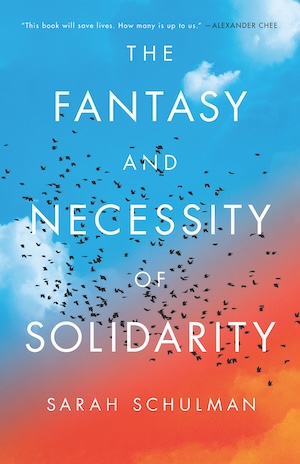
In its soul-searching, the left has been on a solidarity publishing spree. Organizers Leah Hunt-Hendrix and Astra Taylor published a hefty introduction to the term last year, Solidarity. Jewish Voice for Peace leaders Rebecca Vilkomerson and Alissa Wise published Solidarity Is the Political Version of Love on Jewish anti-Zionism, likewise in 2024. The latest addition to this growing library is The Fantasy and Necessity of Solidarity from the novelist, playwright, essayist, historian, and activist Sarah Schulman.
Schulman begins the book in conversation with the elder feminist writer Vivian Gornick, upon realizing that what she means by solidarity may not be what the word actually means—or means to most everyone else. Gornick holds that solidarity occurs among equals, which clarifies for Schulman what she wants to insist upon: that solidarity as a “practice” can and must occur across inequalities of power, particularly from those with more power to those with less. Some people receive it, others give it. This one-way solidarity, she believes, is a necessity of our times when “the collaboration and fellowship of people at other levels of power becomes necessary to create more justice for all.”
Schulman is not shy about revealing herself as a prodigious practitioner, from her early years accompanying Spanish abortion-seekers in the wake of Francisco Franco’s dictatorship to her involvement in the ACT UP movement for gay rights and AIDS research, through many years of devoted labor as a vocal anti-Zionist, pro-Palestinian Jew. She eviscerates the politics of select acquaintances and refuses to allow family or decorum to interfere with explaining why they are wrong. Her solidarity is formidable in devotion and description. So are the standards by which she asks us to measure our lives: “Look in the mirror and see the pain you have created and justified, and you will see yourself.”
The two major political struggles that animate Schulman’s book are those for queer and Palestinian liberation. The connections between the two are sometimes explained but mostly implied by juxtaposition, as chapters shift from one subject to the other. Her experience in the AIDS crisis, she writes, made it “easier for me than for some others to enter into the process of learning about Palestinian life and point of view.” The upshot is primarily a sort of feeling-with; being deeply immersed in one community’s suffering breeds identification with another. She describes relationships and overlaps between those communities, and personal relationships in both that have guided her choices of what stands to take and what boycotts to insist on. And yet her theory of solidarity remains largely one-way—the leveraging and expenditure of power on behalf of others who lack it. She speaks, for instance, about solidarity as something one can give and receive, but the giving and receiving of solidarity are distinguishable. One does not require the other.
We can stay strong together because what we do for others is something we are also doing for ourselves. I fear that when solidarity becomes a byword for allyship, we lose what makes it most fearsome.
There is another word in the contemporary progressive idiom for what Schulman seems to be talking about but does not use: allyship. Perhaps the reason she does not use it is because the word has worn rather thin, particularly when it comes in the vein of Robin DiAngelo-style white anti-racism that peaked in the racial reckoning of 2020 following the violent deaths of George Floyd, Breonna Taylor, and Ahmaud Arbery. Allyship is a noble thing in that it centers the agency of the oppressed and demands that the ally take a supportive back seat and know their place. But its shadow side is a kind of evasion of responsibility (“I am just following others’ lead”), self-aggrandizement (“Look at what a superior ally I am”), and finally exhaustion (“I need to just focus on self-care right now”). Schulman knows better than these modes of failure, which may explain her evasion of a term that bears their associations.
The institutionalization of allyship in diversity, equity, and inclusion (DEI) programs has produced a seismic backlash, emboldening the pro-authoritarian far right into institution-smashing rage. As the recent US presidential election cycle witnessed the denouncement of DEI, it also drove a wedge through Democrats’ former strongholds among voters of color and galvanized young men. The lines of power are not linear, and having to be the ally all the time is not a durable existence.
The question of exhaustion is also directly relevant to Schulman’s ambition, because, as she puts it, “the purpose of this book is to make solidarity doable.” For those of us who lack her tenacity and her hard-won access to elite literary networks where public stands can be taken, however, I fear that the book’s tales and tirades will have the opposite effect. She concludes with the hope that more of us will join her in “being in opposition”—a posture that will surely wear us down if it is all we have. “There is a kind of happiness that comes from trying to be a consistent person,” she promises. But I am not sure how sufficient a comfort that self-satisfaction will be.
The Fantasy and Necessity of Solidarity still offers much to aspire to. Schulman relates her many genuinely impressive exploits defying fascism in Europe and homophobia in her family, impolitely asserting the value of HIV-positive and Palestinian people against an America determined to erase them. Her gripping accounts of extraordinary humans like Jean Genet and Carson McCullers persuaded me to return to one and finally begin reading the other. In other passages, however, we encounter Schulman scrolling on her socials, and I feared the return of the extended online exchange that constitutes the latter pages of her previous book, Conflict Is Not Abuse. In the scrolling, especially, solidarity can seem more fantasy than necessity.
The kind of solidarity Schulman dismisses at the outset might be precisely the non-fantastical sort of thing that is necessary now. In two of the past three presidential elections, the formula of condescending liberal elites plus identity politics has failed to defeat MAGA’s disruptive outrage. The progressive coalition is eroding in the process. People do not want pity, they want to feel their own power for once. Incrementalism has tried and failed. I suspect many people who didn’t show up for January 6 would have stormed Congress on another day, for another reason. Sign me up.
Weird solidarities are possible across political lines and labels, if we look for commonality. The Black Panthers, famously, found common cause with brown and white groups—not so much out of love as out of shared interest. I’m reminded of a provocation often credited to the Indigenous Australian artist Lilla Watson, who in turn credits her broader activist community for it: “If you have come here to help me, you are wasting your time. But if you have come because your liberation is bound up with mine, then let us work together.” What distinguishes solidarity is its mutuality—a bond based on mutual benefit. No, we are not the same or equal in every way. But solidarity does assume one basic kind of commonality: It connects us around goals in which we all have something to gain. Political scientist Margaret Levi calls this the cultivation of an “expanded community of fate.” We’re in it together; our futures are linked.
Labor solidarity succeeds because when workers join together, an individual act of defiance that would get one fired becomes a collective act that wins demands. (As Schulman puts it, “The first person to have an idea that identifies and threatens power structures is an unlucky individual; much better to be the fifth.”) Universal goods and services, from public schools to baby bonds, breed solidarity because, unlike means-tested programs, they don’t draw divides between who is deserving of help and not. A brutal kind of solidarity also tightens the military knot between the United States and Israel; US dollars buy US-made weapons, shoring up ailing factories here while enabling the war machine there. How else, instead, could we bind ourselves to others?
The solidity of solidarity as a theory of change is that it sustains itself. It is a flywheel, not a drain. We can stay strong together because what we do for others is something we are also doing for ourselves. I fear that when solidarity becomes a byword for allyship, we lose what makes it most fearsome.
Putting quibbles about definitions and movement strategy aside, Schulman is right about the things she takes stands for. More specifically, she is right in how she centers Palestine as a uniquely disastrous risk of complicity, both for the United States of America in general and for those bearing the inheritances of Jewishness. (Like Schulman, I have “two Jewish names.”) When she leverages her social capital to advance the cause of boycott, divestment, and sanctions, she is acting both in the manner that Palestinian leaders have requested and with a moral courage that provokes intense backlash from other Jews.
She is also specifically correct in standing for queer experience, a mode of being whose capacity to arouse the impulses of fascism has become ever more evident. From her reflections on the ACT UP movement, which she has done much to document, to being present for today’s epidemic of suicide in the trans community, her words and acts defy the present attempts at erasure. Her queerness is lesbian, but in that experience she has found common cause with HIV-positive gay men in the 1980s and younger trans people today.
In the depths of those commitments, Schulman returns to the sort of solidarity that she eschews at the beginning. Yes, there is a difference of power between a noted New York writer and a Palestinian street vendor. Yet when we can see not just our own “privilege” but also our need for help, all that apparent privilege is not the absolute force of distinction it might have seemed. There is a kind of leveling that becomes possible when you know that your liberation is bound up with that of others, and the privilege is made of chains.
Maybe this is fantasy. But I think not. The dividing lines of privilege and power collapse not in theory but in action. The resulting benefit is more than just a self-satisfied consistency. It is a world where more of us can see, know, and experience each other’s triumphs as our own. Fascism suffocates in this kind of air.