

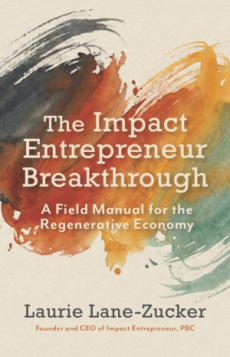
The Impact Entrepreneur Breakthrough: A Field Manual for the Regenerative Economy
Laurie Lane-Zucker
384 pages, Berrett-Koehler Publishers, 2026
Laurie Lane-Zucker believes in the power of words. This will not be a revelation to readers of Impact Entrepreneur magazine, which he founded and publishes online, nor to anyone who knows that Lane-Zucker coined the term impact entrepreneur in 2011. But the words in The Impact Entrepreneur Breakthrough: A Field Manual for the Regenerative Economy are intended to change us, our narratives, the cultures of our communities, and, ultimately, our shared civilization.
The “impact economy,” as Lane-Zucker sees it, is not a sector or a strategy; rather, it is a long-overdue civilization redesign: It is time for a regenerative economy to displace our existing extractive economy. At stake is our mutual security and the future we leave to the generations that will follow us.
Here is where I should pause to confess that I own a worrying number of books about impact investing and social entrepreneurship: I am a scholar and practitioner who is active in these fields, and part of my job is to read for a living and then apply what I read to what I do. But keeping up with the books churned out by my fellow scholars and practitioners is a real problem. The stack of partially read books on my bedside table once grew so large that I dreamed about them toppling over in the night and smothering me in an avalanche of words. I even tried to stay abreast of the burgeoning industry of “impact economy” literature by recruiting a few other practitioners and teachers for a new book club, in which we’d all take a book (from my unsteady pile) and report back to the others, identifying which of these books were worth all of us reading.
I was like Tom Sawyer handing out paintbrushes to help him paint a fence: “Collective book reading will be fun!” I told my new book club recruits. But no one came back for a second book.
The Impact Entrepreneur Breakthrough is a different kind of book: part manifesto, part field manual, and part memoir. It’s a book you can dip in and out of to pull an inspiring quote, recount a story, or refresh an idea. But at nearly 300 pages—not counting its companion teaching guide—it’s also a big book. Big in the breadth, depth, and quantity of ideas; in the stories that Lane-Zucker recounts to explain how he came to those ideas; and, most important, in ambition. Open this book, and before you even start chapter one, you will be invited to acquire the “language to name what you’re doing, frameworks to strengthen it, and connection to a global movement of people doing the same work in different contexts.”
Other books of this ilk tend to follow a three-part formula. They describe what’s happening in the field, they prescribe what’s needed next, and, finally, they issue a call to action to get there. Lane-Zucker’s book changes the formula. While he calls his readers to action, he also calls us to undertake a lot of reflection and introspection about why we’re doing what we’re doing. Then he asks us to deliberately consider how to make sure our efforts take root. He asks us to engender a culture within our communities that will foster the lasting change needed to build a more regenerative economy.
Here is where words as well as actions matter. Words have the power to create narratives that shift cultures, generate breakthroughs, and—as Lane-Zucker witnessed when he created the term impact entrepreneur—even conjure a new professional identity into existence. Lane-Zucker’s secret sauce is his emphasis on asking good questions rather than on serving up pat answers. And so he firmly roots his book in the questions to be asked by those of us working in and studying the fields of impact investing and social entrepreneurship—questions that beget more questions like these: “What if enterprises could heal what the old economy has harmed?” “What makes human systems durable?” and “How do we tell the story of this emerging economy in ways that inspire rather than alienate?”
Lane-Zucker calls on us to resist cynical fearmongering and to redirect capital away from building fortresses and instead push it toward establishing resilient foundations, channeling of resources to the people and communities that generate lasting security through prevention and care.
A careful reader of this book is likely to be reading with pen or pencil in hand, ready to add to its margins additional questions to those that Lane-Zucker offers. This is a journey, as Lane-Zucker reminds us, and where we are at any moment in time is likely to shape not only what we see but also how we respond to those admittedly limited powers of observation. Ask more to see more, he suggests.
Lane-Zucker also is not one of those “If I can do it, so can you” scribes. Quite the opposite. He shares how he failed at an early attempt to become an impact entrepreneur. And he then tells us what he learned from that failure, role-modeling a “fail fast and fail well” approach to impact entrepreneurship.
Fifteen years after Lane-Zucker coined the term “impact entrepreneur,” by his count, there are now tens of thousands of folks who have affixed that label to their social media profiles. And while Lane-Zucker doesn’t say this directly, a big tent can attract those who are not as committed to transforming systems through innovation as he is. Labels without follow-through are rife in this space, from the ineffectual, who through lack of knowledge, skill, or support fall short of their ambitions, to the cynical, who pretend to be doing more than they actually are. In between, there are also folks who are not systems-minded changemakers. Instead, those people are building enterprises and initiatives that are responding to the symptoms of an extractive economy, not addressing and eradicating its root causes.
For practitioners on this spectrum, this book extends an invitation to change or deepen one’s commitment in today’s world. The field manual part of this book offers over a dozen tool kits for showing how to do that, through a combination of inward reflection, outward-facing action, and ongoing curiosity. The manifesto part of this book tells you why action is necessary now, at this moment in history, while the memoir part shares the insights born out of Lane-Zucker’s lived experiences on his own journey as an impact entrepreneur: the good, the bad, the successes, and the failures.
But Lane-Zucker doesn’t stop there, and this is where his book differs from many others. He also tolls a warning: The current extractive economy will not go quietly into the night. There are vested and monied interests that will resist, and they will do so in the name of bolstering security and defense, while actually acting out of short-term, financial self-interest. Lane-Zucker calls on us to resist cynical fearmongering and to redirect capital away from building fortresses and instead push it toward establishing resilient foundations.
Doing so requires channeling of resources to the people and communities that generate lasting security through prevention and care. Because this shift from funding short-term, high-intensity conflicts to investing in long-term resilience systems needs an operational framework—and because Lane-Zucker believes in the power of words—he names this framework, and its principles, “Defense as a Service.”
This change in priorities is possible, Lane-Zucker argues, if we forge authentic identities that are rooted in interdependence. Everything “explored in this book depends on identity,” he puts it. Without that identity work, he warns, all our efforts to build a regenerative economy will collapse.
The book ends with a story of a trip Lane-Zucker took to Mexico to witness the migration of millions of monarch butterflies who winter there. He reminds us of the relay race that these migrating monarch butterflies engage in: After one generation flies south for the winter, multiple successor generations make the return trip north, in the spring, to lands they have never seen across lands they have never traversed.
Think like a monarch butterfly! Lane-Zucker encourages us to join a journey that we are likely never to complete as individuals but can stake a claim to as future generations take up our work and build upon what we’ve created. We, like the monarch, are not just migrating. We’re also pollinating gardens that will flower for future generations.
That is how durable change and ultimately survival take place across generations, be it monarchs or humans.