


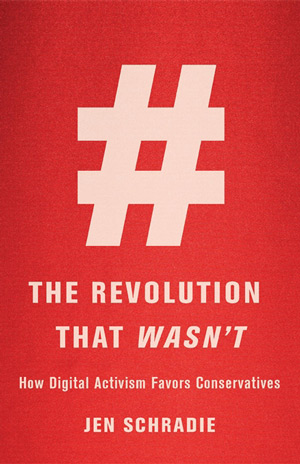
The Revolution That Wasn’t: How Digital Activism Favors Conservatives
Jen Schradie
416 pages, Harvard University Press, 2019
Jen Schradie’s The Revolution That Wasn’t: How Digital Activism Favors Conservatives articulates society’s creeping apprehensions about the digital world. It is not only in surveillance and fake news that digital platforms marketed for our pleasure are harming us. Even in digital activism—the use of digital technology for social change—those who support the status quo have the upper hand.
Even though the scope of the study—an analysis of a few dozen civic groups in one US state—exceeds the magnitude of the book’s title, Schradie’s work should not be dismissed out of hand. Her conclusions regarding the continuing power of those with class privilege, hierarchical organization, and information-focused political aims are compelling and temper utopian arguments about the liberating power of the Internet.
Schradie, a sociologist at Paris’ Sciences Po, quashes the idea that digital tools aid the powerless more than the powerful. Despite her own past work as a media activist and documentary filmmaker, she draws a veil of pessimism on such efforts. “The age of digital utopianism seems to be in its twilight,” she contends. The current digital activism gap between the haves and the have-nots will “not only snuff out the dream that technology would be a force for progress” but also “extinguish the possibility of a truly democratic society.”
Schradie’s dystopianism is not groundless. In fieldwork she conducted between 2011 and 2014, Schradie embedded herself with 34 North Carolina civic groups that either supported or opposed collective bargaining rights. She chose this purple Southern state because it serves as a microcosm in which to study the lived practice of digital activism.
Through her study, Schradie found that the effect of digital technology on activism was far less revolutionary than what past scholars of the topic—such as Manuel Castells, Jennifer Earl, and Lance Bennett—had hypothesized in their own research. “Rather than offering a quick technological fix to repair our broken democracy,” Schradie writes, digital activism has “ended up reproducing, and in some cases intensifying, preexisting power imbalances.” Those with more financial, political, educational, and racial privilege in the offline world are also more productive and powerful online.
Schradie divides her observations about digital activism in North Carolina into the three topic areas of class, organization, and ideology, which structure her book. In the first chapter, she describes how differences in socioeconomic class are amplified rather than erased by digital tools. Members of wealthier organizations in her study had better digital hardware, faster Internet connections, more time to create content, and greater confidence in their own abilities.
The Internet has made possible vast nonhierarchical networks capable of mobilizing mass protests, such as those seen in Occupy Wall Street and the Arab Spring. Yet, in the second chapter Schradie observes that, despite the capacity of nonhierarchical digital networks to foster direct communication, it is division of labor in hierarchical organizations that maximizes digital production. Having a volunteer or paid staffer to run a Facebook page or Twitter account simply results in the creation of more digital content.
Schradie contends that the ideologies that progressives and conservatives bring to Internet use further favor the latter in terms of content volume, complexity, and engagement. In the final two chapters, she posits that conservatives favor freedom, which encourages passionate “informationalizing”—Schradie’s term for propagandizing—by individuals. Progressives, on the other hand, favor fairness, which promotes complex consensus-based organizing of the collective. The organizational efficacy of moving minds, she finds, is easier than that of moving bodies. That is, it is easier to change opinions than it is to change behavior—which is additional evidence that the work of digital activism favors ideological conservatives.
Despite its singular focus on collective bargaining rights in North Carolina, the book is deliberately diverse in its methods. In creating the study on which the book is based, Schradie was careful not to bias her sample by selecting civic groups that were already active online. Instead, she identified 34 groups based on their connection to the issue of collective bargaining and then studied their varying levels of digital activity.
The core of the study is fieldwork. The resulting interviews with 65 progressive and conservative activists are woven into the text as set pieces that illustrate her larger observations about class, hierarchy, and ideology. Her fieldwork is further supported by content analysis of 90,000 instances of digital production and by statistical analysis of that data.
The only methodological shortcoming—which Schradie herself acknowledges—is that she does not link digital activity to the political outcomes of each group. Rather, the level of digital activity is the dependent variable, a kind of end in itself. As a result, she is able to conclude that class privilege, hierarchy, and conservative ideology are correlated with greater digital production, but not that greater digital production is correlated with specific political outcomes.
In the absence of correlation, one is left with coincidence. At the end of the study in 2014, conservatives in North Carolina had won the governorship and a two-thirds majority in the state Legislature, which passed legislation so radically conservative that the Republican governor sometimes vetoed his own party’s bills. The progressives, by contrast, were able to endure and maintain momentum through the Moral Mondays protests, in which a coalition of groups engaged in recurring acts of civil disobedience against discriminatory legislation, intentionally courting arrest inside the state Legislature over which they had utterly lost control.
Schradie also creates a number of innovations in her study, including what she calls a “Digital Activism Score” that forms the basis of her statistical analysis. The score, which seeks to systematize digital activism activity, measures the extent to which each group used and updated specific digital platforms; how interactive a group’s presence was on each platform; and whether or not the public responded to these activities by liking, sharing, and commenting on that content.
In addition, Schradie proposes the acronym ASET (access, skills, empowerment, and time) to explain why the Internet has not flattened social inequities and peppers the text with new concepts to describe the phenomena she is observing. “Informationalizing,” for example, describes the political punditry of self-declared conservative truth-tellers, and her concept of “digital bureaucracy” describes the division of labor in both voluntary and professional organizations that results in higher digital production. As it turns out, within the civic groups Schradie studied, equity-minded college students were less digitally active in their politics than Tea Party retirees.
Importantly, Schradie’s analysis is also intersectional. She digs into the complex racial and class dynamics of labor relations in North Carolina, a state where the fight for workers’ rights began not in the factory but on the plantation. As a result, the fight for collective bargaining rights leads to moments where those on the same ideological side of the debate and who hold the same nominal economical identity as workers are both insiders and outsiders. In one vignette, the professionalized State Employees Association of North Carolina is in the Statehouse lobbying legislators while grassroots groups led by the North Carolina NAACP hold a Moral Mondays protest outside.
So where do these arguments leave us? Is Schradie right that digital activism favors conservatives? Extraordinary claims demand extraordinary evidence, and a four-year study of a small slice of civil society in a single state is not conclusive evidence for the claim that digital technology has not been politically revolutionary for progressives. There are plenty of counterexamples to that thesis, from #MeToo and the anti-Trump network Indivisible to Iran’s Green Movement, the Arab Spring, Occupy Wall Street, and Black Lives Matter. Digital technology has granted new capacities of inexpensive and large-scale communication, coordination, and anonymity to the marginalized on both the left and the right. Whether these new capacities constitute a “revolution” is a matter of interpretation.
Activism is a tactical repertory of outsiders, but it does adhere to the laws of political power. Those who hold power prefer the status quo because it benefits themselves, allowing them to maintain power. Because of that power, they also have the greatest ability to not only prevent but even reverse progressive social change.
The success of the powerful is also more likely because it requires less change. Conservatives aim to retain the status quo. Reactionaries aim to revert to a past status quo. Progressives aim to create a new status quo, the most difficult of the three. For this reason, it is more accurate to say that those who have greater power and more modest aims are more likely to win, regardless of the technology used. What Schradie points out is that, within the bounds of her study, digital technology did not change those preexisting dynamics.
In any revolution, those with the most power benefit the most overall. This rather disheartening trend can be observed in the colonial landowners who benefited most from the American Revolutionary War, in the middle-class white women who benefited most from the women’s movement, and the middle-class white men who benefited most from the gay rights movement. Digital technology has attenuated, but not broken, this pattern.
"In any revolution, those with the most power benefit the most overall. Digital technology has attenuated, but not broken, this pattern.”
Though they are beyond the scope of Schradie’s book, recent examples of successful digital activism further illustrate digital technology’s limited ability to upset existing power dynamics. Though Indivisible and similar groups succeeded in electing a US Congress in 2018 with the greatest racial and gender diversity in US history, and #MeToo succeeded in toppling some of the most powerful sexual predators in the media industry, the Green Movement, the Arab Spring, Occupy Wall Street, and Black Lives Matter offer more complex cases of the disruptive power of digital technology.
In these cases, initial digital mass mobilizations were blocked from consolidating and institutionalizing their gains. In all four instances, digitally enabled protests often resulted in conservative rebounds of varying duration, from former Iranian President Mahmoud Ahmadinejad’s crackdown on the Green Movement to the rise of General Abdel Fattah el-Sisi in Egypt to the election of President Donald Trump in the United States.
Yet, it is also inaccurate to think all is lost. For anyone attempting to make wholesale utopian or dystopian arguments about digital tools, Schradie explains to readers that truth exists closer to the middle. New technologies will continue to shape society, just as society will continue to shape new technologies.