


SkollFest
Reporting from the 6th annual Skoll World Forum for social innovation.
Reporting from the 6th annual Skoll World Forum for social innovation.

Four high-profile female political professionals discuss Hillary Clinton's candidacy for president in this panel discussion. They cover how her run for office affected the future of women in politics and the benefits and weaknesses of women in political leadership.

How does an organization not only promote green and sustainable products but also conduct business in a socially responsible way? At the Stanford 2008 Responsible Supply Chains Conference, leaders of three pioneering enterprises talk in a panel discussion about how they integrate fair trade, sustainable design, green purchasing, and public/private partnerships into every aspect of their business. They offer advice for other organizations and share how they are working to promote social responsibility in their respective industries.

Fraser Nelson, a consultant to nonprofits, gives an entertaining lesson on the why and how of nonprofit lobbying. Most nonprofits do not lobby government for a variety of reasons, but Nelson explains that it is legal, effective, and powerful. In this Stanford Social Innovation Review sponsored audio lecture, Nelson concludes with ways to get the most out of your lobbying efforts and five rules to follow.

With an understanding of these 10 funding models, nonprofit leaders can use the for-profit world's valuable practice of engaging in succinct and clear conversations about long-term financial strategy.

Businesses are not the only organizations rocked by financial scandals. Nonprofits such as the Red Cross, United Way, and many others have been hit as well. In this Stanford Social Innovation Review sponsored audio lecture, Deborah Rhode discusses the need for an ethics upgrade in the nonprofit sector, which by its do-good nature is expected to take the moral high ground. She considers typical pitfalls that nonprofits are vulnerable to, and calls for clearer rules governing transparency and accountability.

In India and Africa, syringes are frequently reused, despite the obvious dangers of cross infection and death. Marc Koska talks about his involvement with Star Syringe, which designed and licensed an auto-disable syringe that prevents syringe reuse. He discusses how single-use syringe adoption is progressing in India, and also talks about the activities and aims of his charity SafePoint Trust.

Social entrepreneurship efforts need marketing as much as any business enterprise. In this audio lecture, Oxford business professor Douglas Holt asserts that there is a systematic way to learn from the marketing success of companies such as Apple, Harley Davidson, and Coca-Cola.

If you haven't bought a flat-screen TV yet, chances are you're waiting for the prices to drop. Technologies get cheaper by virtue of the "experience curve," a phenomenon where, as companies get better at what they do, costs become lower. In this Stanford Social Innovation Review sponsored audio lecture, Robert Searle argues that nonprofits also can have experience curves, achieving a greater volume of outcomes for the same cost. He discusses the types of outcome metrics on which nonprofits should focus.
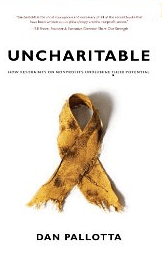
Uncharitable: How Restraints on Nonprofits Undermine Their Potential by Dan Pallotta