


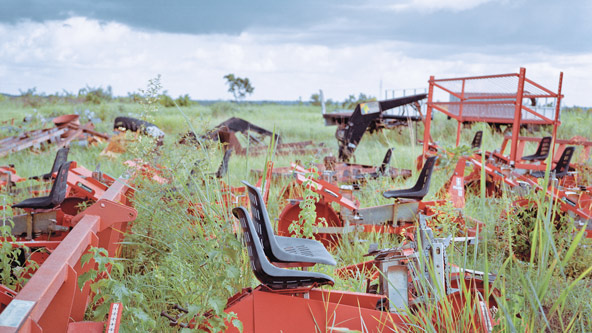
 Biofuel Africa Ltd. came to Ghana to farm the jatropha plant as a fuel alternative, claiming they would bring jobs. Two years later they were gone, leaving behind abandoned tractors. (Photo by Peter DiCampo)
It isn’t unusual that a girl raped in northeastern Kenya would be ignored by law enforcement. But for Mary, whose name has been changed to protect her identity, it should have been different—NGOs had established a hotline to report sexual violence just a few years earlier to help girls like her get justice. Even though the hotline was backed by major aid institutions like Mercy Corps and the British government, calls to it regularly went unanswered.
“That was the story that really affected me. It touched me in terms of how aid failures could impact someone,” says Anthony Langat, a Nairobi-based reporter who investigated the hotline as part of a citizen journalism initiative called What Went Wrong? that examines failed foreign aid projects.
Over six months in 2018, What Went Wrong? collected 142 reports of failed aid projects in Kenya, each submitted over the phone or via social media by the very people the project was supposed to benefit. It’s a move intended to help upend the way foreign aid is disbursed and debated. Although aid organizations spend significant time evaluating whether or not aid works, beneficiaries are often excluded from that process.
“There’s a serious power imbalance,” says Peter DiCampo, the photojournalist behind the initiative. “The people receiving foreign aid generally do not have much say. They don’t get to choose which intervention they want, which one would feel most beneficial for them. Our goal is to help these conversations happen ... to put power into the hands of the people receiving foreign aid.”
What Went Wrong? documented eight failed projects in an investigative series published by Devex in March. In Kibera, one of Kenya’s largest slums, public restrooms meant to improve sanitation failed to connect to water and sewage infrastructure and were later repurposed as churches. In another story, the World Bank and local thugs struggled for control over the slum’s electrical grid.
What Went Wrong? first advertised the project on local radio, encouraging people to report unsuccessful projects in their community. After someone submits a project—a broken well, an empty school building—he or she receives a short text message survey to help a team of journalists verify the report. Once it’s verified, affiliated organizations are notified that a project they were involved in isn’t working.
Although many failed projects were already on locals’ radar, “they would not have been reported on by international media without this mechanism of finding them,” DiCampo says.
The idea sprung from his own experience. As a Peace Corps volunteer in rural Ghana in 2007, he secured supplies for household pit latrines with the understanding that someone else would build them. When he returned years later, the village was scattered with unfinished concrete slabs. Not one household had completed its latrine.
DiCampo began photographing other unsuccessful projects in Africa. “Ride down the street or walk through a village and you will see some semblance of aid that has gone wrong,” he says.
Projects fail for varied reasons—cultural miscommunications, corruption, or ideas that were just bad to start with. But one thing DiCampo kept coming back to was that conversations about aid were often a one-way street.
Aid organizations “are not held accountable in the way that customer service holds companies accountable,” DiCampo says. “If you’re running a company, you know you’re doing a good job because people chose your product over another. That doesn’t exist in foreign aid.”
Put a feedback mechanism in place, he reasons, and you might start to correct this problem.
“Having avenues for people to participate in independent verification is really important,” says Bill Savedoff, a senior fellow at the Center for Global Development. “It’s a way for them to protect themselves as well as to be good citizens, and it’s a way of checking the imbalance of power.” But it’s not going to be easy, he says.
Getting responses from aid organizations responsible for the reported projects has sometimes proven difficult, and maintaining the reporting platform is expensive, making expansion tricky. But even starting the conversation is significant in an industry that often fails to serve the very people it aims to support.
People know what’s best for them, says Langat, the journalist. “Some of these projects failed because the organizations who were going to implement that project were not consulting the people who were supposed to benefit in the first place.”
This article appeared in the Summer 2019 issue of the magazine with the headline: “When Aid Fails.”
Read more stories by Abigail Higgins.