


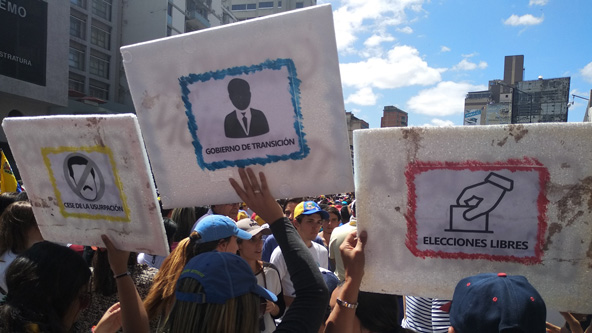
 In addition to raising awareness of human rights
abuses within Venezuela and advocating for political change, PROVEA is now spreading the word about their country’s situation abroad to gain support for “democratic and inclusive elections.” (Photo courtesy of PROVEA)
In addition to raising awareness of human rights
abuses within Venezuela and advocating for political change, PROVEA is now spreading the word about their country’s situation abroad to gain support for “democratic and inclusive elections.” (Photo courtesy of PROVEA)
Countless people have sat on the sofa in the foyer of PROVEA’s offices in one of the many tall buildings of downtown Caracas, waiting to speak with the organization’s staff and seeking help fighting for their rights. Back in the 1990s, a subway union representative named Nicolás Maduro even sat on this very couch while waiting for a meeting.
But Maduro, Venezuela’s president since 2013, is now the cause of most visits to PROVEA’s offices, says Rafael Uzcátegui, the general coordinator for the human rights NGO. The country’s economy has plummeted, with record inflation and unemployment; shortages of water and food; and cuts to basic services that have forced thousands of Venezuelans to flee. For most of the millions who remain, life under Maduro is becoming ever more difficult.
So in addition to raising awareness of human rights abuses within Venezuela and advocating for political change, PROVEA (an organization founded in 1988 whose name comes from the first letters of the Spanish words for “Venezuelan Action-Education Program in Human Rights”) is now spreading the word about their country’s situation abroad to gain support for “democratic and inclusive elections.”
In 2016, PROVEA began an international effort that they call “citizen diplomacy.” The goal was for PROVEA staff to meet with journalists, academics, and human rights activists in other Latin American countries to raise awareness about the problems facing Venezuela and strengthen regional ties.
Uzcátegui says the plan came together after PROVEA’s staff visited Colombia, Peru, and Ecuador—some of the countries that have received Venezuelan migrants. Now they organize at least three weeklong international meetings per year.
Marino Alvarado, PROVEA’s former general coordinator and a frequent member of these trips, says his group “tried to prioritize visiting organizations that still have doubts about what is going on in Venezuela.”
This was the case for Dejusticia, a Colombian human rights NGO that met with PROVEA’s delegation in 2017. “Back then,” says Lucía Ramírez Bolívar, Dejusticia’s head of international affairs, “we didn’t have a deep knowledge about the Venezuelan crisis. We were just starting to see Venezuelan migrants coming here.”
Dejusticia connected PROVEA with Colombian media outlets, and the two organizations helped launch a journalistic investigation into how the Venezuelan crisis was affecting Cúcuta, the largest Colombian city on the border between the two countries.
Colombia has received more than a million Venezuelan migrants, and Dejusticia has become a close ally of PROVEA. During their meeting, as well as in other countries, PROVEA found that there was a regional impetus to work together more closely. PROVEA and Dejusticia, for example, are looking to jointly address humanitarian aid for migrants and assistance for victims of state violence.
“We always see big organizations from the global north talking about problems of the south,” Ramírez says. “We are trying to build regional alliances to better deal with our issues.”
Uzcátegui agrees. Besides, he says, the international aid industry’s priorities often don’t align with the region’s problems.
This is both a financial and an optics problem. PROVEA and other Latin American human rights groups have been criticized for their international funding (the Open Society Foundations, founded by George Soros, and Misereor, the German Catholic Bishops’ Organisation for Development Cooperation, provide the bulk of PROVEA’s budget). And the Venezuelan government and TeleSur—an international TV network run by the leftist governments of five Latin American nations—have accused PROVEA of being a US front trying to overthrow Maduro.
For now, the regional alliance is informal. The organizations mostly communicate through WhatsApp. Their goal, however, is large: “We want to create a horizontal relationship between all our allies,” one that eventually leads to more funders from the region financing human rights work in these same countries.
Some of the trips were not as successful as the one to Colombia—PROVEA has not always been able to change hearts and minds. “We meet with leftist and progressive organizations, and some of them have a sort of automatic allegiance to Venezuela’s [leftist] government,” Alvarado says. But he thinks these meetings still help PROVEA to make strides.
On Alvarado’s 2018 trip to Mexico, where he met with academics from National Autonomous University of Mexico and with a group of leftist activists, “people were very receptive, even if they didn’t share our views,” he recalls.
PROVEA has also visited Brazil, Chile, Argentina, and Uruguay. And Uzcátegui confirms that Dejusticia will welcome PROVEA back to Colombia this year and that they will keep thinking about ways in which regional human rights NGOs can help each other grow.
This article appeared in the Summer 2019 issue of the magazine with the headline: “New Alliances for Human Rights.”
Read more stories by Pablo Medina Uribe.