


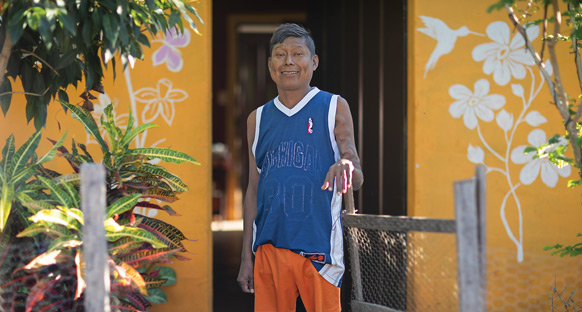
 Elvin Afefeiro Jiménez smiles in front of his new
home in Ahuachapán, El Salvador, built by New Story. (Photo by Mary Anne Morgan Photography)
Elvin Afefeiro Jiménez smiles in front of his new
home in Ahuachapán, El Salvador, built by New Story. (Photo by Mary Anne Morgan Photography)
In Ahuachapán, El Salvador, Elvin Afefeiro Jiménez smiles as he gives Brett Hagler, CEO and cofounder of New Story, a tour of his new home. Kidney failure may have stripped Jiménez, 31, of his youthful vitality, but he no longer has to recover from his daily dialysis in a mice-infested shack with a leaky roof.
“Before, I felt a little bit more depressed, sadder, due to the place where I was living,” Jiménez says. Hagler’s nonprofit not only constructed the new home; it built a sterile private clinic in Jiménez’s backyard for his dialysis. Jiménez also uses his new house to make money fashioning the blue-and-white house number signs that New Story installs on each home they build in El Salvador.
New Story believes its technology can end homelessness. Since its founding in 2014, Hagler and his team have raised funds to build 1,600 homes in El Salvador, Haiti, Bolivia, and Mexico. Their goal is to erect 1,000 communities consisting of at least 100 homes each by the end of the organization’s first decade. New Story will break ground on the first 3-D-printed community this summer.
Stable housing provides more than just a roof over one’s head, says Christy Chin, venture partner at Draper Richards Kaplan Foundation, a New Story funder. “If you know where you’re going to sleep at night, you sleep longer, and you’re healthier,” according to Chin. Her point is substantiated by research conducted by the National Health Care for the Homeless Council, which found that the homeless suffer chronic ailments from disrupted sleep. “It’s easier to get to school and to work, and the family unit is much stronger,” Chin continues. “New Story has been successful because they recognize that they’re going to be focused on housing as a core fundamental stepping-stone to alleviate poverty. Surprisingly, few people have focused on this.”
Data-Rich Foundations
New Story is finding solutions to the housing crisis through tailored software, including a 3-D house printer, participatory design, and data it shares with partner organizations. Before New Story purchases a piece of land, it partners with local governments, local nonprofits, and families who are going to be living in the homes.
“While [involving the local community] should not seem radical in any way, unfortunately, it really is,” says New Story cofounder Alexandria Lafci. “It’s very seldom that the opinions of families in extreme poverty are asked for and, furthermore, incorporated into the end product in a home community.” New Story relies exclusively on local labor and materials to stimulate local economies.
Many applications of technology can improve the welfare of people living in poverty. But technology often takes too long to reach the people who could benefit from it the most. “Instead of waiting for market forces or for-profit incentives to bring technology to the nonprofit sector or directly to people, we really believe in the role of social-impact organizations to bridge that gap,” Lafci explains.
Engineers designed a mobile tool that works offline, making it easier to do surveying beyond the parameters of a Wi-Fi signal or a cell tower. Recently, New Story conducted a six-month impact survey in Labodrie, Haiti. They learned that 75 percent of families reported feeling unsafe in their own home—which, for many at the time, was a tarp tent that could barely fight off downpours and extreme heat. Only 20 percent of families had access to proper sanitation. Just six months after moving into a house, 96 percent of families reported feeling safe in Labodrie, and 96 percent of families can now get to a toilet.
New Story software collects data on safety, health, happiness, and education. Mobile surveys help the team see the difference a home can make, as well as areas in need of improvement. With data-backed findings, they’re able to learn and change systems in current and future communities. They’re also able to partner with the right community organizations to solve issues where they lack expertise. “Surveys have led us in holistically addressing poverty’s complex and unique dimensions,” New Story Brand Experience Manager Annie Brannon says.
In Labodrie, surveys alerted the team that even in the new homes, mosquitos continued to pester people. New Story employees are now working with local partners to find a solution, as well as to inform the way they approach future construction in the area.
The nonprofit plans to sell the software to NGOs, governments, and others, in order to generate sustainable revenue for the organization. “Digital tech can be a game changer in the speed, cost, and accuracy of data collection—thereby speeding up feedback loops,” says social innovation advocate Ann Mei Chang, who interviewed New Story’s team for her 2018 book Lean Impact. But Chang points to the risks of privacy, security, or leaving out disadvantaged populations who aren’t able to access technology.
While the houses in Labodrie were built by hand with bricks and mortar, New Story will use a 3-D printer to build a community of homes throughout Latin America in 2019. They estimate that the Vulcan printer, designed in tandem with the Austin-based construction technologies company Icon, can engineer a concrete 800-square-foot home in the difficult tropical terrain in 24 hours. New Story leaders have partnered with Gente Ayudando Gente (People Helping People) for plans to build about 100 homes.
The social sector tends to focus on “sexy” new ideas, like a 3-D house printer. “While that is promising,” Chang comments, “what is more interesting about New Story is that they have built customer focus, data-driven experimentation, and fast iteration into their DNA. They are continually discovering opportunities to add value.”
Open-Sourced Change
In order to construct homes in rural Haiti and on the rough terrain in El Salvador, New Story engineers designed its printer to work with local materials—a potential challenging constraint. “If the printer were to be a complete failure,” Lafci recalls asking New Story’s board of directors, “and it just doesn’t work for our application, is this still a worthwhile investment?” The overwhelming answer was yes.
Funders and team members are attracted to New Story not only for its proven impact, but also for the potential global benefits. The New Story funding model allows Hagler and the teams to take bigger risks, invest in building software and software engineers, and create 3-D home printers. For $6,500, a donor can sponsor a family and build them a home. Each needy family’s current living situation is described in detail at the New Story website NewStoryCharity.org. To contribute to innovation and R&D, donations run from $50,000 to $1 million per donor annually.
From the start, the team pitched a select group of risk-tolerant investors on the importance of an R&D budget and bringing more technology in-house to create the best product—not just for New Story, but for other organizations too. “We have been fortunate to attract people that understand that just because you’re a nonprofit, it doesn’t mean that you shouldn’t have an R&D budget or an innovation fund,” Hagler says.
Draper Richards Kaplan venture capitalist Arthur Reimers was most attracted to the team as a cohort of exceptional leaders “who are taking a shot at fixing a humongous problem. They’re pioneers.”
“They did an incredible job figuring out who to target for fundraising and how to describe what they were doing,” says Aaron Harris, a partner at Y Combinator. “They were able to clearly articulate how what they’re doing is better, faster, cheaper than existing options, and had the evidence to demonstrate that they could actually do what they said. I think that resonated powerfully with donors.”
At the Draper Richards Kaplan Foundation, Chin was drawn to New Story in part because of their bold vision and the fresh thinking that the young, diverse, and experienced group brought to the age-old problem of housing. Chin wishes more nonprofits received the financial freedom that donors, primarily individuals, have granted New Story: “That’s what special ventures need, that’s what for-profit ventures need,” she says. “They need flexible, patient capital to allow them to fully explore and catch their idea and learn.”
There are approximately one billion homeless people worldwide—a problem not easily addressed by one small nonprofit. But New Story is undeterred. “I am sure they don’t have all the answers yet,” Chang observes, “but having this as a North Star helps them push themselves to constantly think bigger and look for ways to expand their impact. I expect they will have to reinvent their business model a few times on the path to that degree of scale.”
Finding solutions to homelessness also demands cross-sector collaboration. Land needs to be donated close to where the people are currently squatting so that they don’t have to disrupt their lives. The government has to provide utilities. Homes must be built. Donors must be patient and understand that this is not easy work, Chin says. “The donors also need to be open to failing forward and to the iterative process, because this team and the board and our partners are deeply committed to solving the long-term difficult problems of providing housing to a billion people who are internally displaced.”
Lafci is the first to admit that New Story can’t do this on its own. There are many organizations, governments, and private builders that are also addressing the same population of people who lack adequate shelter around the globe. “If change is an open-source pursuit and if we make everything that we are learning and building available to the broader sector,” she says, “that is how we’re going to have impact at scale.”
Read more stories by Corey Binns.