


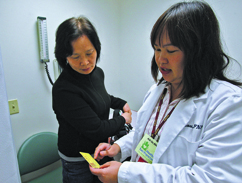
 Patient Yin Ling Ho receives care at North East Medical Services in San Francisco. (Photo by Jim Wilson/The New York Times/Redux)
Behind the busy sushi bar, chef Ki Meyer felt his heart racing faster than usual. When the last customer left, he shared sake and cigarettes with his co-workers as always. Then he collapsed. Emergency room doctors told him his blood sugar level indicated he was prediabetic. Only 47, Meyer worried his poor diet had already turned him into an old man. Even more terrifying was the hospital bill. Meyer prepared sushi at several small restaurants in San Francisco’s Chinatown, but none of his jobs came with health care. “I hadn’t been to a doctor in 17 years,” he said. “I just couldn’t afford it.”
In the ER, a nurse asked Meyer if he had ever heard of Healthy San Francisco. The answer was a veritable lifesaver. San Francisco is the first US municipality to offer universal health care through the city’s Department of Public Health. Uninsured people like Meyer, between the ages of 18 and 64, some with jobs, with preexisting conditions, even without citizenship—some 64,000 San Franciscans in all—are now able to see a doctor and avoid debt.
Meyer belongs to the ranks of 50.7 million US health care outsiders who are too young to qualify for federal Medicare health insurance, earn too much to qualify for state Medi-Cal, and do not make enough to pay for private coverage. To join Healthy San Francisco, he picked from 32 “medical homes.” He selected one in his neighborhood, the Chinatown Public Health Center, and was issued a medical ID card with the name of the doctor who would oversee his care. The card entitles him to routine checkups, referrals to specialists and mental health therapists, X-rays, and lab work. Dental and vision care are not covered.
Since Mayor Gavin Newsom launched Healthy San Francisco in 2007, more than 54,000 people have enrolled, comprising 84 percent of the city’s estimated uninsured. The program is not insurance; it’s a revamped system of health care access that uses the city’s network of providers at neighborhood clinics, community hospitals, public health centers, and state-of-the-art resources at the University of California, San Francisco. Since 2009, Kaiser Permanente and the Brown & Toland Physicians health plans have agreed to provide services to Healthy San Francisco patients as well.
The program has become the rare solution for the laid-off tech worker who gets a kidney stone, the bike messenger who gets hit by a car, or the immigrant family whose small corner store covers the rent but nothing more. As more people join the “patchwork force,” Healthy San Francisco is emerging as a replacement for the traditional model of full-time employer-provided health benefits. “When this first started, I saw mostly poor people, in the 40 to 64 age range, signing up,” said Sharon Kong, an eligibility worker for the Department of Public Health. “Now, because the economy changed, it’s more people in their 30s to 40s, people who work five jobs, work on call, or on contract.”
EARLY PUBLIC HEALTH IMPACT
At first, Healthy San Francisco was available only to those living at or below the poverty line. By the third year, people making 500 percent more than poverty wage could sign up, ensuring the working poor also would be covered. San Franciscans are amazed to learn they can make up to $54,480 a year and still qualify, Kong said. Many homeowners assume they won’t make the cut until she tells them only liquid assets are counted in calculating income. For those earning less than $908 a month, almost three-fourths of those enrolled, the program is free. The rest pay $60 to $450 per month, based on income.
The bulk of Healthy San Francisco’s $164 million annual price tag is covered by public monies: nearly $100 million from the San Francisco city and county general fund, and $23 million in federal funding. Private providers, such as California Pacific Medical Center and St. Francis Memorial Hospital, pay $23 million. Patient fees add $5 million and another $14 million comes from a city requirement that businesses with more than 20 workers pay up to $2 per employee per hour toward some form of health care: either private insurance, a flexible spending account, or Healthy San Francisco. Some restaurants now pass that cost on to diners through a health care surcharge on their bills.
Early reports show that Healthy San Francisco is already having an impact on public health. Hospital admissions among plan members have dropped 14 percent, and the average number of hospital days has been cut in half, suggesting that chronic illnesses such as diabetes, asthma, and hypertension are better controlled. But the real eyepopper can be found in the emergency room. The whole point of investing in universal health care is to pay now so that the community doesn’t pay later—in overuse of the emergency room for nonemergencies, or for urgent ER care that could have been avoided with routine checkups.
“Statewide, 18 percent of the adult Medi-Cal population is using the emergency room for nonemergencies, and in our program it’s 9 percent,” said Tangerine Brigham, who runs the Healthy San Francisco program. “When we allow people to select a clinic, they develop relationships with their providers, so when they get sick they are more inclined to return to those providers.”
Dr. Albert Yu is doing less episodic care at the Chinatown Public Health Center, now that he has assigned patients. Before, most Healthy San Francisco members got some sort of care on a sliding scale for the indigent at the city’s network of public clinics, but it was difficult to diagnose and prescribe accurately when patients had no coordinated medical records.
“Before, I’d give a referral, then never know if the patient followed up,” he said. “It was hard, because most of us who choose to work for the Department of Public Health want to serve people with little or no access to health care.”
POLITICAL WILL PLUS INFRASTRUCTURE
San Francisco’s health care experiment has won numerous national awards, has been replicated in Howard County, Md., and most notably was used as a blueprint for President Barrack Obama’s $938 billion Health Care Reform Act, which aims to bring universal health care to the nation by 2014. Brigham estimates that up to two-thirds of Healthy San Francisco users will take advantage of expanded Medicaid under Obama’s plan. But there will still be people who don’t fit into any of the health care boxes—the homeless and undocumented people are not mentioned in the health care reform talks, for example.
“In large part, national health reform will cover 30 million people in the United States, and estimates are that there will still be over 20 million people who will be uninsured, using county delivery systems,” Brigham said. “It’s still important to ensure access to health care on a local level.”
Will the most disenfranchised sign up for Healthy San Francisco? The program already requires annual membership renewal, something that has proven difficult for some. In the 2009-10 fiscal year, 17,311 participants were dropped from Healthy San Francisco because they didn’t fill out their paperwork, despite multilingual reminder letters, phone calls, and some home visits. Public health workers are crunching the numbers now to see if their solution—a lottery-driven Safeway supermarket gift card for people who turn their paperwork in on time—was an incentive to stop the outflow.
Sandra Hernandez, the city’s former health director who was given 100 days to implement Healthy San Francisco after she took over as CEO of the San Francisco Foundation, said what makes San Francisco unique is also what it makes it one of the handful of places—along with the state of Massachusetts—where universal health care works. San Francisco had the political will, a previously existing network of public health clinics, and the benefit of being both a county and a city so the two entities were not in competition for funding. Previous attempts at universal health care in San Francisco had failed because the unions were not at the table, so Hernandez made sure to invite them this time, along with small business, medical providers, politicians, doctors, and patient advocates.
“We always felt, how could it be that here was San Francisco with a world-class academic medical center, a world-class public health department, some of the best federally qualified health centers in the country—yet we had tens of thousands of uninsured adults with no access to these amazing services?” Hernandez said. “We were determined to make it better.”
After he joined Healthy San Francisco, Meyer quit smoking and stopped socializing with his drinking buddies. He changed his diet and lost seven pounds. Now he checks in regularly with his assigned nurse practitioner. “I have somebody to talk to now, to ask questions about all this stuff that’s going on,” Meyer said. At a recent visit with his nurse, he said he had bouts of shortness of breath, typically when he was hunched forward playing videogames on the city bus. She checked his lungs and heart, and found both to be clear. He told her it might be anxiety—he’s worried about getting laid off because the sushi business is slow.
“Do you have a relaxation practice?” she asked, like yoga? “I’m not a yoga person. I go gambling. I’ll drive all night to Nevada and play the slot machines for three hours, that calms me down,” he said. He asked if it was normal that he kept losing weight. He was also worried about becoming diabetic, so he had started skipping meals. She advised him to eat smaller portions, but not to skip meals, because that could make him dizzy. She got on the intercom, and a behaviorist appeared in the doorway to talk to him privately about calming lifestyle changes.
“I don’t know what I would have done about all this before,” he said, as he followed the therapist to her office. “It feels like someone is looking out for me now.”
Meredith May is an award-winning feature writer for the San Francisco Chronicle and a journalism teacher at Mills College in Oakland, Calif.
Read more stories by Meredith May.