


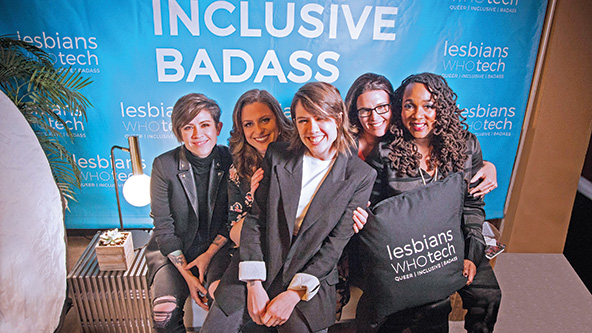
 Musicians Tegan and Sara, founder Leanne Pittsford, and emcees Danielle Moodie and Andrea Minkow, huddle at the 2018 summit in San Francisco. (Photo courtesy of Marisa McGrody)
Since the tech boom of the late 1990s, Silicon Valley has been synonymous with a certain kind of power player—one who is typically straight, white, and male. And, despite Sheryl Sandberg’s 2013 Lean In manifesto, which popularized the idea of women unapologetically striving for career success, women of color and other marginalized people have had no clear path to make their way into the land of opportunity.
In the mid-aughts, entrepreneur Leanne Pittsford found herself grappling with the lack of inclusivity in Silicon Valley and the desire for role models and peers. She was looking to meet other LGBT women but had trouble finding them, ironically, in San Francisco—an international gay mecca. The LGBT tech spaces in the city were filled with men, while the sector’s community groups for women were overwhelmingly heteronormative.
The frustration that Pittsford felt was an extension of what she’d seen in her previous role as senior director of the civil rights nonprofit Equality California, where calls on the community to fundraise for marriage equality had proven similarly skewed, largely a result of queer and trans women and nonbinary people not having the financial ability to contribute like their gay male counterparts—not only do gay men earn more than all other segments of the LGBT community, but they now earn more than their straight male counterparts.
“Economic power is how we’re going to create change; it’s how the world moves. It’s really our civic duty to have economic power,” Pittsford says. “I wondered how I could increase economic power for LGBT women, and what can we do to have an impact and figure out a solution [to economically empower] queer women and nonbinary folks.”
In 2012, Pittsford founded Lesbians Who Tech & Allies, what is now the largest LGBT community of technologists in the world. Since its launch, Lesbians Who Tech & Allies has created spaces and opportunities for more than 70,000 LGBT women, people of color, nonbinary people, and their allies from more than 100 countries through meetups, bicoastal summits, mentorships, and scholarships.
Pittsford is transparent about how she came to fund the beginnings of Lesbians Who Tech & Allies: Her father and brother both passed away and left her with the finances to build the future she wanted. She launched Lesbians Who Tech & Allies initially under the auspices of her own self-funded agency, Start Somewhere, but has since been able to partner with and find sponsorships from technology companies to support its endeavors. This relationship is mutually beneficial, as these companies get to take advantage of Lesbians Who Tech & Allies’ network for their own diversity and inclusion recruiting and hiring efforts.
“It’s a social enterprise,” Pittsford explains. “Tech companies need recruiting and retention support, so it’s all built around how you retain and recruit talent. The LGBT women and nonbinary folks that work at these companies—how do you keep them there? We’ve basically become, over the course of seven years, recruiting experts.”
An Intentional Community
“People used to enter these spaces in the tech industry and think that they were the only one—that they had to keep their head down; they didn’t really have any support within the confines of their jobs and positions,” LGBT advocate and journalist Danielle Moodie explains. “Now they have this whole outside network where they don’t have to feel like they are alone anymore.”
Moodie first met Pittsford in 2013 and, impressed by Lesbians Who Tech & Allies’ mission, agreed to host an early summit and joined the advisory board shortly thereafter.
Roz Francuz-Harris also joined the advisory board after attending an Lesbians Who Tech & Allies summit in 2015 with her then-employer, IBM, which was a corporate sponsor of the summit. Now the director of technical recruiting at Zillow, Francuz-Harris was inspired like Moodie, calling it an “internal awaking” about the potential of what this deliberate community could achieve. “There were congressional candidates, there were CEOs, there were VPs and executives and leaders and foundations that supported LGBTQ rights,” she recalls of her first summit, “and we were having a discussion about best practices, legislation, and inclusive benefits—we talked as if we all worked for the same company.”
Belonging is an integral value of Lesbians Who Tech & Allies, and creating an intentional community presents a rare opportunity for a marginalized group of people to speak with each other in a nurturing and empowering environment. For Pittsford, that includes a personal mission to make sure Lesbians Who Tech & Allies events meet a quota of having 50 percent people of color and 15 percent trans, gender-nonconforming, or nonbinary presenters in the lineup.
“If you want to be intentional about representation, if you want to be intentional about equity, then you have to create markers until it becomes second nature,” Mills says. “And even then, people always lapse. So, I think that it’s important to challenge yourself to reach these goals. I don’t know why other organizations and companies don’t just do that.”
As a white cisgender woman, Pittsford says, she knew it meant working to build trust with communities of color. “You have to prioritize building trust,” Pittsford says. “If you don’t prioritize it, then you’re just going to [erode] the trust we’ve built over 20 summits.” To build this trust, Pittsford went into these communities to listen, learn, and participate. “I would make time to show up at their spaces when it was appropriate—show up for them in whatever way I could as a leader and as a person, trying to provide value for those communities.”
At a time when diversity and inclusion are cornerstones of equity efforts in the tech sector, Lesbians Who Tech & Allies is a network that makes entire communities of people visible. The opportunity to connect with a diverse talent pool is why companies like Amazon, Google, Facebook, and Target have sponsored past summits, which take place annually in San Francisco and New York. And sponsoring a summit, which ranges from $10K to $100K, lends queer cultural cachet to these companies; investment represents a kind of allyship.
One of the biggest draws for summit attendees is seeing people who share identities and backgrounds with them on the Lesbians Who Tech & Allies stage and having the opportunity to network with them. Lesbians Who Tech & Allies speakers have included everyone from Hillary Clinton and Stacey Abrams to civil rights lawyer Roberta Kaplan, podcaster Kara Swisher, San Francisco Mayor London Breed, and Netflix’s Chief Marketing Officer Bozoma Saint John.
In addition to its quota system, Lesbians Who Tech & Allies has launched initiatives aimed at helping LGBT people and people of color suffering financial hardship to gain a foothold in the tech industry. For example, in 2016 it created the Edie Windsor Coding Scholarship, named after the late lesbian activist who was also a programming pioneer at IBM; it covers up to half of recipients’ tuition for a coding boot camp or partner school of their choice. Since its inception, Lesbians Who Tech & Allies has funded more than 250 recipients, and the program has grown to include extended support to help scholars find jobs, network, and connect with mentors in their chosen field.
“I feel very indebted to being part of one of the cohorts because that really catapulted me into a tech career,” data engineer Christine Liu says of her Edie Windsor Scholarship in 2017. “And I think there’s something also about being an Edie Windsor scholar where you’re like, ‘I need to live up to that.’ Every time I see that on my résumé, I’m like, ‘I have something to work toward and to live for.’”
Moving Online
Lesbians Who Tech & Allies’ summits are self-sustaining, thanks to the sponsorship model and ticket prices, which range from $149 early-bird pricing to $349 last-minute pricing. Pittsford says that around 75 percent of ticket sales come from companies sponsoring their employees, and 25 percent of summit tickets are awarded through Lesbians Who Tech & Allies scholarships, so that people with economic hardships can attend for free.
Because of the COVID-19 pandemic, the summit moved online in 2020. And, while so much of what Lesbians Who Tech & Allies does can happen virtually, part of its initial success was in the spirit of gathering, making real-life connections that could translate elsewhere but were inspired by the camaraderie too rarely extended to LGBT women and nonbinary people. Lesbians Who Tech & Allies likely won’t have another in-person summit until 2022, Pittsford says. The slow-down period has been crucial for her and her staff, now a team of eight, to reflect on internal operations in terms of sustainability and staff benefits, including parental leave and 401(k) plans for employees.
Showing up for the community looks a little different in 2021. Pittsford has been steadily working on keeping the connections strong and frequent through a new app called Include. The app sources LGBT tech workers from a broad range of educational backgrounds and professional experience and connects them with companies looking to hire and create more diverse teams of engineers, product managers, user experience designers, data scientists, and designers.
In addition to the app, Lesbians Who Tech & Allies hosted a free Pride Summit last June and hopes to expand upon the networking and recruiting it’s been doing since its founding. This includes programmatic work to support LGBT women and nonbinary people throughout all levels of their careers, as they had planned to do before the COVID-19 pandemic. When in-person summits resume, Lesbians Who Tech & Allies hopes to secure more long-term and sustainable funding for mentorship and career shadowing such as “Bring a Lesbian to Work Day,” as well as creating opportunities for midlevel executives in tech looking for upward career mobility.
“What does our community need? What are the priorities?” Pittsford says of the path forward. “We’re always trying to figure out how we can make sure that people within our community are not getting left out and that their voices are being heard.”
For Francuz-Harris, it is this intentionality about community needs that continues to drive her passion in working on LWTA’s board.
“We are here,” she says, “and we deserve to be seen.”
Read more stories by Trish Bendix.