


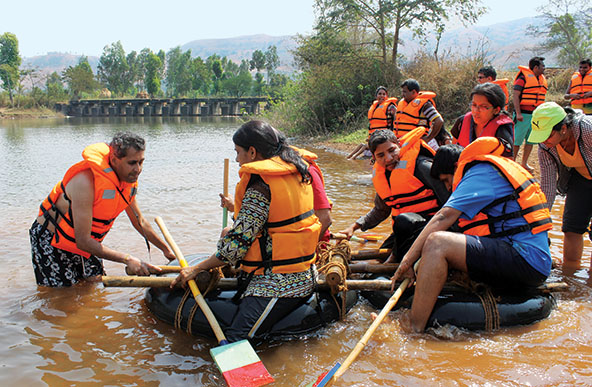
 ABBF founder Divyanshu Ganatra assists participants during a raft-building activity in Pune, India, in 2017. (Photo courtesy of Adventures Beyond Barriers Foundation)
As a blind person, Tony Kurian spent his youth without much outdoor activity. He wasn’t allowed to play outside with his classmates during recess. When he was a teenager, he opted out of activities like hiking with friends, because he thought he would slow them down.
In 2015, Kurian met Divyanshu Ganatra, founder of the nonprofit Adventures Beyond Barriers Foundation (ABBF). Established the previous year in the western city of Pune, ABBF offers subsidized, accessible, and inclusive adventure sports trips to all people, both disabled and nondisabled.
Ganatra, who is also blind, encouraged him to run a marathon with ABBF. “I always thought disabled bodies like mine were weak, and I could never associate [my body] with sports and adventure,” says Kurian, now a doctoral student at the Indian Institute of Technology Bombay. But his experiences with ABBF soon changed his perception of himself and other disabled people. Through his participation with the nonprofit, Kurian ran his first 5K race, guided by a sighted person. Today, he participates in several of its activities, including marathons, rock climbing, and tandem cycling.
ABBF brought adventure sports into Kurian’s life just as it has done for more than 10,000 disabled people and counting. It designs activities—scuba diving, solo and tandem cycling, mountaineering, rock climbing, trekking, marathons, wall climbing, rappelling, and paragliding—to be accessible for all people. The first nonprofit in India to tailor adventure sports specifically for people with disabilities, it has already organized and operated more than 150 events in 15 Indian cities. “ABBF has built camaraderie between the two [disabled and nondisabled] communities and fostered understanding and empathy for each other,” Ganatra says.
Adventure sports companies in India have traditionally been reluctant and ill-equipped to serve people with disabilities, leading to exclusion and rejection. “You are blind, so we can’t help you,” Kurian was once told by a paragliding instructor. And Rahul Ramugade, a wheelchair cricketer and national-level para-swimmer, was denied permission to scuba dive. “If you fall and hurt yourself, we’ll be asked about why we let a disabled person participate,” an instructor told him.
In a world that questions the abilities of disabled people, ABBF instead recognizes their potential and gives them opportunities.
India’s most recent census, in 2011, recorded 26.8 million people with disabilities. Globally, there are more than one billion disabled people. Misconceptions that disabled people can’t travel, are not adventure-seeking, or lack the spending capacity have rendered them an underserved community in travel, adventure, and leisure tourism.
Providing accessibility for disabled people to travel and participate in physical activities is not just a social responsibility—there is a business case, too. A 2017 study by the global travel technology provider Amadeus found that eliminating accessibility barriers could increase disabled people’s travel budget by up to 34 percent.
Shattering Stereotypes
Ganatra spotted an opportunity. An enthusiastic outdoorsman, he lost his sight from glaucoma at 19 years old. He immediately stopped trekking, cycling, and mountaineering—largely because adventure sports companies refused to allow him to participate. It took him seven years to find an instructor who agreed to train him to paraglide solo. In April 2014, he garnered significant media attention by becoming India’s first blind pilot to paraglide independently. He thought that if one person’s success created so much awareness, the impact could be much greater if more disabled people were given the opportunity to participate, too.
Ganatra believes that adventure sports is an effective medium to give visibility to and integrate the disabled community more fully into society. By providing opportunities to both disabled people and able-bodied people together, ABBF has generated cross-community engagement that has nurtured friendships and awareness about the abilities of disabled people. “Often, nondisabled people come with common misconceptions, such as a blind person can’t fly solo or a quadriplegic person can’t experience the joy of free and liberated scuba diving,” Ganatra explains. “Once they meet and those stereotypes are broken, they also realize that disabled people have PhDs, MBAs, and diverse talents, and they can be hired across disciplines.”
Ganatra founded ABBF based on the very premise that people learn much more about each other in an hour of play than in a year of conversation. Ganatra had frequently spoken with his friend Harish Raichandani about societal attitudes being the biggest barrier to people with disabilities being treated as equal in dignity to nondisabled people, and about the fact that mindsets needed to change to pave the way for social progress. Ganatra was so committed to this belief that he launched the nonprofit using only his personal savings, and Raichandani, an organization development consultant and now ABBF advisor, sponsored the first employee’s salary.
Each expedition begins with a planning stage, in which ABBF’s team members conduct reconnaissance of the entire projected route to map out the challenges of the terrain, weather, and travel, as well as noting any medical facilities along the route in case of emergency. Then they work on safety measures and determine the maximum number of participants before advertising a trip to the public. Once people register, Ganatra offers them an orientation session on accessibility and safety, as well as practice sessions for nondisabled participants on engaging with disabled participants.
In these practice sessions, a disabled person and a nondisabled person are partnered to figure out ways to work together during the adventure. For example, a blind person seated behind a sighted pilot on a tandem cycle might discuss ways to maintain the center of gravity on a long bike or how to maneuver a sharp turn with their partner. Blind marathoners, for example, are able to experiment to determine if they prefer holding their sighted partner’s hand or elbow, or have a hands-free tether to link them.
ABBF provides specialized equipment for different disabilities, such as adaptive harnesses for wall and rock climbing, solo and tandem cycles for amputees, scuba gear designed for people with paralyzed limbs, and all-terrain wheelchairs for mountaineering.
Every expedition ends with a reflection session—a defining component of the nonprofit’s mission to “introduce inclusion through play”—where participants share thoughts about their experience. Many able-bodied participants say that they have become aware of their ignorance about the disabled community. Most leave their experience with the conviction that they can adopt inclusive practices within their own professions.
ABBF also hosts public sessions after daylong events, like marathons, to create visibility and awareness about disability, in which disabled participants volunteer to talk with audiences about their adventure experiences.
Each ABBF activity has a fee for participants that varies by activity. If a participant cannot afford to pay the fee, ABBF subsidizes or fully covers it.
Funding from financial services company Bajaj Finserv Ltd., HSBC Bank, and management consulting company Capco have supported ABBF’s largest expenditures, particularly the adaptive equipment and traveling medical team, since 2017.
Some participants have even become its biggest funders. Philanthropist Sudhir Shenoy not only has financed and fundraised for ABBF but also has led their food relief and COVID-19 vaccination efforts in Maharashtra state. Working with ABBF, Shenoy felt that “there is much more to do for the disabled community than just offering donations” and has actively connected numerous disabled people with employment opportunities.
Despite this financial support, however, funding remains ABBF’s greatest challenge because potential benefactors do not consider adventure sports important for disabled people, and the bias that disabled people cannot participate in sports is still widespread. Ganatra has fielded questions from potential donors who are skeptical about ABBF’s mission such as “Why do they need to climb a wall or a mountain? What’s the point of a wheelchair user scuba diving? Shouldn’t they be sitting safely inside their homes? Shouldn’t the money be spent on their education or employment?”
Making Space
Since its early days, ABBF’s events have been limited because it has had to schedule them based on venue availability and venue cost. So, in 2017, Ganatra decided to build India’s first outdoor accessible adventure sports and development center. The 3.5-acre space in Dhanep, a village 43 miles from Pune, is being constructed in phases as ABBF acquires funding. It will be home to most of ABBF’s adventure sports, making its operations financially sustainable from charging fees. The center will also give ABBF an opportunity to run activities with more regularity.
In addition to serving as an adventure sports venue, the site will offer people with disabilities free certified vocational courses to enhance their employment chances. ABBF plans to launch the first phase of the development center with skilling courses such as cycle repair by mid-2022.
The COVID-19 pandemic has suspended all adventure sports activities for almost two years, during which time ABBF has provided food relief and vaccinations for people with disabilities. The operation will reopen this summer with the first phase of the sports center. ABBF also aims to grow their team from 7 to 10 staff members.
ABBF hopes that the venue will be a hub where corporations can engage with people who have different abilities. “Their experiences at the center will motivate them to build cultures of inclusion within their organizations,” Ganatra says. “It will be a win for everyone when these corporations then deliberately take steps to include disabled people in their workforce and also create products for them.”
Read more stories by Priti Salian.