


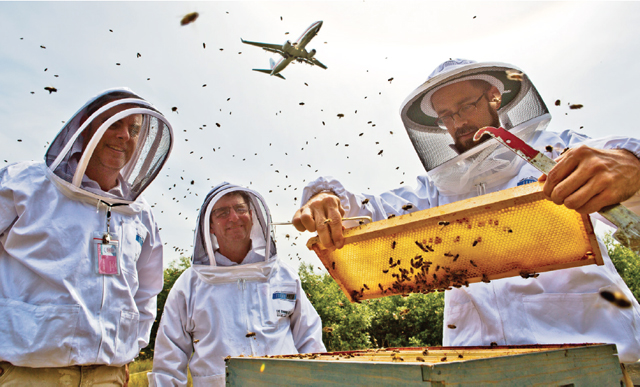
 Beekeepers examine an early honey harvest at Sea-Tac International Airport. (Photo by Rod Hatfield, courtesy of the Common Acre)
If you happen to arrive in Seattle or Portland, Ore., by plane this spring, you might notice dense fields of wildflowers and other flowering shrubs blanketing open spaces near the airport runways. “For the few people who get to see it, this is going to be amazing,” says Eric Mader, co-director of the pollinator program for the Xerces Society for Invertebrate Conservation, a nonprofit based in Portland. But human enjoyment of the scene is only a pleasant side effect; the intended beneficiaries are bees.
When it comes to managing flora and fauna, most airports focus their efforts on keeping geese and other wildlife safely out of the way of air traffic. Bee projects reverse that pattern, turning airport land into an attractive space for bee species that are under environmental duress. “No matter what you do at an airport, you’re going to attract something,” says Steve Osmek, a wildlife biologist who works at Sea-Tac Airport, near Seattle. (Sea-Tac was the first US airport to create such a position.) “We want to attract species that aren’t hazardous at all [but] that need some help. That’s especially important in urban areas where habitats are at a minimum.”
Honeybees, bumblebees, and less-known species of wild bees all face serious ecological threats today—even the threat of extinction. So conservationists are getting creative about finding habitats for them. “This is a tremendously good fit for airports,” says Mader, whose organization helps create and maintain pollinator habitat projects. “There’s no reason why more airports aren’t doing it.”
The bee project in Seattle, called Flight Path, came about at the suggestion of Bob Redmond, executive director of the Common Acre, a nonprofit that offers programs that combine ecology and the arts. He and his colleagues persuaded the Port of Seattle to join them on a two-pronged effort: First, replant vacant airport land to attract bees and to breed healthier bee stock that can adapt to the Pacific Northwest climate. And second, he explains, use the arts to “get people thinking about what’s going on with our bees.”
Since the summer of 2013, Redmond’s organization has moved 25 honeybee hives onto airport property, started replanting 20 acres of scrubland with wildflowers, and curated an education outreach and arts exhibit—at Terminal B, of course. “We want people to understand the science and the poetry of bees,” Redmond says. “They’re fascinating, and they bring out the entomologist in all of us.”
Breeding a more resilient honeybee is likely to take several years, but other benefits of the project should accrue more quickly. “By creating habitat for native pollinators, we’re going to identify which wild bees are thriving here,” Redmond says. The European honeybee, which is used extensively in commercial agriculture, is not native to the United States, and it has been devastated by a condition called colony collapse disorder. “We can tell local farmers, ‘If you plant these specific plants, you will attract a community of wild [native] pollinators. That’s a new workforce for your crops,’” Redmond says.
Mader, meanwhile, notes that “the situation with our native bees is just as perilous” as the plight of the honeybee, but it “gets virtually no attention.” Bumblebees, for instance, produce no honey but are powerhouses when it comes to pollinating valuable crops like blueberries and tomatoes. “On a bee-for-bee basis, they move more pollen [than honeybees],” he says. About one-third of the bumblebee species in the United States are threatened with extinction, he estimates.
At Sea-Tac Airport, Osmek is finalizing plans for the next expansion of pollinator habitat. A public golf course on the south end of the airport was recently declared a hazard because it attracts geese and other flocking birds that can get in the way of planes. The course will soon close, and the airport will replant a 50-acre section of that area with types of vegetation that repel wildfowl but attract bees and small songbirds. “In the long term, this [project] will save maintenance costs” while also benefiting bees, Osmek says.
Read more stories by Suzie Boss.