


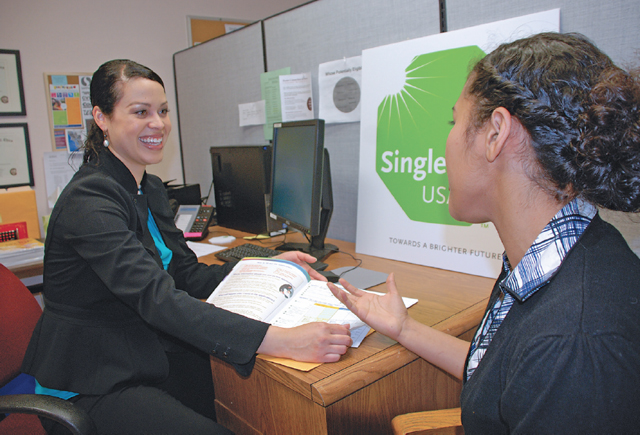
 At City College of San Francisco, a Single Stop USA coordinator talks with a client about available resources. (Photo courtesy of Single Stop USA)
Ruben Gomez never thought that he’d have to go on food stamps. But in 2012, his wife became pregnant, and his cost of living suddenly increased. At the time, he was a student at Miami Dade College in Miami, Fla. He considered dropping out of school and getting two or three jobs to pay the extra bills. “I didn’t want to sign up for welfare. I was prideful,” he says. Pride wasn’t the only reason for his reluctance, though. Gomez also dreaded the laborious and complex sign-up procedures that public assistance programs often require.
But Gomez changed his mind about using food stamps—and about leaving school. Through Single Stop USA, a national nonprofit that connects people with a broad range of benefits and services, he was able to sign up for food stamps, apply for a student loan, and enroll in emergency Medicaid. He also secured a $3,000 tax credit. A Single Stop coordinator based at his college not only helped him determine his eligibility for those benefits, but also guided him through the process of applying for them. Gaining access to those benefits paid off. Gomez received an associate’s degree in 2012, and he’s now pursuing a bachelor’s degree from Florida International University.
Single Stop operates in more than 100 locations across eight states. As its name implies, it’s a one-stop shop where struggling students, people who are unemployed, and other low-income Americans can access the resources they need to improve their condition—and their future prospects. “We’re looking at 46 million Americans in poverty, with a nonprofit market that’s splintered in how it delivers services to people trying to move up the economic ladder,” says Elisabeth Mason, cofounder and CEO of Single Stop. “Our approach allows low-income clients to get all of the resources and support they need in one place.”
Since 2007, Single Stop has helped nearly 900,000 households to tap into services and benefits worth a total of more than $2.4 billion. The organization has grown fast, and it’s poised to grow still more. Its goal, according to Mason, is to serve more than 1 million households annually by 2018. By expanding its reach into community colleges, veterans’ facilities, and other venues, Single Stop aims to equip more and more clients with the skills, services, and benefits that they need to gain a shot at sustainable economic security.
A “Comprehensive Model”
When clients visit a Single Stop site, they meet with a trained staff member who helps them answer a handful of questions (about their family income, their ZIP code, and so on). Then, in as little as 15 minutes, they receive an estimate of the benefits they’re eligible to receive—$3,000 per year for health insurance and $6,500 per year in college tuition assistance, for example. Single Stop provides this core service at community centers, job training facilities, libraries, health clinics, and other sites.
As part of its push to scale up the one-stop model, Single Stop started a community college initiative in 2009. The initiative now extends to 17 campuses across the country. “Community colleges offer an ideal opportunity to penetrate millions of households,” Mason says. Nationwide, she notes, about 12 million students attend community colleges—yet more than half of them end up dropping out. By taking advantage of Single Stop services, she adds, students “are able to get through college and have the potential for higher-paying jobs.” According to research cited by the organization, a boost worth as little as $300 can be all that a student needs to stay in school and receive a degree or certificate. Along with enabling students like Gomez to access public benefits, a Single Stop coordinator can help them with issues that require legal counseling, financial coaching, and other services.
Noah Brown, president and CEO of the Association of Community College Trustees, began a partnership between his organization and Single Stop four years ago. He was intrigued by the simple, unified approach that Mason and her team have developed. “It just made sense,” he says. “Its comprehensive model is intelligently designed and has the power to shift the needle for low-income students.” Brown meets routinely with students who have received assistance through Single Stop. “It’s the first time in some of these students’ lives when someone has taken them by the hand and told them that resources exist and are available to them,” he notes.
For Mason and her team, the community college initiative has a crucial strategic advantage: It leverages an existing system that can enable the institutionalization of the Single Stop model. Single Stop takes charge of training and managing coordinators on each campus, and those coordinators work out of an office that bears the Single Stop name and logo. But the coordinators are community college employees, and colleges provide office space and other forms of support. Single Stop plans to expand its reach to dozens of additional campuses over the next five years. Already the initiative has demonstrated that it can achieve an impressive level of impact. In 2012, Single Stop helped more than 2,300 students nationwide access more than $6 million in food stamps. (That year, roughly half of those who obtained a public benefit through Single Stop received food stamps.)
The community college initiative isn’t the only way that Single Stop is expanding its model. The organization also operates a program that helps people navigate the services available through the Affordable Care Act, along with a program that assists survivors of the 9/11 attack on the World Trade Center. In 2013, moreover, Single Stop partnered with the Robin Hood Foundation and the US Veterans Administration (VA) to launch a veterans initiative. Aimed primarily at men and women who have served in Iraq and Afghanistan, the initiative provides one-stop assistance to veterans and their families who live in New York City. By visiting one of several sites—including two VA hospitals and a VA clinic—veterans can access not only benefits available through the VA, but also benefits and services related to employment, health, housing, and education. The initiative also has a peer-based element: Single Stop trains veterans to help other veterans navigate the challenges of life after military service.
“A Problem-Solving Device”
Single Stop was born out of an idea hatched by Michael Weinstein, an economist and a former writer for the New York Times. In the 1970s, Weinstein started a program in a Philadelphia church basement that provided neighbors with financial counseling and tax preparation assistance. (Program coordinators even gave advice on which plumber to call or which refrigerator to buy.) In 2001, he brought that model to the Robin Hood Foundation, which launched Single Stop in New York City. In 2007, Weinstein and Mason, who was then managing director of the foundation, founded Single Stop USA, a spin-off organization that has expanded the program to other communities.
Over time, Single Stop has evolved into a multi-faceted provider of support to low-income citizens. “There’s a fantastic array of services,” says Weinstein, who now serves as chief program officer at the Robin Hood Foundation. “Where else can someone go for legal and financial counseling, help with tax preparation, and screening for government benefits? It’s streamlined and customer-focused.” Weinstein cites the example of a man with a learning disability who was at risk of eviction from his apartment. Single Stop not only connected the man with a legal aid provider and a social worker, but also helped him set up a bank account so that he could easily pay his rent. “The landlord was paid. The problem disappeared,” Weinstein says. “Single Stop is a problem-solving device.”
Today, along with expanding its services, Single Stop aims to extend them to a larger population of clients. In June 2014, the organization began building an online platform that will reduce the need for in-person meetings between clients and Single Stop coordinators. On the platform, users will be able to conduct a self-screening for benefits by answering a set of eight simple questions. This new capability will allow Single Stop to reach more people—and to do so in a cost-effective way. Mason likens it to Amazon. com. “We’re trying to mimic the online shopping experience,” she says. “This is the first online, mobile-enabled platform that quickly screens all major government resources and services for low-income clients.”
All the same, Single Stop leaders emphasize the value of providing clients with a human touch. “It isn’t hard to get people food stamps or health insurance. The hard part is simply getting them to visit us,” Weinstein says. “A lot of people are scared, but Single Stop has become known as a place of trust, a place of disinterested advice.”
Consider Ashley Cooks, a 27-year-old student who lives in Miami. Previously, she had been denied access to food stamps and other forms of low-income support. But soon after visiting the Single Stop site at her school—Miami Dade College, North Campus—she had completed her screening and was able to apply for food stamps, Medicaid, and housing assistance. “I was elated. I didn’t have to worry about where I’d sleep or if I’d eat, and I was able to continue school and focus on my radiology studies,” she recalls. “I was pregnant, my husband was in prison, and I didn’t have any family support. I was homeless. But I found hope.”
Denise DelSignore, associate director of Single Stop’s community college initiative, got to know Cooks. “We talked a lot about all of the resources available to her, and we became friends,” DelSignore says. “Her water broke when she was in class. But because she had resources, she was back in school a few weeks later. There are so many cases of people like Ashley who are given hope and a chance at a sustainable, independent life.”
Read more stories by Kathryn Peterson.