


 (Illustration by Mike McQuade)
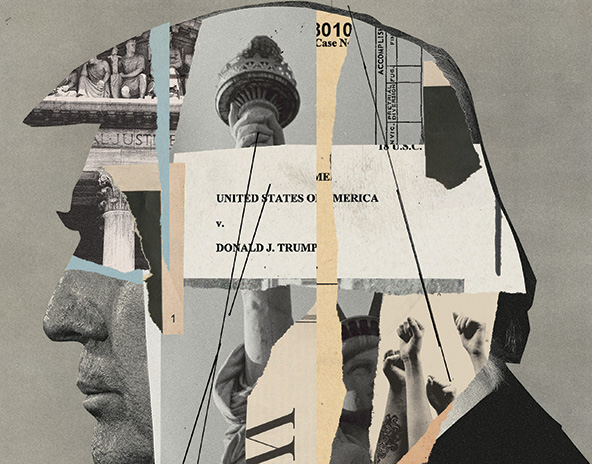
The American Revolution launched in 1776 struck a blow to monarchism and took a big step in world history toward democracy. As the United States approaches its 250th anniversary, its democracy is mired in crisis. President Trump has deployed the National Guard to several US cities and, according to media reports, is considering invoking the Insurrection Act of 1807 to quell protests against his mass deportation policies. How serious is the situation, and how might it be resolved?
On September 30, I interviewed ACLU Executive Director Anthony Romero and two of his colleagues, A.J. Hikes and Aletheia Henry, about their fight to protect civil rights and civil liberties against Trump administration crackdowns. I was especially interested in their “Firewall for Freedom” campaign—their strategy to use federalism as a defense against executive overreach. We feature an edited transcript of our conversation in this issue.
At SSIR, we are always focused on long-term solutions. In “Getting Youth Engaged in Democracy,” Laura Brill, executive director of The Civics Center, proposes that all US high schoolers should be registered to vote and have their participation and self-organizing supported by civics education and civil society, so that they are equipped to exercise their full rights as citizens.
And in a dispatch for us, consultants Jarrett Bell and Sam Greenberg explain the interlocking factors they use to assess backsliding in democracies worldwide, from India to Mexico. About the United States the pair write: “Backsliding is a particular concern, since recent policies that risk widening economic inequality, efforts to strengthen the executive’s power at the expense of other branches of government, high-profile instances of political violence, and legal and regulatory initiatives designed to undermine civil society are all likely to negatively impact the country’s scores in the years ahead.” The work of restoring democracy rests with all of us in the social sector.
Democracy is an engine for political innovation, as our academic editor Johanna Mair has demonstrated in her recent published research. So this issue offers a fitting conclusion to her 15-year tenure at SSIR. She leaves us to become director of the Florence School of Transnational Governance at the European University Institute.
The joy of working at SSIR is getting to discuss ideas with world-class leaders in many different disciplines, whether they be Stanford faculty members or contributors to the magazine. With Johanna as our academic editor, we’ve had the pleasure of working closely with one of the world’s foremost experts on social innovation. I cannot imagine a better way for a nonspecialist such as myself to learn about the field. Her leadership, keen judgment, and camaraderie will be deeply missed.
This is not, however, a goodbye. We will continue to follow her research and career as a guiding light in the knowledge and practice of social innovation, and continue to publish her work. In fact, she will soon be filing a case study that is set to be published in our next issue, so stay tuned.
Read more stories by David V. Johnson.