


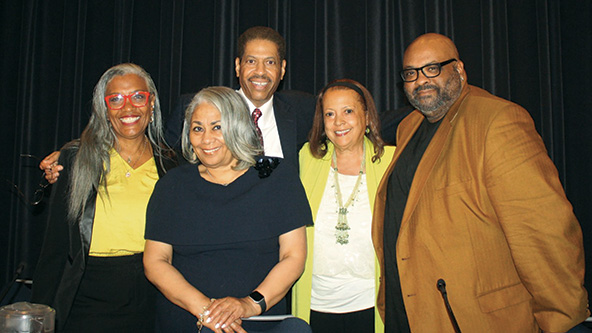
 Black radio professionals Helen Little, Dyana Williams, Ken Johnson, Carole Carper, and Sam Weaver (left to right) attend the LEGENDS Collection launch event in April 2023. (Photo Courtesy of Perception Media)
When Helen Little was growing up in a small North Carolina town in the 1970s, she loved listening to the radio but never imagined she would one day be on-air in the white- and male-dominated industry.
“When you don’t see yourself in something, it’s hard to picture yourself there,” she says.
Yet Little refused to give up on her dream. She now boasts a 30-plus-year-long career and hosts a show on 106.7 Lite FM in New York City, entertaining one of the largest listening audiences of any solo show nationwide.
Wanting to make Black radio more visible, Little began volunteering last year at the Black Women in Radio Historical Society (BWIR), a nonprofit launched in 2023 and developed from BWIR’s LLC, founded by former radio host Felèsha Love to recognize the contributions of Black women in the radio industry.
BWIR’s first preservation project was a collection of oral histories from Black women radio professionals. Little was one of the women interviewed, and her experience inspired her volunteerism with the nonprofit. She is assisting with their new project, the LEGENDS Collection, which is an archive of radio media and ephemera, like old photographs and print advertisements, representing the richness of Black radio culture.
“One of the very important things about preserving and creating this collection is creating a place where young people who look like me can see themselves and realize they can be a part of mass media and continue to tell our stories and share our music and our culture,” Little says.
Launched in 2023, the LEGENDS Collection is made possible through a partnership with the Radio Preservation Task Force (RPTF), a consortium of institutions and individual scholars, librarians, and collectors, organized under the National Recording Preservation Board (NRPB) of the Library of Congress (LOC). Love is curating the collection with help from well-known radio personalities, including Little and Skip Dillard, the operations brand manager at 94.7 The Block, a classic hip-hop station serving New York City. The LOC will house the collection and an accompanying exhibition at a date still to be determined.
The NRPB created the RPTF in 2014 as part of its mission to preserve the nation’s audio history. “What we found in that first year was that almost the entirety of radio history in the country had been already thrown out or had been mismanaged and was decaying,” RPTF director Josh Shepperd says.
Often, older audio recordings exist in obsolete formats like 78s, early records made of shellac rather than vinyl and meant to be played at a speed of 78 revolutions per minute. Some can only be digitized or played using rare and specialized equipment. Many recordings have also been discarded as stations downsize or change ownership and new technologies replace the old. According to Shepperd, archivists and collectors have also tended not to prioritize Black media for preservation due to racial biases.
Love says BWIR’s work is also a response to today’s political climate, which has prompted crackdowns on how Black history is taught, if at all, in schools. “That makes this collection even more important,” Love says. “If we don’t tell our stories, who will?”
While the LEGENDS Collection focuses on Black radio culture, it will also allow historians to tell richer, more inclusive stories. Old radio recordings hold vital details for historians, since radio captures the day-to-day political actions that give rise to historic episodes such as the Civil Rights Movement. The collection will offer context for decades of pop-culture moments and trends that have grown out of Black radio, from 1960s dance crazes to the genre of hip-hop.
In addition to recorded media, the collection will include print media like scrapbooks of playlists and vintage photographs. One of the challenges of curating the collection has been locating items like these, which may be held in private collections or just gathering dust in someone’s attic.
“I lament that we didn’t always do a good job of saving more of the rare items,” Dillard says of times when he has seen stations dispose of old audio and visual material during his three-decade-long career. “Now, I want to help find as much of it as we can.”
Read more stories by Marianne Dhenin.