


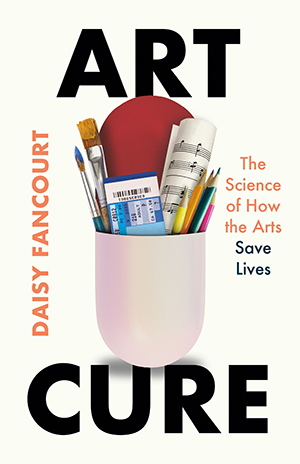
Art Cure: The Science of How the Arts Save Lives
Daisy Fancourt
320 pages, Celadon Books, 2026
Eat your fruit and veg. Get your exercise. Quit smoking. Don’t stress. Go to sleep. Every day, we are bombarded with information about how to live happier, healthier lives. But here is a piece of health advice I bet you’ve never been given: Engage more in the arts. It’s a deceptively simple recommendation, and probably one of the most enjoyable pieces of advice you could be given. But it’s one we rarely follow. In fact, go outside and start asking US adults on the street whether they did any arts yesterday, and 95 percent of them will say no.
For some reason, the evidence base around the health benefits of arts engagement is a bizarrely well-kept secret. Despite thousands of studies using neuroimaging, wearable sensors, blood biomarkers, psychiatric assessments and behavioral monitoring showing that the arts tangibly, measurably good for us. Arts engagement in our everyday lives can reduce our risk of developing depression, dementia, chronic pain, harmful behaviors, physical decline, even premature mortality. And bespoke arts programs designed to tackle specific clinical challenges have been demonstrated to help people with Alzheimer’s disease to unlock forgotten memories, improved respiratory function in people with lung diseases, reduce motor decline in people with Parkinson’s disease, and improve preventative health-care behaviors to help tackle the spread of epidemics.
In my new book, Art Cure, I take readers on a journey through this astonishing scientific evidence, showing how arts can improve your health, stave off illness and disease and help you live a longer and fuller life. I blend the findings from clinical trials, laboratory experiments and epidemiological data with case studies and stories of how the arts have transformed the lives of individuals. Stories of people like Josh. This excerpt tells his story, about how an incredible program designed by clinicians, artists, and magicians helped him regain hand and arm function after cerebral palsy had left him partially paralyzed, and the mesmerizing science underpinning these remarkable effects.—Daisy Fancourt
* * *
Down a back street in London, around the corner from my office, is the headquarters of the most famous, secretive, and exclusive magic society in the world: the Magic Circle. I’d walked past its unassuming black door for years without realizing. But once inside, it’s quite a different story.
Visitors are greeted by bright blue walls, a black-and-white checkerboard floor with the signs of the zodiac in a circle in the middle, and a wooden spiral staircase with what look like silver bowls stuck to the balustrades, snaking up three floors. On the second floor, everything is red. Red walls, red carpet, and 162 vintage red fabric flip-down seats, all facing the Magic Circle stage.
It was here, hiding behind the thick red velvet curtains, that Josh was waiting to give his magic performance. He wasn’t even supposed to be in the building—the president had had to give special permission as he wasn’t a member of the prestigious Circle. Walking through the front door, Josh—just twenty years old—had thought he was entering the wizarding world. Now, heart pounding, watching the faces of 162 Magic Circle magicians in the audience, he stood waiting for his name to be called. And the stakes were especially high, because tonight, he was making history.
Josh was the first person with cerebral palsy ever to perform on the Magic Circle stage.
Josh’s cerebral palsy happened as a result of a surgery to fix a malformation on a vein in his brain. After the surgery, Josh was left with hemiplegia on his left side—a partial paralysis that meant he couldn’t move or control his muscles. He stopped trying to use his left hand at all and walked with a limp. “At school I was badly bullied because I looked different to everyone else,” he told me. Every time he did sports classes, teachers had to help him get dressed. He tried physiotherapy—hours of stretching and exercises—but he was just a young child and he wasn’t interested in it.
When he was twelve, Josh’s parents saw an advert in the magazine HemiHelp for a magic-themed summer camp for children with hemiplegia. Two weeks of intensive therapy using specially designed magic tricks to improve hand and arm function. By this time, Josh’s confidence was low but he agreed to go along.
The camp was led by magicians from the Magic Circle alongside occupational therapists from the Evelina London Children’s Hospital and an arts organization called Breathe Arts Health Research who had all worked together to turn hand therapy exercises into magic tricks. Every day at the magic camp, Josh spent six hours doing one-on-one therapy with occupational therapists trained in the magic tricks. It was intense, but each trick was broken down into manageable stages and progress was fast. New magic tricks were each mastered in just two days. During the breaks between learning the tricks, the magical theme continued—playing with circus apparatus, sewing magic costumes, and making magical props. It was like no hand therapy he’d tried before.
I had the privilege of joining the team working on this program a few years later, which is when I met Josh (by then a program alumnus). I asked him how soon he had noticed an improvement during that first magic camp, and he answered instantly: “Day two.” He’d finished intensively practicing a trick called cups and balls that involved him repeating movements he was more used to hearing in his therapy sessions as “pincer grip,” “supernation,” and “pronation.” But he hadn’t been thinking about those terms as he’d practiced the trick—he’d been focused on making the balls disappear beneath the cups. As he’d picked up a banana for his snack, his occupational therapist had suggested he cut it up with a safety knife, using his affected hand to hold the banana. Josh was skeptical—he couldn’t use a knife. But to his surprise, he managed it. On day five, a local politician came to see the magic camp in action. Josh had just mastered another trick, making coins disappear in a box. He showed it to the politician. “It was my first magic performance.”
This was just the beginning. At the end of the two weeks, Josh and the others in the camp had put on a professional magic show in a theater in front of a packed audience of their friends and families.
But perhaps the most magical thing about the magic camp was that it wasn’t just a camp. It was part of a major international experiment.
In the summer of 2012, in London and over two thousand miles away in Tel Aviv, children with hemiplegia had signed up to spend their summer holidays in similar magic camps. Before the camps started, they attended a clinic where medical staff assessed their hand function, getting them to pick up and handle objects, complete timed exercises, squeeze dynamometers, and answer questions on their ability to perform everyday tasks from doing up buttons to opening cans. Immediately after the magic camp and again three months later, all the assessments were repeated.
The results immediately attracted the attention of scientists and the media. Within just two weeks, there was a 30 percent improvement in how much the children used their affected hand. The children were faster too. In a timed test of how long it took to complete a series of tasks such as stacking objects and turning pages, the children took over nine minutes before the magic camp. Two weeks later, they took just seven minutes. In fact, by the end of the magic camp, instead of just relying on their unaffected hand, the children were performing 93 percent of daily tasks with both hands. Three months later, the improvements the children had experienced from just that two-week camp were maintained.
Percentage improvements can seem a bit abstract, so let’s put it into daily gains. To one little boy, those improvements meant being able to have a snack when he wanted—opening a cereal bar wrapper or making a sandwich by himself. To one teenage girl, they meant being able to shower and wash her hair on her own for the first time. To Josh, it meant being able to get dressed and put on his shoes without help. The first time he did up his own buttons on his shirt after a sports lesson the week after the magic camp, the teacher came in saying, “I’m here to help you, Josh,” just as Josh walked proudly out of the room.
Arts for Physical Performance
Movement is something fundamental to our entire existence. From the moment we are born, our brains are constantly working to optimize our movements and make them more efficient and accurate. As this optimization improves, we move from ham-fisted grasps at a rattle or faltering first steps to eventually managing complex motor movements like touch-typing and climbing, and even “elite” movements such as performing surgeries or Olympic rowing. It’s easy to think of movement as a physical thing—the work of bones, muscles, and tendons. But Josh shows us how crucial the brain’s role is, and this is where the arts come in. Because whether we’re doing physical rehabilitation for a brain injury or disease, trying to increase our skills wielding a surgical knife, shaving time off our 10K speed, or simply getting the most out of the time we spend exercising, neuroscientific research on how the arts affect the motor regions in the brain shows how they can substantially improve our performance.
For five years, I collaborated with the English National Ballet and clinicians at King’s College Hospital in London on a program with an ambitious goal: to slow motor decline in patients with Parkinson’s disease. The program was designed around the season’s dance repertoire of Swan Lake, Giselle, and The Nutcracker. Clinicians in the hospital could refer patients of any age to the program, resulting in classes ranging in age from twenty-five to eighty-nine. Through the classes, which were taught by the professional dancers, the patients learned elements of the choreography accompanied by live music, attended live performances, and got to know one another in shared learning and social spaces.
Over the twelve weeks of the dance sessions, those in the dance group not only stopped getting worse in their overall Parkinson’s symptoms, they actually saw an improvement in all aspects of their movement— faster walking, better coordination sitting down and standing up, and improved balance. Other symptoms improved too—things like pain, mental health, cognition, sleep, and even libido. One of the participants in the study, a man called Joel, described to me how he’d watched his body lose power: His steps had become shorter, slower, and more uneven; his muscles stiffened; tremors shook his hands; and his limbs had started to freeze as if they were stuck to the ground. But within just a few weeks of starting the classes, he could stand up straight again, walk up the stairs unaided, and make himself a cup of tea without spilling it. “I know my symptoms will return in the future—that’s Parkinson’s,” he told me. “But this respite the dance has given me—this extra time when I can be more mobile, more myself—is invaluable.” He was planning to take his first holiday away in years.
Dozens of other trials have shown similar benefits for people with Parkinson’s, from dance and other movement to music—improved gait, balance, and overall reductions in motor problems from the disease. The extent of the improvement has been large enough to be considered meaningful clinically. And improvements can be seen within just three months, although longer interventions yield even stronger effects.
Research on other neurodegenerative conditions is at an earlier stage, but there are indications of similar benefits. For Huntington’s disease, multiple sclerosis (MS), and acquired brain or spinal cord injuries, dancing appears to help various aspects of motor function. These findings are important because maintaining motor function helps to slow the rate of decline in conditions that are progressive and aid rehabilitation in conditions where recovery is possible. I can anticipate some skepticism: Dance is a form of exercise, so perhaps it’s just the exercise ingredients in dance that really deserve the prize? Not so. A number of trials have not only compared dance to “no intervention” or “usual care” but also pitched dance against other therapies like exercise, and still dance comes out on top.
Even more simply, just listening to music improves our physical performance. We humans have been using music to make us march faster, toil harder, and compete more aggressively throughout our evolutionary history. Scientific studies on this phenomenon go back over a hundred years—ever since a scientist named Leonard Porter Ayres observed that contestants in the 1911 New York six-day bicycle race cycled 8.5 percent faster when the military band was playing. Having background music playing makes us increase our running speed, manage more reps in the gym, and hold weights in the air for longer. Surgeons in the operating theater who listen to their favorite music can even complete complex motor tasks like closing wounds faster (and the quality of the work is also improved).*
The secret to these effects lies in the brain. Understanding how to use the arts to support our own movements, whether in rehab, work, or exercise, is all about feeling the beat.
From Art Cure: The Science of How Art Saves Lives by Daisy Fancourt. Copyright (c) 2026 by the author and reprinted with permission of Celadon Books, a division of Macmillan Publishing Group, LLC.