


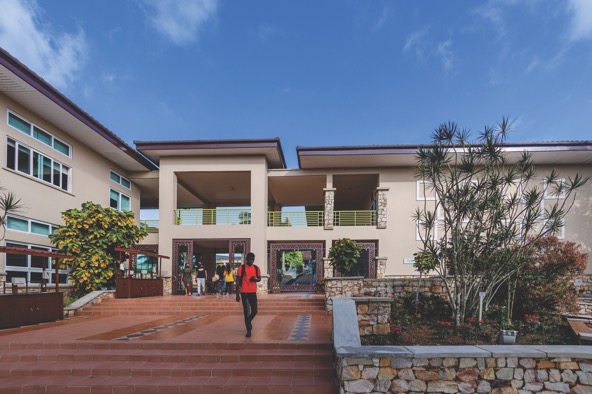
 A student walks through Founders’ Plaza in the heart of Ashesi University’s campus. (Photo courtesy of Ashesi University)
In February 2025, I traveled to Berekuso, Ghana, to visit Ashesi University. I came with a set of questions and long-simmering curiosities that had started during my years at Ashoka, the global nonprofit devoted to social entrepreneurship. I worked there for nearly four years with Ashoka U, the nonprofit’s initiative to embed social innovation into universities around the world. The subject eventually became the focus of my graduate research at the University of Cambridge’s Judge Business School. I was also, more personally, conceiving the launch of a new university in my native Nepal. I wanted to understand how Ashesi had navigated the challenges that I expect to face myself.
Berekuso is about 18 miles northeast of the capital, Accra. The drive follows a highway before turning onto a short, unpaved stretch. Atop a low hill, the campus of Ashesi University comes into view, with its mortared columns; bright windowed buildings; open-air amphitheater; and manicured lawns, flowers, and palm trees.
I got out of the car and walked up a flight of stairs into Radichel Hall, the administrative building. On the first floor, somewhat hidden, was the office of the person I had long looked forward to meeting. I was ushered into a meeting room next door, where I waited briefly before he walked in.
Patrick Awuah, Ashesi’s founder and president, is a composed presence—warm but measured, someone who speaks thoughtfully and without rush. After pleasantries, I soon asked him one of my questions: How did Ashesi, a Ghanaian university, think about incorporating ideas developed elsewhere?
“Sometimes it is better to bring a seed than transplant a whole plant,” he said. “Transplanting involves handling an entire root network—a complex, difficult task. If you identify a tree species suitable for your context, planting a seed is simpler.”
Awuah conceived the idea of Ashesi more than 25 years ago as a different kind of university for Ghana—one that would incorporate social innovation into educating the new type of leader that Ghana and Africa at large would need for their continued development. But why think that such concepts, transferred from elsewhere, would work in Ghana? It is a question many institutions around the world, from Ghana to Nepal, are navigating, often with limited resources and guidance.
Social innovation in higher education takes many forms. At a programmatic level, it includes structured approaches such as design thinking, ethical leadership, entrepreneurship courses, and community-engaged learning. But social innovation also operates as an institutional orientation, dictating not just what a university teaches but how it defines its purpose, culture, and strategy. Ashoka U describes universities that embed social innovation at this deeper level as “changemaker institutions.” These are universities that treat values like ethical leadership, community engagement, systems thinking, and social impact not as add-on programs but as organizing principles for the entire institution.
Ashesi is one such institution. It began in 2002 with a class of 30 Ghanaian students. It now enrolls over 1,800 students from more than 30 nationalities across Africa. Awuah—who had studied at Swarthmore College in the United States (my alma mater) before building a career at Microsoft and completing his MBA at the University of California, Berkeley’s Haas School of Business—founded Ashesi with the conviction that higher education was the most powerful lever for producing the new generation of ethical, entrepreneurial leaders that Africa and the world needed. Ashesi University was his attempt to build that kind of institution in Ghana.
At the time of its founding, Ghana’s higher-education landscape had hallmarks of a colonial legacy that had outlasted the country’s independence from Great Britain in 1957. The country’s first universities had been affiliated with the University of London, which had controlled staff appointments, curriculum, and examinations. The dominant public institutions, the University of Ghana at Legon and Kwame Nkrumah University of Science and Technology, continued to be organized around specialization, credentialing, and direct pathways to employment. Private universities had begun to emerge following the establishment of Ghana’s National Accreditation Board in 1993, but they largely followed the same template, offering narrow programs aligned primarily with labor-market demands.
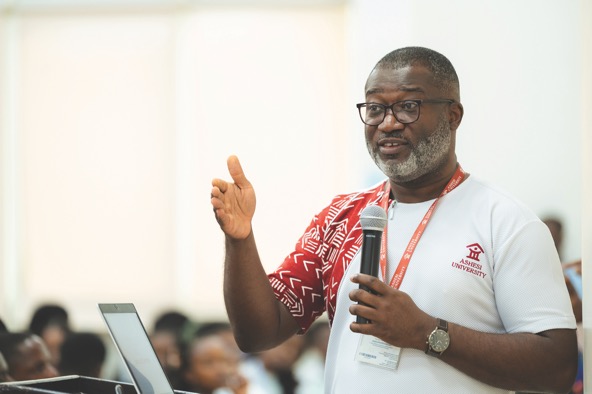 Abdul Mahdi, dean of students and community affairs, addresses an assembly. (Photo courtesy of Ashesi University)
As a result, Ashesi faced a series of practical and strategic questions from its early years. How could a new institution establish legitimacy and trust among regulators, students, their families, and employers? How could it introduce pedagogical approaches and institutional values that challenged prevailing norms without being dismissed as disconnected from local realities? And how might globally recognized and validated frameworks enable, or hinder, the process?
These questions shaped Ashesi University’s early use of global social innovation frameworks. Such models offered a shared vocabulary and a sense of validation at a time when Ashesi’s institutional model was largely untested. Referencing internationally recognized universities, frameworks, and practices helped Ashesi signal its credibility, particularly to immediate stakeholders unfamiliar with liberal-arts education or social innovation-oriented approaches to learning. At the same time, these frameworks were developed in contexts with different assumptions about student preparation, funding structures, labor- market demands, and institutional autonomy.
As Ashesi matured and established its credibility locally, its relationship with these frameworks gradually changed. Early reliance on globally validated models gave way to a more selective engagement with global social innovation frameworks, as Ashesi faculty and staff confronted questions of relevance, fit, and effectiveness in the Ghanaian context. Over time, Ashesi began developing its own approaches and frameworks based on its institutional experience and values.
Ashesi’s application of social innovation frameworks, at its core, is a story of building legitimacy. Only by accumulating credibility could Ashesi fully assert its own institutional values and evolve from an adapter to a creator of social innovation frameworks for its students, faculty, and the world at large.
Borrowing Legitimacy
In its early years, Ashesi University’s institutional model of ethical leadership, social impact, and entrepreneurship challenged the established higher-education system that allowed limited room for deviation. With little established legitimacy and a nascent institutional track record, Ashesi prioritized securing the approvals and trust necessary to survive. Awuah described these early years as a period of fitting in enough to earn the “right to experiment.”
But earning that right required understanding what Ghanaians expected. Before enrolling the university’s first student in 2002, Awuah and his team held focus groups with leaders across business and government, and surveyed high school students, parents, and university students. The findings confirmed that Ghanaian society valued what a liberal-arts model handled well, including critical thinking, clear communication, and the ability to navigate complexity. But they also raised clear constraints. Industry wanted preprofessional majors. In Ghana, unlike in the United States, you could not study a broad degree and then work in finance—you had to have studied business. Parents, understandably, needed to feel confident that their children were obtaining degrees that led directly to employment.
“I knew I had to truly understand what society expected and what was nonnegotiable,” Awuah recalled. “If you did not meet certain expectations, you would miss the boat.”
I learned more about the model that emerged from this process from Rebecca Awuah, Patrick’s wife and a faculty member at Ashesi since 2008. The two first met at Microsoft, where she worked as a software-testing engineer. They have two children, the second of whom arrived one year after the launch of Ashesi. They had to balance the demands of being new parents to their children and countless students. I spoke with Rebecca during the same visit to Berekuso, curious about her perspective as someone who had been part of Ashesi’s story from nearly the beginning. Like Patrick, she was warm and thoughtful.
Ashesi’s commitments to leadership development, ethical reasoning, and community engagement were woven into the model from the early years through course requirements, community service, and, over time, early-stage grant programs supporting student-led social-impact projects.
The new university, Rebecca explained, balanced Ashesi’s vision and the realities they were forced to confront. The product was “essentially a hybrid between liberal-arts and professional majors,” she said. Regardless of their majors, all students are required to complete two writing courses, two courses in design thinking and entrepreneurship, and four leadership seminars, most of which are completed in their first two years, before concentrating on their chosen field and continuing to take non-major electives that maintain some breadth across disciplines.
This hybrid model was not just a concession to market expectations; Ashesi’s commitments to leadership development, ethical reasoning, and community engagement were woven into the model from the early years through these requirements, community service, and, over time, early-stage grant programs supporting student-led social-impact projects.
Even this carefully constructed model, however, faced considerable resistance. Accreditation in Ghana was administered by professors from public universities who reviewed new institutions, and Patrick described the difficult dynamic that came with it.
“Although it was called a peer review, they felt superior, coming to instruct juniors,” he said. “Initially, they reacted negatively to our curriculum, saying it was the wrong approach for computer science and business administration.”
Regulators preferred specialized discipline-based programs over the broader foundation Ashesi proposed. Communication also proved challenging. “Often, people interpret ‘liberal’ in liberal arts in terms of social or political values rather than its intended meaning—broad curriculum offerings and liberation of mind toward independent thinking,” Rebecca said. “We had to communicate this distinction repeatedly, and there was resistance along the way.”
The elements of Ashesi’s model that drew the most regulatory scrutiny were often linked to social innovation. Courses like the leadership seminars, which emphasized reflection, group projects, and real-world engagement rather than traditional exams, clashed directly with formal expectations around standardized assessment. Under Ghanaian higher-education regulations, newly established universities must operate for a minimum of 10 years under the supervision of an older, established institution, which awards degrees on their behalf. For Ashesi, that institution was the University of Cape Coast (UCC). This dynamic created friction.
“Each semester, UCC had to moderate our exams,” Rebecca said. “These disagreements would ebb and flow depending on their leadership. Sometimes we would gain approval for alternative assessments, only to start over again when UCC leadership changed.”
A foundational expression of Ashesi’s commitment to building an ethical institutional culture, the Honor Code, also became a point of negotiation with the regulators. Adopted in 2008, the Honor Code invites each incoming class to vote, by a two-thirds majority, on whether to govern their own exam environment without proctors, committing collectively to ethical behavior and holding one another accountable. When Ghana’s Tertiary Education Commission (GTEC) required Ashesi to move the Honor Code vote from the first year to the second year, Patrick initially agreed to the change but later reversed it. When GTEC mandated a fixed split between continuous and final assessment of student grades, Ashesi resisted for a long time before complying on paper—defining, as Rebecca put it, “final assessment broadly enough to suit our purposes.”
These adjustments were strategic compromises Ashesi made to preserve its underlying institutional values, particularly given the stakes of the negotiations. “Subsequent reviews were tougher, and reviewers wanted to undo previously approved aspects,” Patrick said. “With students enrolled, losing accreditation was not an option.”
Alongside navigating these regulatory constraints, Ashesi also worked to build trust and legitimacy among families and students. Given the lack of familiarity with its model, Ashesi positioned itself as globally informed, using associations with recognized institutions as a proxy for its own credibility. The curriculum had been designed during Patrick’s time as a student at the University of California, Berkeley’s Haas School of Business—the product, as Ashesi’s Provost Angela Owusu-Ansah described it, of “five or six brilliant minds” who put together the institutional blueprint. Early recruitment and outreach materials highlighted the involvement of faculty from UC Berkeley, the University of Washington, and Swarthmore College in the curriculum’s design.
“For students and families, it was important to know the curriculum was designed by experts,” Patrick said. He also leveraged his own professional background. “Because I had worked at Microsoft, there was a sense of credibility,” he noted. “People thought, ‘Okay, he has been in that field; if he is telling us this is important, maybe we should listen.’”
This credential signaling was both necessary and effective, even though it also meant that Ashesi’s early identity was partly validated through external association. At this stage, Ashesi was not yet an institution capable of setting the terms of its engagement with global social innovation frameworks. It embedded social innovation values selectively and used global frameworks and affiliations strategically as signals of credibility. To survive, they would have to carefully rework such frameworks until they built the kind of legitimacy that would allow for autonomy and self-fashioning.
Adapting to Context
By the mid 2000s, Ashesi’s early efforts to establish legitimacy and local trust had begun to yield fruit. All the graduates from its first class in 2005 secured employment, with over 90 percent choosing to remain in Africa. In 2007, a study by researchers at UC Berkeley found that local and multinational employers in Ghana rated Ashesi first in the country across six categories: quality of curriculum, career preparation, communication skills, maturity, professional skills, and ethics.
This growing reputational capital enabled Ashesi to push back more forcefully against pressures from accreditation bodies. Such resistance would not have been possible in the early years of Ashesi, and it gradually enabled the university to rethink its application of external frameworks, shifting from using them primarily as a legitimacy signal to adapting them for relevance and fit.
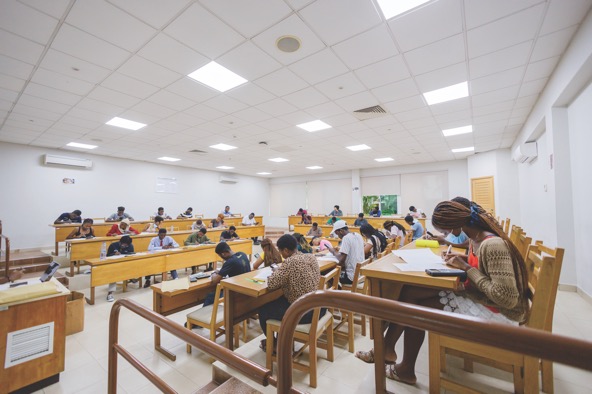 All students take two courses in design thinking and entrepreneurship, and four leadership seminars before concentrating on their chosen field. (Photo courtesy of Ashesi University)
The Foundations of Design and Entrepreneurship (FDE), now a required first-year course taken by every Ashesi student regardless of major, introduces students to design thinking and entrepreneurship by having them identify community challenges linked to the UN’s Sustainable Development Goals (SDGs) and develop solutions through ethnographic research, prototyping, and iteration across two semesters. Patrick got the idea for the course after he returned from his 2013 visit to Babson College in Massachusetts, where its Foundations of Management and Entrepreneurship (FME) program had made a strong impression. The initial framework drew on Babson’s model and design-thinking approaches from the British Design Council, Stanford’s Hasso Plattner Institute of Design (Stanford d.school), and IDEO.
Jewel Thompson, who joined the teaching team in 2018 and is now the faculty lead for FDE, noted that while design thinking is often taught as a rapid five-step process—empathize, define, ideate, prototype, and test—Ashesi condensed the framework to four steps—research, analyze, ideate, prototype—and extended it across the semester. The course also replaced the global case studies typically used in such classes abroad with Ghanaian and broader African examples. And instead of being assigned predefined problems, students begin by identifying issues in their own communities. “They explore their lived experience using the design thinking framework and develop an idea that can eventually become a venture,” Thompson said.
For example, Cynthia Anaba—a 2025 graduate who grew up near the northern border with Burkina Faso—and her team worked on rice farming and irrigation in northern Ghana, where agriculture is heavily reliant on rain and food-insecurity spikes during periods of low rainfall.
“Ghana imports a lot of rice from Thailand and other Asian countries,” she explained. “Most of these farmers are relying on rain-fed agriculture, and so when there is not much rain, there is nothing these farmers can do.”
Her team ideated solutions for irrigation tools and water-management systems that could be more accessible and affordable for farmers in the north, and implemented an early prototype with rice farmers near Berekuso, with support from Ashesi.
The experience also shaped what she has continued to pursue since graduating.
“I am currently working on local rice and how we can make it more marketable compared to the polished long-grain rice imported from Thailand,” she said. “FDE was really instrumental in helping me think about that problem rigorously.”
Ashesi similarly adapted the Giving Voice to Values (GVV) curriculum, a global framework for values-driven leadership development, for its own needs. Rebecca encountered GVV at a conference in 2009 and found that its pedagogy of rehearsal and role-playing aligned well with Ashesi’s emphasis on active learning. It also addressed a challenge that students faced at the time: the Honor Code commitment to hold their peers accountable in a culture that emphasized loyalty and friendship. Ashesi developed its own ethics cases drawn from students’ actual dilemmas, expanded the curriculum by involving alumni who returned to share real-world ethical experiences, and shaped implementation to reflect Ghanaian realities.
“We still call it ‘Giving Voice to Values’ and adhere to its core pedagogy,” Rebecca said, “but our implementation looks distinctly different from other institutions.”
Ashesi’s determination to ground its education in local issues and realities also began to influence student ventures. In late 2015, Ashesi launched the Ford Fund for Service to Children and Youth, funded by the Ford Foundation. One of the university’s first in-house grant programs, it supported student-led social-impact projects. Jude Samuel Acquah, assistant director of Ashesi’s Experiential Learning and Outreach Programs, helped design the program. “A lot of the thinking was internal,” Acquah said. “What do our students want to do? How do they tend to work? What support do they need?”
Over roughly seven years, the program backed more than 100 student-led projects. One student, Moses Yangnemenga, submitted an early grant application for a mentorship project focused on helping high school students identify their strengths and make informed choices about their education. Although his proposal was rough and loosely structured, “we saw his passion and potential, so we funded him with $1,000,” Accquah recalled. Yangnemenga, recipient of a full scholarship from Mastercard Foundation to study at Ashesi, refined his thinking through additional coursework and mentorship. He eventually launched another venture, Tieme Ndo, supporting over 100 farmers in his hometown of Nandom, Ghana, and raising $22,000 independently through the D-Prize, a prestigious international competition for social entrepreneurs, while still a student. Stories like Yangnemenga’s are very common at Ashesi.
Leadership courses offer another example of the university’s outreach. Through the Leadership Seminar series, a four-part, mandatory sequence spanning the first three years, students engage with questions of ethics, responsibility, and service alongside their academic coursework. The first seminar investigates the idea of a good leader, the second examines the governance of a good society, and the third explores the economic organization of a good society. The fourth, Leadership as Service, requires students to complete a minimum of 40 hours of service placements in schools, hospitals, local nonprofits, or projects they design themselves. These placements are designed to put students in direct engagement with local communities and enable them to reflect on leadership as it is practiced in context.
Such projects also taught Ashesi that social innovation frameworks sometimes overlook important local differences. For instance, Thompson described a cross-institutional exchange she facilitated between students at Ashesi and those at the US-based John Carroll University. Both student groups worked on the same Sustainable Development Goal of eliminating poverty using a shared set of prompts, but the approaches of both sets of students differed significantly. “Even though we use the same global language, the lived realities of users are completely different,” Thompson said. “That, in itself, shows why social innovation must look different on the continent.”
At this stage, Ashesi’s administrators, faculty, and staff increasingly believed that global social innovation frameworks, though useful entry points, were not neutral or universally applicable. The university needed to change how it applied these frameworks. Instead of relying primarily on global models to signal legitimacy, Ashesi increasingly drew on its own credibility and accumulated experience to adapt such frameworks to its own institutional vision, priorities, and local context. Ashesi would have to apply such knowledge and practice on its own terms.
Creating a Framework
In 2018, after more than a decade of operating under UCC’s supervision, Ashesi completed the independence process and received its charter from President Nana Akufo-Addo of Ghana. It became the youngest private university in the nation’s history to do so. It could now award its own degrees, set its own assessment standards, and, as Rebecca put it, exercise “a substantial flexibility to innovate” that it did not have before. External models did not disappear, of course; Ashesi continued to interact with peer institutions worldwide and borrow where appropriate. But they were no longer the foundation from which Ashesi worked.
“The outside framework is a learning tool, not a template,” said Elena Rosca, the head of the bioengineering department at Ashesi. “If we can learn from it, great. If not, we move on and develop our own solution.”
This institutional orientation of starting from internal goals rather than external models is now visible across Ashesi’s programming. Gordon Adomdza, who helped launch FDE and led the program for seven years, framed the university’s evolving approach as a reorientation of the design question itself: “Maybe instead of asking how to edit global models to fit the local context, we should ask what models we can create … and then see if they align with global practices.”
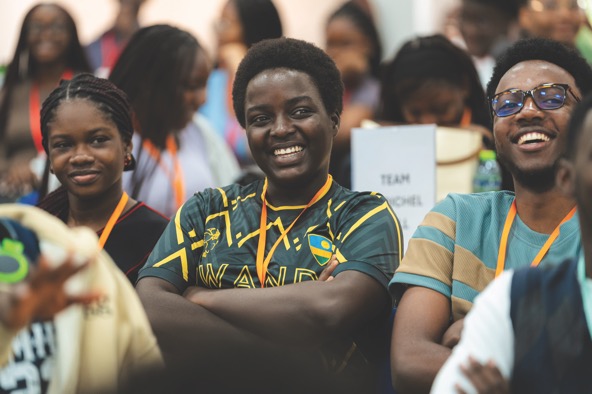 Ashesi University enrolls over 1,800 students from more than 30 nationalities across Africa. (Photo courtesy of Ashesi University)
The design of Ashesi’s law program, officially announced in October 2024, shows what this looks like in practice. Maame Mensa-Bonsu, who leads Ashesi’s Department of Law, Humanities, and Social Sciences, recalled that her team began not with existing legal- education models but with an assessment of gaps in how legal training in Ghana prepared graduates to engage with public institutions, policymaking, and systemic reform. Ghana’s legal education is governed by statutory requirements that mandate a fixed set of core subjects, leaving little room for the kind of policy thinking Mensa-Bonsu believed was most needed. From there, Ashesi reverse-engineered a curriculum around the kind of legal scholar Ashesi hoped to produce. The goal, she said, was to prepare students to engage not only with legal content but also with the social structures that shape how laws are applied and interpreted. This required building a curriculum that emphasized integrity, ethical reasoning, and the ability to navigate policy and systems, not just legal knowledge.
“The identity and values piece of the program was a ‘nonnegotiable’ pillar,” Mensa-Bonsu said. “Even ideas that seemed to be useful to the market had to be evaluated: Do they align with this identity? Just because it is hailed in 80 countries does not mean it is what you should do.”
The Ashesi Center for Entrepreneurship took a similar path. Jessica Boifio, a 2014 Ashesi graduate who returned to lead the center in 2023 after stints in the private and public sectors, described how earlier incubator models at Ashesi had been more linear and theoretical, relying heavily on established global startup frameworks like the Lean Startup methodology and the Business Model Canvas for writing business plans. Boifio’s team developed a new approach through internal observation and iteration. They created a diagnostic tool to map students’ entrepreneurial identities, building their own archetypes—Innovators, Founders, Catalysts, and Investors—based on patterns they observed among Ashesi students. The center also redesigned its support structure for students around a developmental arc—idea, project, venture—derived from Ashesi’s own ecosystem. “We are not just replicating frameworks,” Boifio said, “but developing contextually relevant methods informed by ongoing faculty research.”
These principles extend beyond individual programs. Rebecca explained that every Ashesi course syllabus, regardless of discipline, is expected to include learning goals aligned with the core values of scholarship, leadership, and citizenship: “Instructors teaching precalculus consider how ethics or civic engagement can be incorporated into their classes.” Elena Rosca described how her department had combined a technical project course with the leadership curriculum so that students engaged with community stakeholders and developed solutions in the same semester, rather than treating the two as separate exercises. When Ashesi sent its new bioengineering program to experienced faculty at other universities for review, their feedback was revealing.
“Some responses were like, ‘You are doing too much, too many social-science courses, too many leadership components,’” Rosca recalled. “But we have explained that those are requirements at our university. They are not optional.” The focus on internally driven design was, in other words, not limited to flagship programs. It had become an institutional expectation that external reviewers noticed because it was so different from what they were used to.
By this point, Ashesi had developed a new set of design principles: Start with local goals and realities; stay close to what students experience; and filter decisions through the institution’s identity, values, and learning outcomes. External frameworks are still considered, but, as Mensa-Bonsu put it, they are “offerings of wisdom” rather than rules. In the third part of the leadership seminar, for example, students are asked to articulate their own values before examining whether those values align with the SDGs. “If they don’t,” she said, “we should feel perfectly okay walking away from them—because no one asked us whether that should be our goal.”
Building a Forest
This story of Ashesi’s institutional trajectory—and within it, its translation of social innovation frameworks—is, by most measures, a significant institutional achievement. But for Patrick Awuah, the story of one institution was never the point. His ultimate goal for Ashesi, from its founding years, was to transform Africa through higher education.
In the early years, that ambition understandably required an inward focus. But by 2017, its orientation had begun to shift. “Ashesi is a tree now, but a single tree isn’t enough,” Awuah said. “We need a forest. But a healthy forest isn’t made of a single species; it requires ideas from many places.”
Initially, Ashesi envisioned scaling through additional brick-and-mortar campuses across Africa. Peter Materu, chief program officer of the Mastercard Foundation and an education expert who has worked extensively across Africa, explained that Awuah “eventually landed on the fact that it is not going to work” and instead chose to “scale the model, not the university.” Materu described this as “a new approach to scaling quality university education” on the continent, one that “builds institutions across many universities rather than concentrating excellence within one.”
In the leadership seminar, students are asked to articulate their own values before examining whether those values align with the SDGs. “If they don’t,” Mensa-Bonsu said, “we should feel perfectly okay walking away from them— because no one asked us whether that should be our goal.”
The Education Collaborative operationalizes this vision. Launched at Ashesi in 2017 with nine participating universities gathering for a weeklong convening, it has now grown to 42 members and engages with over 500 participating universities. The Collaborative has three regional hubs—for East, West, and Southern Africa—to help develop shared frameworks contextualized to different regulatory and cultural environments. Formal member institutions include the Kepler College in Rwanda, Pan-Atlantic University in Nigeria, the University of Cape Town in South Africa, and Botho University in Botswana. The Collaborative seeks to reach over one million students by 2030 and support their development “as ethical entrepreneurial leaders who create jobs, transform industries, and lead economies.”
Materu framed this as an “Africa-to-Africa” translation, a more horizontal diffusion of practices in contrast to historical patterns in which models from the Global North were translated into African institutions. “Universities are a lot about competition—competing with each other for money, for recognition,” Materu said. “In Ashesi’s case, it is competition and collaboration together.”
Ashesi provost Owusu-Ansah echoed this sentiment. “The frameworks being formed through the Collaborative are created by members themselves. Even though Ashesi might be driving or speaking into them, there is no Ashesi ownership; it is collective.” She said she hoped the Collaborative—and Ashesi’s own story—could reach beyond the continent.
“For the longest time, the benchmark has been Global North—unidirectional,” Owusu-Ansah said. “But we believe the Global South also has something to offer, different forms of knowledge. At some point, it would be great if that knowledge flowed up as well.”
Unresolved Questions
Although Ashesi has established itself as a fixture in Ghanaian higher education and as one of the world’s shining examples of “changemaker institutions,” it remains subject to complaints by rivals.
“The biggest criticism of Ashesi is that the bigger universities, especially the public universities, say, ‘If you were to give us the same amount of money as you are giving Ashesi, we would do wonders,’” Materu says.
The claim certainly has merit. Ashesi’s per-student expenditure is approximately $9,100 annually, compared with an estimated $1,500-$1,700 per student at the University of Ghana, the country’s largest public university. The resources and early support Ashesi mobilized—from foundations, international partners, and a committed donor base—enabled the kind of institutional experimentation that most public universities cannot emulate.
But Materu pushed back on the idea that funding alone explains the difference. “The dollar value does not explain it all,” he argued. “It is not so much about the number of students as it is about the quality of individuals that come out. The soft skills—those do not necessarily cost much money. It takes more of an ethos, how the institution operates, and what is valued in the institution.”
Materu also pointed to the structural constraints of public universities. In many public higher-education systems across Anglophone Africa, universities operate within civil service frameworks that constrain institutional agility regardless of budget. Decision-making is procedural, hierarchical, and slow. Curriculum reform requires navigating layers of committee approval.
Kwame Ofori Afreh, who heads human resources for the Ghana subsidiary of multinational Tullow Oil and has recruited Ashesi graduates for over a decade, made a similar point. A University of Ghana alumnus, he was in a class with someone whose father had attended years earlier, and the son did not bother taking notes because his father’s notes were identical to what was being taught.
“That gives you a sense of how static things were,” he said. “I have always questioned why traditional universities, which were great universities before Ashesi, have never been interested in understanding from Ashesi how they have done it.” Equal funding into the same system, in his view, would produce more of the same. “If you invest in the same rigid process, you get a multiplication of the same product.”
 Students play volleyball on one of the courts in the yards between university halls. (Photo courtesy of Ashesi University)
Both sides of the debate have merit. Ashesi’s resources, institutional values, and structure enabled it to experiment and act on what it had learned. Separating its funding from its innovation is difficult. Perhaps a more productive question, one that the Education Collaborative is beginning to test, is whether elements of Ashesi’s approach can take hold in institutions with different funding profiles but with university leaders willing to champion their ideas and push against structural constraints.
A second, more personal question arose in my conversations about Ashesi, and people who admire the university ask it as often as those who are skeptical. Awuah remains Ashesi’s driving force and, by many accounts, the person who defines and maintains Ashesi’s identity. “I get a bit concerned about succession planning when I look at Patrick,” Materu said. “He is so far ahead of everybody else … in the way he does things, the way he lives, the way he connects to the world.”
Awuah is clearly aware of the issue. He described his own evolution at Ashesi as a gradual, deliberate process of stepping back: “Now, other people handle hiring, and I am informed afterward. I have had to build an organization in which critical functions are managed by people I trust and to whom I delegate extensively. My ultimate goal is building a team capable of running Ashesi without me.”
But he acknowledged that his instincts to lead have not fully gone away. “If something is not going well, I still get hands-on involved,” he said. “I will go down to the ground level, work closely with the team until the issue is resolved, then step back. When there is a problem, I revert to startup mode.”
The faculty and staff I interviewed spoke about Ashesi’s programs, values, and priorities with a confidence and conviction that exhibited strong institutional ownership. These are not the hallmarks of an institution dependent on a single person.
When I posed the succession question to alumna Cynthia Anaba, she did not seem bothered at all. “I do think there are a lot of Patricks that have been raised over the years as Ashesi has been in existence,” she said. “His values are being passed on through what we are learning in the leadership seminars, in the classroom, and in interactions outside of the class. Probably I may be one of them.”
Read more stories by Nimesh Ghimire.