


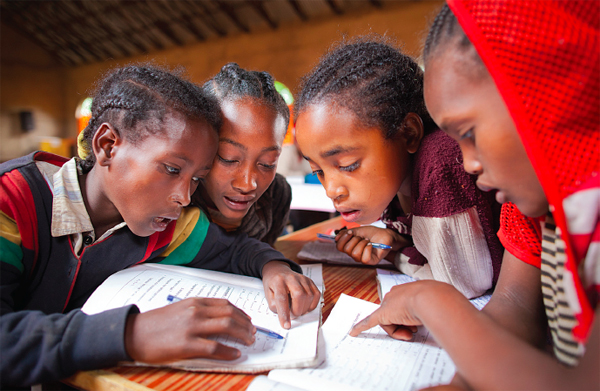
 Children work on a group assignment at a Speed School located in southern Ethiopia. (Photo by Jiro Ose, courtesy of Geneva Global)
Asefa Tadese was a full-time cattle tender. For seven years and without a day off, he roamed the scorched earth near the border between Eritrea and the Tigray Region in northern Ethiopia. His days followed the path of the sun’s rays: a light breakfast at sunrise, hours of tough labor until sunset, a meager dinner, and then bedtime. He was just a boy. In fact, he still is one.
“I’m 13 [years old]. This is my first time in school, and I will not go back to that life,” he says. Then he stares at the dirt floor as if he is watching images of those days dance across it. He looks up and flashes a shy smile, but there’s a fierce squint in his eyes: He realizes that his former life had nearly drained him of the potential to be anything other than a cattleman. “Never again,” he declares.
Tadese was able to leave that life when he received an opportunity to enroll in a program called Speed School. Over the past four years, more than 65,000 previously out-of-school Ethiopian children have taken part in the program, which works in tandem with local public schools. Each Speed School offers a 10-month course of instruction that enables students to advance up to three grade levels. At that point, they have the capability to enter (or re-enter) a standard government school.
Geneva Global, a US-based philanthropic consulting firm, developed the initiative and now manages it. Funding for Speed School comes from the Legatum Foundation, the development arm of Legatum Group, a global private investment firm based in Dubai. To implement the initiative, Geneva Global partners with community organizations that it carefully selects and then closely monitors.
The project in Ethiopia uses a variation on an accelerated learning program that was part of the West Africa Children’s Education Strategic Initiative, a joint effort launched in 2007 by Legatum and Strømme Foundation, a Norwegian international development organization. Geneva Global and Legatum launched the Speed School initiative in September 2011. During its initial phase, they opened 106 schools in five districts across the Southern Nations, Nationalities, and People’s Region of Ethiopia. Later, the program expanded into the Tigray and Oromia regions. Today it encompasses more than 800 schools.
Ethiopia has an especially pressing need for an intervention like Speed School. Even though primary school is free in Ethiopia, children face many obstacles to taking up that opportunity. Indeed, the Global Campaign for Education named Ethiopia one of the six “worst places in the world to be a child.” Nationwide, there are three million primary-school-age kids who are not receiving any kind of formal education.
Speed School is giving many of those children a second chance in life. The initiative is also earning the praise of school principals, NGO leaders, and government education officials. They value the effort for its financial efficiency—its ability to generate maximum social impact with every dollar spent. “We apply the same analysis and rigor to our philanthropy as we do to our investment portfolio,” says Alan McCormick, managing director of Legatum. “We look for outsized returns and for [a chance to make] the incremental value of each dollar go further. That requires a venture mentality and willingness to seed and test ideas. We scale up [ideas] that work, and we cut those that don’t. Speed School is an example of an intervention that has worked.”
Fast Learners
Before launching Speed School in Ethiopia, Geneva Global investigated the programs in West Africa that incorporated accelerated learning methods. “Although I liked what I saw after traveling throughout Mali, Burkina Faso, and Niger, I realized there were three primary reasons why these countries still ranked low in education: They weren’t adequately measuring impact, effectively empowering mothers, or engaging students through a curriculum based on children’s natural desire to play,” says Madurendrum Jeyachandran, country director for Ethiopia at Geneva Global. Jeyachandran and his colleagues built on those findings as they designed the initiative in Ethiopia.
To enable impact measurement, Geneva Global and its partners have assigned to each district a community mobilizer who records data on Speed School dropout rates and on the rate at which students make the transition back into government schools after graduating from a Speed School. Overall, 95 percent of students enrolled in a Speed School will successfully make that transition.
To empower mothers, Geneva Global created self-help groups in which the mothers of Speed School students get together to provide mutual support, to engage in a savings program, to create micro-enterprises, and to participate in adult learning on topics that range from malaria prevention and irrigation to English and social entrepreneurship. They also discuss ways to support their children’s efforts in school. “We thought education was a luxury. We didn’t realize its worth,” says one mother from the Samre district of the Tigray Region. “It’s about more than future opportunities to make money, or even reading and writing. It’s about thinking better on important issues and life situations.”
To address unengaged students, Geneva Global developed a curriculum that relies on activity-based learning (ABL). Speed School teachers must complete a 21-day ABL training course that equips them to use that method to maximum effect. Partly to make the ABL approach feasible, program organizers strictly cap the size of each Speed School at 25 students. “Speed School would not be successful without ABL,” says Yohannes Kidanemariam, the top education officer in Kilte Awulaelo, another district in Tigray. “Students learn better through play, and after 10 months of play-based learning, they are caught up and equipped to join their age-mates in their rightful grade level.” As a result, he adds, students don’t “suffer the shame of having to enter a class where they are older than everyone else.”
Another component of the program aims to lower the chances that children will drop out of public school in the first place. In many cases, children drop out because they have entered school with inadequate preparation. To address this problem, Geneva Global and its partners help local schools create a Child-to-Child initiative in which gifted students spend a few hours on Saturdays teaching basic literary and numeracy skills to preschool-age children.
Early this year, Geneva Global hired Kwame Akyeampong, professor of international education and development at the University of Sussex, to conduct an independent assessment of the program. “From our research, the improvements in reading and math among the children enrolled in Speed School were impressive, and we know that [those children] had overwhelmingly positive school experiences. When they enter the school system, they outperform their peers. It is hard to see how they would have made such progress without the [Speed School] accelerated learning program,” says Akyeampong.
But serious challenges continue to affect students after they make the transition to government schools. Public school classes typically have from 60 to 100 students, and many teachers in those schools eventually succumb to burnout. In a study led by Akyeampong, only 57 percent of students in public schools indicated that their teachers always attended lessons. “We need to do more work to figure out how to get the children who have re-enrolled in the local schools to stay in school and complete their education,” says Doug Balfour, CEO of Geneva Global. According to Balfour, early results indicate that Speed School children are leaving public school at rates that are similar to those of students who have not gone through the Speed School program. “We’ve been experimenting with various approaches to ensure that children stay in school until graduation—which is the entire motivation for this program,” he says.
High Stakes
Harreya Hagos, a facilitator who works at Tadese’s Speed School, is one of nearly 6,000 teachers who have received training in the ABL method. “My students realize that this is their second and final chance at an education. They see it as ‘do or die,’” she says. “So they always come to class motivated. They don’t interrupt. There’s no absenteeism. And with ABL, we’re having fun because, for example, students are learning mathematics through music rather than through lecture. The attitudes of parents have changed in this community because they see the impact of education. Both students and parents are very grateful for this chance to turn their lives in a new direction.”
Hagos is grateful for the Speed School program as well. Along with recruiting at-risk students to attend school, the program leverages community relationships to recruit people who have the potential to become effective classroom facilitators. Hagos, who has only a 10th-grade education, worked as a shepherd for most of her life. If not for the opportunity to become a facilitator, she likely would have resigned herself to that fate. She plans to use her Speed School position as a springboard to continue her education so that she can become a licensed teacher.
In many parts of Ethiopia, the experience of intergenerational poverty has instilled in people a mindset that makes it hard for them to move beyond the routines of daily survival. Poverty is by far the most typical reason that parents don’t send their children to school. But wealth, ironically, is another reason. For many Ethiopians—85 percent of whom work in agriculture—going to school seems to serve no purpose if they and their family are thriving in their current livelihood.
Speed School is helping to change that attitude by inspiring a belief in the power of education. McCormick argues that the Speed School model is “ready for scaling up. Later in 2015, he notes, Legatum will announce the launch of a new $100 million venture fund that will identify and support innovative educational approaches, including the Speed School model. “Education is the ultimate development accelerator,” he says. “[It’s] changing the destinies of children and their communities.”
Read more stories by Cameron Conaway.