


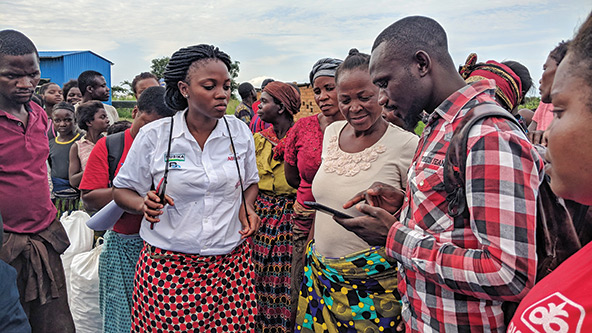
 Ugandan barley farmers learn how to use the BanQu blockchain app on mobile phones. (Photo courtesy of Ab Inbev/BanQu)
On a trip to Zambia in 2018, Katie Hoard, Anheuser-Busch InBev’s (AB InBev’s) global director of agricultural innovation, remembers watching a smallholder farmer named Agnes receive a series of text messages: a receipt for her cassava sale, confirmation of payment to her mobile money account, and notification that her solar power bill could be paid from the funds now in her mobile money wallet.
Hoard was in Zambia for the rollout of the next phase of a technology platform that allows AB InBev, the world’s largest brewer, to trace its purchases, help its farmers gain control over their finances, and ensure that the traders from which it buys commodities are paying farmers the right amount.
Agnes’s sale was the first it had used to test the new system. With a simple mobile phone, she not only logged proof of her sales via blockchain—technology that makes data immutable, verifiable, and immediately available to anyone in a network—but also started to build the business track record needed to win supply contracts and secure loans.
“It was a really cool thing to see that it’s a broader part of the digital ecosystem we’re trying to build—and in the very first transaction we did, we saw proof of that,” Hoard says.
AB InBev’s technology partner is BanQu, a blockchain software company seeking solutions to extreme poverty. It is doing this in two ways: empowering the world’s poorest people by giving them a verifiable economic identity; and selling a software service to global brands looking to cut supply chain costs, reduce post-harvest loss, and improve their social and environmental performance at a time when more consumers want to buy green and ethical products.
Early in its history, BanQu received grant funding from the Rockefeller Foundation. However, BanQu was established as a for-profit company. Its founder and CEO, Ashish Gadnis, argues that to achieve social progress at scale, BanQu can do far more as a for-profit company.
“For me, it’s easier to walk into a CEO’s office and say, ‘I can make 15 percent more on your supply chain and drive your category sales on the consumer side—and by the way, you’ll do some good in the world,’” he says. “It also allows me to not be the bleeding heart in the room. I don’t need anybody’s pity, because that mother in Congo doesn’t need pity. She needs business.”
Blockchain’s Advantages
It was his experience in the development sector that prompted Gadnis—who grew up in a poor community in Mumbai, India—to create BanQu in December 2015.
Three years prior, in 2012, he ended a successful career as a technology entrepreneur, sold his last start-up to a global consulting firm, and joined USAID’s volunteer CEO program in the Democratic Republic of Congo, where he worked for two years.
While there, Gadnis overheard a conversation between a female farmer and a local bank manager. “She wanted to open a bank account, but the local bank refused because she couldn’t prove her harvest—she couldn’t prove her existence in the supply chain,” he explains. The manager then turned to Gadnis. “The guy said, ‘I can’t bank her. But I’ll bank you.’”
This got him thinking about what prevented so many people from escaping poverty. “There are billions of people working in global supply chains producing coffee, cacao, or maize, or making your jeans and shoes,” he says, “yet they are completely invisible.”
In 2016, Gadnis and his cofounders, Hamse Warfe and Jeff Keiser, started developing technology that would provide smallholder farmers supplying global buyers with transaction records, enabling them to open bank accounts and access credit and other financial services. The phrase “bank you” became BanQu.
Gadnis is not alone in making the link between financial exclusion and poverty. From nonprofits and microfinance institutions to development banks, plenty of time and dollars have been directed toward providing the roughly 1.7 billion unbanked adults in the world with access to financial services.
Nor is BanQu the only company using blockchain to increase the transparency of global supply chains. For example, Germany-based Minespider’s open, interoperable blockchain protocol tracks shipments of raw materials to ensure that they come from mines that are free from child labor, corruption, human rights abuses, and environmental degradation.
“Whatever the claim is—whether it’s fish not produced by slaves or a garment produced in a factory that’s paying a living wage—blockchain use in the supply chain is all about this expanded ability to have traceability and transparency,” says Jim Fruchterman, founder of Tech Matters, which helps social sector organizations use technology to solve problems.
Other technologies play a role, too. OpenSC, launched by the World Wildlife Fund and BCG Digital Ventures, the investment and incubation arm of Boston Consulting Group, uses technologies such as sensors and machine learning to help companies and consumers to verify whether a product has been sustainably and ethically produced.
“Technology can also help smallholders gain a bigger share of the profits from their products,” says Ed Marcum, vice president of investments at Humanity United, which has invested in OpenSC through the Working Capital venture fund it launched in 2018.
For Gadnis, the first priority was to solve the lack of a system of identity for poor farmers and other suppliers. “And it wasn’t an identity problem—it was an inability to prove your transaction identity,” he says.
The power of blockchain lies not only in its ability to create immutable data but also in the fact that—unlike with a database—everyone in a supply chain shares that data.
“A database is always owned,” says Hoard. “So, if we shift growing regions and, for whatever reason, we’re no longer in that supply chain, the database goes with us. But the blockchain remains, and the farmer will always have ownership of that data.”
Providing smallholders with an economic identity is not the only application of the BanQu platform. BanQu’s customers include Japan Tobacco International (JTI), which is using blockchain to track the eradication of child labor in its supply chain.
The challenge for JTI was to link the impact of its ARISE (Achieving Reduction of Child Labour in Support of Education) program to the farmers from which it sources tobacco leaf. ARISE educates communities about the need to end child labor, helps families acquire the skills needed to find alternative ways of earning money, offers resources to schools and training to teachers, and helps inform governments in the design and enforcement of relevant laws.
Through the program, JTI has removed about 51,000 children from child labor. But it wanted to know how many of those were from families in its supply chain. With half of its tobacco sourced from countries such as Tanzania, Malawi, and Brazil, obtaining documentation such as birth certificates was a challenge. Blockchain offered a solution.
“With BanQu, we have designed the first fully digitized system that can track where a child is vulnerable to child labor in our tobacco- growing population and when that child is receiving a service from ARISE,” explains Elaine McKay, social programs director at JTI.
“We document that in blockchain, and ARISE will tell us what services a child is being offered and if the child has been in school in the past 10 days,” she says. “And the fact that the system is immutable means we have the security of knowing that no supplier is trying to change the reality on the ground.”
Business for Social Change
While efforts to reduce poverty and address human rights abuses have traditionally been led by foundations, nonprofits, and international development institutions, Gadnis believes that private sector supply chains offer the scale and speed needed to reach millions of poor and disenfranchised people.
“[Nonprofits are] doing amazing work. It’s just that they can’t make social change fast enough,” says Matt Swenson, chief product officer for Chameleon Cold-Brew, a values-led coffee company that recently signed a contract to work with BanQu in Guatemala.
Moreover, as consumer demand for sustainable products increases, the business case for acting responsibly is becoming more compelling. “You’re seeing some shift in consumers already,” says Swenson. “They’re voting with their dollars.”
Using business to help solve big global problems is an idea to which Gadnis is firmly wedded. And his experience as a tech entrepreneur has informed the way he has developed the BanQu revenue model, which is similar to that of software-as-a-service companies such as Salesforce, SAP, and Oracle.
“We sell an annual license fee for subscription to the brand,” he explains. “And the brand pays us for the connection points in their supply chain, either on the sourcing side or on the distribution side.”
The company has two measurement metrics: annual recurring revenue (ARR) and the number of people in the “last mile”—the smallholder farmers, miners, and other workers at the end of global supply chains—that are connected to its technology. Its goal is to reach the 100 million mark for both by 2023.
While ambitious, BanQu’s current trajectory suggests it might not be impossible. By the end of 2017, a year after launching, the company had $100,000 in ARR and 3,000 people connected in the last mile. In 2018, this rose to $706,000 with 145,000 people connected. And by 2020, with about 500,000 people connected, Gadnis was predicting revenues of $3 million to $4 million.
Moreover, mainstream investors are attracted to the BanQu model. “We’ve closed three rounds of funding and raised $4.5 million in the past three years,” says Gadnis. “And it’s been pretty much institutional and private investors who believe that return on investment with purpose is the way to go.”
In fact, Gadnis is unequivocal in his belief that harnessing the power of the private sector can accelerate social change. “I want to set a new trend, honestly,” he says. “I want to be a $100 million company; that is, a for-profit company that has enabled 100 million people to get out of poverty—that’s never been done before.”
Read more stories by Sarah Murray.